Robert Forster, the actor best known for his Academy Award nominated role in Jackie Brown has passed away at the age of 78 from brain cancer.
Forster was one of those rare actors who made everything in was in better. I first became aware of Forster in the tv series Banyon. I liked him better than the show and often that seemed to be the case. The same could be said for his appearances in Reflections in a Golden Eye; The Black Hole; Alligator; The Delta Force; and so many more.
“My career went like this for five years and then like that for 27. Every time it reached a lower level I thought I could tolerate, it dropped some more, and then some more. Near the end I had no agent, no manager, no lawyer, no nothing. I was taking whatever fell through the cracks.”
But Forster hung in taking whatever parts he could that would pay the bills.
Quentin Tarantino was a fan and had Forster audition for Reservoir Dogs. Ultimately Tarantino gave the part to Lawrence Tierney, but had another idea for Forster. And that was the male lead in Jackie Brown. Forster was nominated for an Academy Award and that restarted his career. Better roles continued, and Forster worked until his death — having two films, El Camino: A Breaking Bad Story and Phil coming out in 2019.
“You gotta be ready… Accept all things that give you a good attitude. Deliver excellence right now… And never quit. You can win it in the late innings if you don’t quit.”
Our thoughts and prayers go out to Robert Forster’s family, friends and fans.
4. Stallone hated the first cut of First Blood. The first time Stallone saw the edit for “First Blood,” he hated it. It was three and a half hours long, and Rambo’s dialogue was terrible. At first, Stallone wanted to buy the film so he could burn it. Instead of that, he re-cut the film to 93 minutes with most of his dialogue removed, which is what you see when you watch it today.
5. Without ‘Rambo’ there would be no ‘Predator’ When Rocky Balboa took on Ivan Drago in “Rocky IV,” no one in Hollywood was quite sure who Rocky’s next opponent could possibly be. The joke was made that Rocky would have to fight some kind of Alien in “Rocky V.” After a while, Screenwriters Jim and John Thomas began to take the idea seriously and wrote a Rocky-Rambo Hybrid movie that we call “Predator.”
3. Rambo wasn’t a killer – originally. John Rambo never actually kills anyone in “First Blood.” There is only one death in the entire movie, and that happened as an accident when an overzealous cop falls from a helicopter while shooting at Rambo. (This refers to the movie “First Blood” not the novel on which the film was based. – Craig)
In subsequent movies, that all changes of course. Rambo’s body count is 76 in “First Blood: Part II,” and 132 in “Rambo III.” In “Rambo,” he appears to kill the entire Burmese Army with one .50-cal.
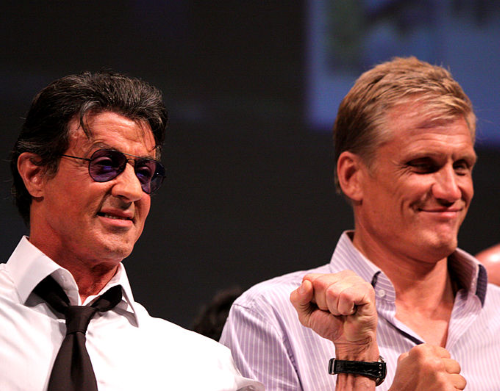
Sly Stallone and Dolph Lundgren’s The International, a one-hour on-going series will appear on CBS. Lundgren is set to serve as star and Producer with Stallone taking the role of Executive Producer and the series coming from Stallone’s Balboa Productions.
Lundgren plays…
…Anders Soto, described as a one-man covert black-ops team working for the U.N., who is called in to find asymmetrical solutions to the world’s most delicate and complex problems. He is part negotiator and part international spy….
Fans are hopeful that Stallone will make an appearance(s) and perhaps direct some of the episodes.
Matthew Jackson and Mental Floss present 10 Terrifying Facts About Creepshow. Here are three of my favorites (with my comments) before you click over and check out them all!
1. IT BEGAN WITH SALEM’S LOT.
(Can you imagine if Stephen King and George Romero had made a theatrical version of Salem’s Lot? I loved the tv version of Salem’s Lot, but the thought of a King/Romero movie makes me smile and wonder. – Craig)
9. CREEPSHOW INTRODUCED GREG NICOTERO TO FILMMAKING.
(If getting Nicotero into movies was the only thing that Creepshow was known for it would be enough. – Craig)
10. CREEPSHOW IS PART OF THE STEPHEN KING UNIVERSE.
(I love that Stephen King stories, for the most part, take place in the Stephen King universe. – Craig)
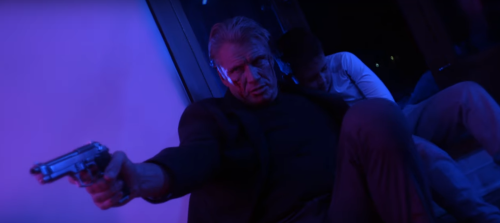
The Acceleration Trailer is Here! Starring Dolpj Lundgren, Natalie Burn, Sean Patrick Flanery, Chuck Liddell, Quinton ‘Rampage’ Jackson, and Danny Trejo. This would be the featured film if we still had drive-ins. 🙂
DesVladik Zorich (Dolph Lundgren), a villainous crime lord, is double-crossed by his most trusted operative Rhona (Natalie Burn). Vladik’s propensity for power, control, and violence drives him to kidnap Rhona’s son forcing her to participate in a twisted plan to eliminate one of Vladik’s enemies. To keep her on a short leash, Vladik sets out the ‘rules’ to his ‘game’ and overseas Rhona’s every move as she navigates the darkened streets of Los Angeles. As her son’s life hangs in the balance, Rhona struggles to eliminate the most violent and depraved delinquents, however, Vladik underestimates the power of a mother’s love and finds himself losing control as his devious plan.
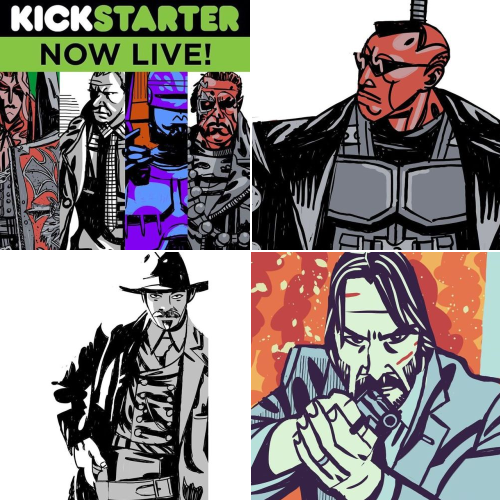
If you want to participate you can simply make a donation or pony up for a digital or physical copy of Michael’s sketchbook or the sketchbook and any of several original art options. If you do join in, you’ll be helping an artist and getting some cool art at the same time!
Rodolfo at CBR.com did a piece called Top 10 Groundbreaking John Carpenter Characters. You just know I’m going to play along by posting my thoughts on three of my favorite John Carpenter characters and one who didn’t make Rodolfo’s list but should have.
Snake Plissken. I’d be surprised if Snake Plissken wasn’t at the top of anyone’s John Carpenter characters list. Heck, Plissken should be near the top of any cool characters list. He’s the classic anti-hero: ex-military, individualist with an attitude, more than capable in any situation and played perfectly by Kurt Russell channeling Clint Eastwood. I’m surprised that there weren’t more Snake Plissken movies made (besides EFNY and ESFLA) and that Snake has become more popular in other media.
Napoleon Wilson. Perhaps Carpenter’s least known character with the most potential. Wilson appeared in Assault on Precinct 13 and like Snake Plissken was an anti-hero. On his way to prison, Wilson find himself and a small group trapped in an abandoned building under siege by a street gang. Napoleon Wilson was perfectly played by Darwin Joston in his most famous role.
John Nada. Roddy Piper was the perfect choice to play John Nada, an average guy just looking to survive in a world unknowingly under the control of aliens. Nada isn’t a specially trained soldier or cop — he’s just a drifter who discovers a secret that no one would believe and then he takes action to save the world!
Romero. While Romero didn’t make Rodolfo’s list, there was no way I’d leave him out of mine. Romero appeared in a relatively small role in Escape from New York. In a movie full of larger-than-life characters, Romero (as played by Frank Doubleday) was as memorable as any and more frightening than all.
1. AN ERRANT PAIR OF FORCEPS GAVE SYLVESTER STALLONE HIS DISTINCTIVE LOOK.
Many comedians have paid their bills over the decades by adopting Sylvester Stallone’s distinctive lip droop and guttural baritone voice. The facial feature was the result of some slight mishandling at birth. When Stallone was born on July 6, 1946 in Manhattan, the physician used a pair of forceps to deliver him. The malpractice left his lip, chin, and part of his tongue partially paralyzed due to a severed nerve. Stallone later said his face and awkward demeanor earned him the nickname “Sylvia” and authority figures telling him his brain was “dormant.” Burdened with low self-esteem, Stallone turned to bodybuilding and later performing as a way of breaking through what seemed to be a consensus of low expectations.
5. SYLVESTER STALLONE WROTE A NOVEL.
In addition to his acting ambitions, Stallone decided to pursue a career in writing. After numerous screenplays, he wrote Paradise Alley, a novel about siblings who get caught up in the circus world of professional wrestling in Hell’s Kitchen. Stallone finished the novel before deciding to turn it into a screenplay. Paradise Alley was eventually produced in 1978. The book, which was perceived as a novelization, was published that same year. (It appeared in hard cover and mass market paperback. – Craig)
10. ARNOLD SCHWARZENEGGER ONCE TRICKED SYLVESTER STALLONE INTO STARRING IN A BOX OFFICE BOMB.
Stallone has often discussed his rivalry with Arnold Schwarzenegger, as the two action stars were believed to be the two biggest marquee attractions in the 1980s. Recalling his 1992 bomb Stop! Or My Mom Will Shoot, Stallone told a journalist in 2014 that he believed Schwarzenegger was to blame. “I heard Arnold wanted to do that movie and after hearing that, I said I wanted to do it,” he said. “He tricked me. He’s always been clever.”
Screenplay: Matthew Cirulnick & Sylvester Stallone from a story by Dan Gordon & Sylvester Stallone based on the character created by David Morrell.
Stars: Sylvester Stallone, Paz Vega and Yvette Monreal.
The Pitch: “Sly Stallone is ready to do another Rambo!”
Tagline: They Drew First Blood. He Will Draw Last.
The Overview: Beware of Spoilers…
Rambo: Last Blood takes place ten years after Rambo has returned home to the farm of his childhood. All of his friends and family are dead except for his adopted family of Maria (his housekeeper) and her granddaughter Gabrielle who is about to leave for college.
When Gabrielle doesn’t return from a trip across the border to confront the father that deserted her years ago, Rambo goes to find her. In Mexico, Rambo learns that Gabrielle has been kidnapped by a gang led by two brothers who are sex-traffickers. It’s not giving away anything to say that he goes to rescue her and the fight begins in Mexico and culminates on Rambo’s ranch in Arizona.
Rambo: Last Blood is not for everyone (is any film?). It is excessively brutal. It’s not a feel-good film. I liked it, but understand why some folks don’t. I’ll tell you more about what I liked and address some criticisms after the trailer — be advised spoilers will follow.
Rating:
Rambo: Last Blood seemed like a natural extension of Rambo (the last movie). Rambo has returned to his childhood farm where he lives with his adopted family. I liked that while Rambo has made progress, he still suffers from memories of the war, but is getting medical help. I liked that although Gabrielle’s father is a horrible person, he wasn’t a member of the gang.
I’m not a fan of overly gory movies. I don’t like slasher movies. I agree that the violence in Rambo: Last Blood is excessive, but complaining about violence in a Rambo movie (especially one that advertises itself as being “savage”) is like going out into the rain and complaining when you get wet.
It is strange to me that folks who loved First Blood (where Rambo did terrible physical damage to innocent police officers and National Guard troops, and destroyed businesses of innocent citizens) are finding fault with the violence in this movie.
There were a couple of twists that I liked: Rambo being caught watching the house and when he tries to walk away is met by overwhelming force. It was unexpected of how bad a beating he took and that Gabrielle died after Rambo rescued her. I liked that Rambo went back in without his gun or knife and used a hammer. It seemed like a real choice.
Some folks are complaining that all Mexicans are being portrayed as evil. I get the concern but it reminds me of the same complaints that Italians made about The Godfather. Not all Mexicans are bad and to get that message from the movie is extremely simplistic.
The movie focuses on Rambo and the revenge he takes upon the gang members that kidnapped, drugged, raped and killed his adopted niece. The people who did that are not good people. These outlaws don’t represent all of Mexico just as Rambo doesn’t represent all of America. Had the movie focused on the Mexican reporter or other good people in Mexico it would have been a different film. Perhaps some would have liked that film better, but to judge a movie on what it isn’t, doesn’t seem right to me.
There has been a lot of criticism leveled at the last act where Rambo has lured the gang members back to his ranch which has been riddled with traps. Did these people not see a single trailer? Wouldn’t that be like going to a McDonalds after watching ads for a Big Mac and then complaining when you got what you saw in the commercial?
I think that some of the complaints against Rambo: Last Blood may have been from folks who’ve romanticized John Rambo. Don’t get me wrong, he’s the guy you’d want in the fox hole next to you. He’s also the same guy who was described as “slipping up” when he didn’t kill Teasle and all his deputies in First Blood. Rambo is a guy fighting to keep the lid on and when he loses it, he becomes war. And war is brutal and unforgiving.
I’m a huge Stallone fan and that plays into my enjoyment of his movies. I liked Rambo: Last Blood a lot more than I thought I would. As with anyone’s review of anything, your mileage may vary.
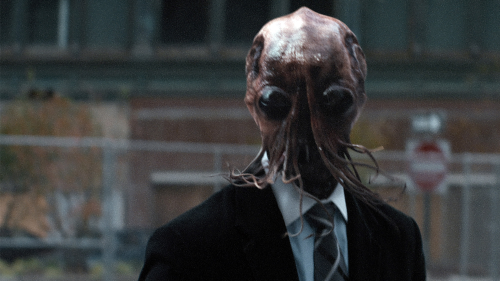
Corporate Monster is a well done horror/scifi short that could easily be set in the world of John Carpenter’s They Live. It’s almost as if Ruairi Robinson saw They Live and then said, ‘Hold my beer.” Robinson’s monsters are cooler looking (thank you improvements in computer technology) and scarier — look at what that monster is eating for lunch!
I could easily see Corporate Monster being made into a feature length film.
From acclaimed filmmaker Ruairi Robinson (Blinky™, The Leviathan) comes a new vision of fantastic horror. After being fired from his job, a dangerously unstable man’s life spirals out of control when he starts to see parasitic beings that puppeteer our world from the shadows.