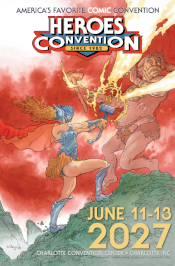
Steranko’s Captain America Variant Cover

What do you think of Steranko’s variant cover for Captain America?
Previews and Reviews that are Z's Views
What do you think of Steranko’s variant cover for Captain America?
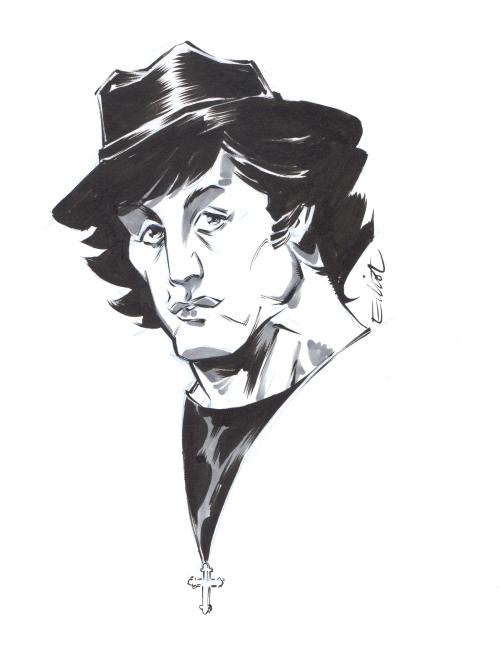
Elliott Fernandez makes his third, but not hopefully not last appearance in our Stallone Sketch Gallery with his take on Sly as Rocky Balboa.
You can see more of Elliott’s art here and here. If you want to keep up with Elliott’s latest, you can follow him on Twitter.

Andrew LaSane and Mental_Floss present 11 Transformative Facts About The Fly. Here are three of my favorites…
1. IT WAS PRODUCED BY MEL BROOKS.
Known as a master of comedy, Mel Brooks is also a fan of the horror genre. Producer Stuart Cornfeld convinced the reluctant studio to distribute the film if he could find the money to make it, and Mel Brooks was the first person he went to for help (the two had previously collaborated on David Lynch’s The Elephant Man in 1980). It was Brooks who encouraged Cronenberg to take the movie as far as he wanted. “[Brooks] said ‘I want you to go all the way. Let yourself go, and don’t hold back.’ There were no restraints,” Cronenberg recalled. “They were willing to lose that percentage of the audience that would have liked the love interest stuff, but couldn’t take the horror.”
2. BROOKS CAME UP WITH THE FILM’S MOST FAMOUS LINE.
“Be afraid, be very afraid” is a quote that many people have heard, but not everyone knows comes from The Fly. Cronenberg revealed in a commentary track that the iconic line was invented by Mel Brooks while discussing how characters should react to the early stages of Seth Brundle’s transformation. The quote also became one of the film’s taglines.
5. JEFF GOLDBLUM AND GEENA DAVIS WERE A COUPLE.
Goldblum was the one who campaigned for then-girlfriend Geena Davis to co-star in the film as journalist/love interest Veronica Quaife, a.k.a. Ronnie. Goldblum admits in a special features documentary that he became jealous of her scenes with actor John Getz and had to be told to leave the set because of his emotional attachment. Their relationship also affected the way they performed the roles. “The problem really in working with a couple who were so close and had been together for quite some time was that Geena, who was an adept mimic, she would basically do Jeff,” Cronenberg said in his commentary track. “She was like Jeff in her linguistic rhythm, her speech rhythm, and her body language because Jeff has a very strange and infectious way of speaking and moving …one of the things we had to do was to disconnect Geena and Jeff for the sake of the movie.”
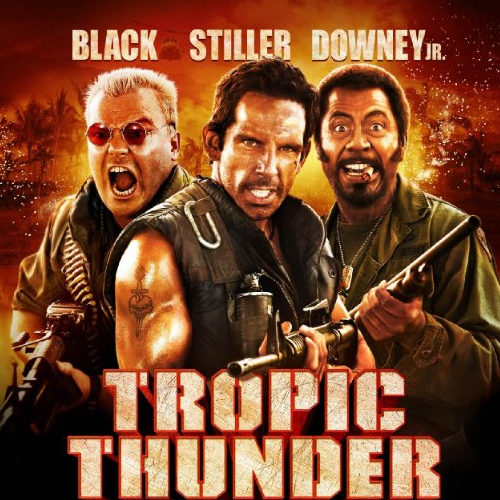
Rob Hunter and Film School Rejects present 21 Things We Learned from the Tropical Thunder Commentary. Here are three of my favorites…
9. Downey’s promise to himself — or, Osisris’ promise that he makes in the film — was that he doesn’t “drop character till I done a DVD commentary.” He commits to it here and is a man of his word.
19. “This moment,” says Stiller, “I wasn’t really expecting even when we shot it.” He’s referring to Tom Cruise‘s shift into dance moves after Les Grossman (Cruise) explains to Peck how they’re going to make an insurance claim against Tugg’s death. “I don’t think anybody was really expecting that he was going to go to that place.”
21. Downey finally drops the Osiris voice as the character does the same onscreen, but it’s clear he’s not keen on saying goodbye. “This is Lincoln Osiris signing off forever now. Thank you people. Thanks for letting me float with you. I love you ladies and gentlemen. Man, it’s hard to let go.” He then pauses briefly… and begins speaking in Kirk Lazarus’ Australian accent.
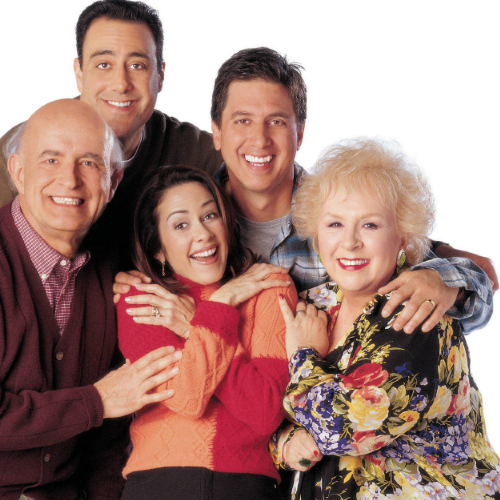
Roger Cormier and Mental_Floss present 15 Fun Facts About Everybody Loves Raymond. Here are three of my favorites…
6. RAY IS OLDER THAN HIS “OLDER” BROTHER.
Brad Garrett, who played Ray’s older brother Robert, was 36 when the series first aired. Romano was a few months shy of his 39th birthday.
4. PETER BOYLE WAS PERFECTLY ANGRY AT HIS AUDITION FOR FRANK.
Peter Boyle had trouble just getting into the studio lot. He then couldn’t find a parking space. Then he went into the wrong building. By the time he reached Romano and show creator/showrunner Philip Rosenthal he was, in his own words, “enraged”—and perfectly in character for Frank Barone. The topper of it all was that, according to Romano, the CBS President was going to give Boyle the gig anyway.
12. THE SHOW MADE ROMANO THE HIGHEST PAID ACTOR ON TELEVISION.
Romano made $1.7 to 1.8 million per episode during the last two seasons of Raymond, surpassing Kelsey Grammer’s $1.6 million per episode salary for Frasier at the time.

Tara Aquino and Mental_Floss present 10 Mind-Blowing Facts About Scanners. Here are three of my favorites…
4. CRONENBERG SHOT TWO ENDINGS TO SCANNERS.
According to Michael Ironside, who played Darryl Revok, he and Stephen Lack filmed a less exciting version of the ending. “With one ending, we had this psycho-battle between my brother and I and it didn’t work, we shot it right up until Christmas and sent the script to [special effects wizard] Dick Smith in New York and asked him what he could come up with in terms of cutting edge makeup,” Ironside explained. “You know, something that would give us a more memorable battle and a different ending. Dick then came up with the idea of the exploding heads and that was a very collaborative thing.”
5. ACCORDING TO LACK, THE SCANNERS SCRIPT WASN’T EVEN WRITTEN WHILE FILMING.
It’s no surprise that Cronenberg allegedly called Scanners his most frustrating film to make. In addition to delays in filming, the script wasn’t even completed when production commenced. “Not only was Scanners not rehearsed, but it wasn’t written,” Lack told Film Comment. “David was coming in with pink, blue, and yellow pages for the day for the version of the script that we were doing, and he was working on it right there. As a result I had to deal with the dialogue in such a way that I was not reacting to things, because the information hadn’t been given to my character in the linear progression of the story. If you chop it up and look at it, 50 percent of my dialogue is not an assertion of anything but rather a question: ‘You called me a Scanner, what does that mean?’ ‘You’re part of an organization, who are you?’ Everything is a freaking question!”
6. MICHAEL IRONSIDE WORE DUSTIN HOFFMAN’S EYES FROM LITTLE BIG MAN IN A CRUCIAL SCENE.
Scanners was all about making its special effects work at all costs, which is why Ironside’s story about his peculiar eyes at the end of the film fits in perfectly. “There’s a scene … where I’m set on fire and my head comes up and those scleras they put on your eyes, they had scratched all my corneas,” Ironside recalled. “So the contact lenses they had made for me to change my eye color didn’t fit properly because my eyes had been scratched. Dick Smith happened to have with him Dustin Hoffman’s eyes from Little Big Man and they were actually oversized, and you wouldn’t normally do this because they have to be fitted, but when you see me come out from under that coat at the end of Scanners, those blue eyes of mine are Dustin Hoffman’s from Little Big Man.”
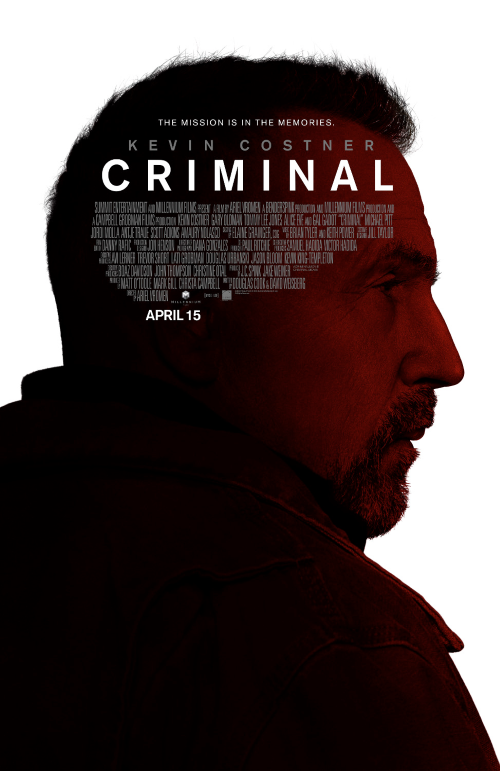
Here’s the poster and trailer to Criminal starring Kevin Costner, Gary Oldman, Tommy Lee Jones, Gal Gadot and Ryan Reynolds.
The poster is okay, but I am diggin’ the trailer.

Mark Mancini and Mental_Floss present 10 Facts About Invasion of the Body Snatchers. Here are three of my favorites…
1. IT’S BASED ON A MAGAZINE SERIAL.
In November and December of 1954, Collier’s magazine ran a three-part series that would come to be called “the year’s most original story of suspense.” Written by Jack Finney, The Body Snatchers wowed producer Walter Wanger, who began negotiating the story’s movie rights before he’d even read part two.
5. ORIGINALLY, THE MOVIE WAS SUPPOSED TO BE A LOT FUNNIER.
“I felt that pods growing into a likeness of a person would strike the characters as preposterous,” Siegel recalled. “I wanted to play it that way, with the characters not taking the threat seriously.” Hoping to offset the scares, he filmed a number of comedic scenes, which were later cut out by Allied Artists, the film’s distributor. “In their hallowed words, ‘horror films are horror films and there’s no room for humor,’” Siegel explained. “I translated [this] to mean that in their pod brains there was no room for humor.”
8. THE PROLOGUE AND EPILOGUE WERE LAST-MINUTE ADDITIONS.
Allied Artists didn’t just cut a few jokes here and there; the studio also insisted on a completely different ending. Originally, the movie was going to close with a shot of Dr. Bennell watching hopelessly as truckloads of pods drive out into the distance. Wanting to end the film on a more hopeful note, Allied Artists came up with a slightly happier conclusion. Over his strong objections, Siegel was told to film a new intro and a new final scene (“I reluctantly consented,” he said.) The revamped opening puts Bennell in a police station, where he tells the story as anextended flashback. After the famous “You’re next!” sequence, his tale ends and, after a while, the authorities begin to believe him.
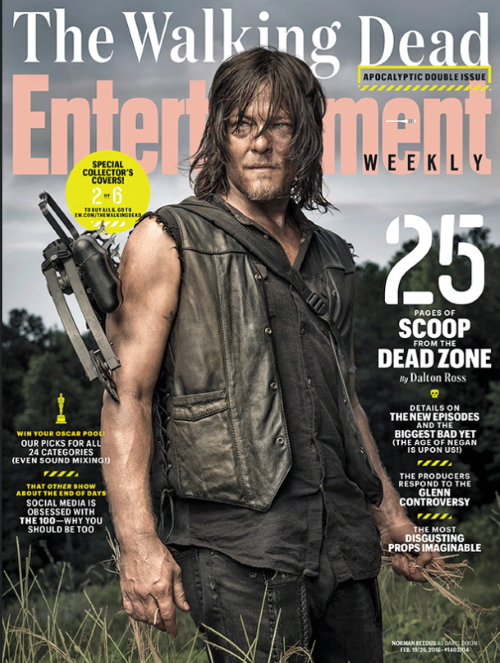
The Walking Dead returns tonight. To celebrate, Entertainment Weekly has published six collector’s covers.
My guess is that the one above or with Michone will be the most sought out. My subscription issue came with Glen and that works for me.
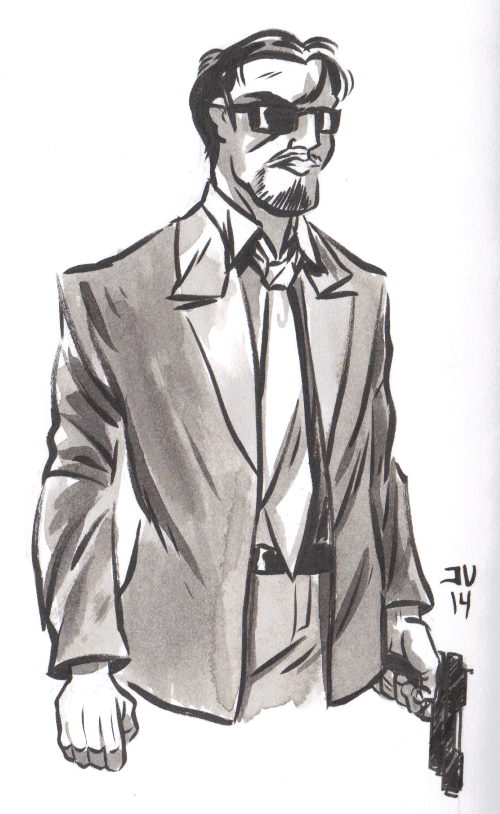
June Vigants created the Sly as Jack Carter piece above. June was doing sketch commissions through the mail and although I’d never met her, I liked June’s art and decided to commission a few pieces. I wasn’t disappointed. This is the first with more to be posted!
You can see more of June’s art here and here.
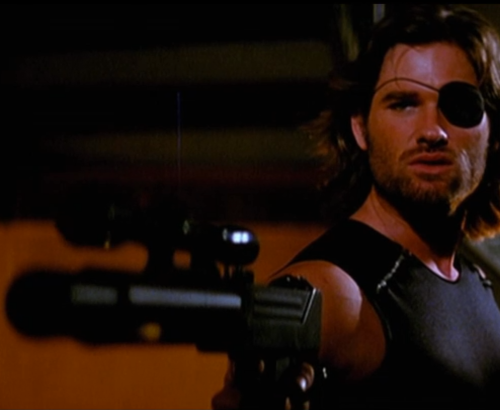
Matthew Jackson and Mental_Floss present 12 Futuristic Facts About Escape from New York. Here are three of my favorites…
3. THE NAME “SNAKE PLISSKEN” CAME FROM A REAL PERSON.
When writing the original script for the film, Carpenter was in search of a name for his main character, and it just so happened that a friend of a friend actually knew a person named “Snake Plissken,” who Carpenter described as “a kinda high school tough guy,” complete with a snake tattoo. It was too perfect to pass up.“Anybody with a snake tattooed on them some place … that’s my kinda hero,” Carpenter said.
4. CARPENTER HAD TO FIGHT FOR KURT RUSSELL AS SNAKE.
At the time of the film’s production, Kurt Russell was an actor best known for his work in Disney projects like The Computer Wore Tennis Shoes. He wasn’t an action star, but Carpenter thought he was the right choice to play Snake. The studio, on the other hand,wanted a star like Tommy Lee Jones or Chuck Norris for the part. Carpenter dismissed Norris as too old, and preferred Russell over Jones, so he fought for his young star, and eventually won.
9. JAMIE LEE CURTIS HAS A CAMEO.
Three years prior to Escape From New York, Carpenter directed his breakout hit: the slasher film Halloween, which also proved to be the breakout film for star Jamie Lee Curtis. If Halloween hadn’t worked out, it’s doubtful Carpenter ever would have made Escape From New York, so he called upon his Halloween star to participate when it finally happened. You won’t see Curtis in the film, but you will hear her: She voices both the narrator and the computer.

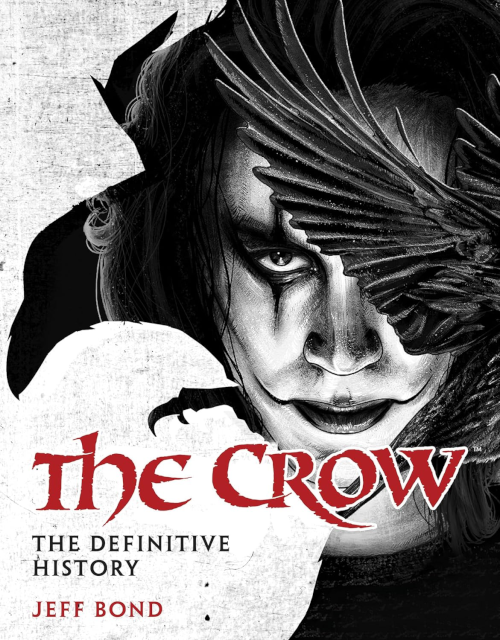
Erin McCarthy and Mental_Floss present 18 Fascinating Facts About The Crow. Here are three of my favorites…
1. IT’S BASED ON A COMIC BOOK, WHICH WAS INSPIRED BY TWO TRAGEDIES.
In 1981, 21-year-old James O’Barr was drawing combat manuals in the Marines when he decided to start The Crow. He hoped it would be a healthy way of dealing with the death of his fiancée, who had been killed by a drunk driver. “I tried all the typical angst-ridden outlets, like substance abuse and going to clubs or parties every night and just basically trying to keep yourself numb for as long a period of time as possible,” O’Barr told The Baltimore Sun in 1994. “Eventually I was smart enough to realize that that was a dead end, and so I thought perhaps putting something down on paper I could exorcise some of that anger.”Pivotal to his comic book’s plotline was another tragedy O’Barr heard about: A couple killed over an engagement ring. “I thought it was outlandish, a $30 ring, two lives wasted,” he said in a book about the production called The Crow: The Movie. “That became the beginning of the focal point, and the idea that there could be a love so strong that it could transcend death, that it could refuse death, and this soul would not rest until it could set things right.”
4. THE PRODUCERS KNEW WHO THEY WANTED TO DIRECT AND STAR.
Pressman had Alex Proyas, an Australian director who at that point had helmed music videos and commercials, but no features, in mind to direct The Crow. Though Proyas was very much in demand in Hollywood, he was waiting for the right project—and The Crow was it. He signed on in 1991.The producers first looked at musicians to fill the role of Eric Draven, among them Charlie Sexton, a rocker from Texas. But ultimately, their first choice was Brandon Lee. At that point, Lee—son of famed actor/martial artist Bruce Lee—had appeared in a few films, but hadn’t had a breakout role yet. “We had considered some more established actors and we were concerned that certain of these actors did not have the athletic ability,” Pressman said in The Crow: The Movie. “Other people had the athletic ability but not the acting talents. Brandon combined it all. When Brandon walked into this office, it was an immediate flash. We knew we had our Eric Draven that instant.”
17. O’BARR DONATED MOST OF HIS PROFITS FROM THE FILM TO CHARITY.
O’Barr bought his mom a car, and a surround system for himself, then donated the rest. “I was really good friends with Brandon, so it just felt like blood money to me,” he said at a comics convention in 2009. “I didn’t want to profit at his expense. And I kept that secret for as long as I could. It’s not charity if you get credit for it.”
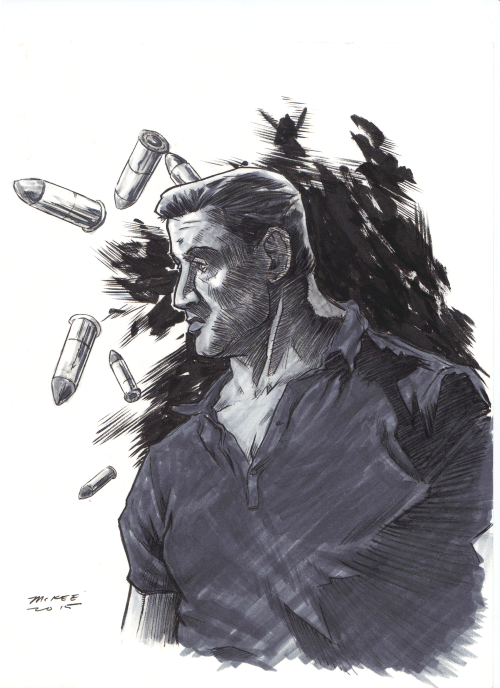
Last year at HeroesCon Gary McKee surprised and gifted me with the sketch above of Sly as Jimmy Bobo from Bullet to the Head. What an amazing sketch and gesture from a great artist and friend.
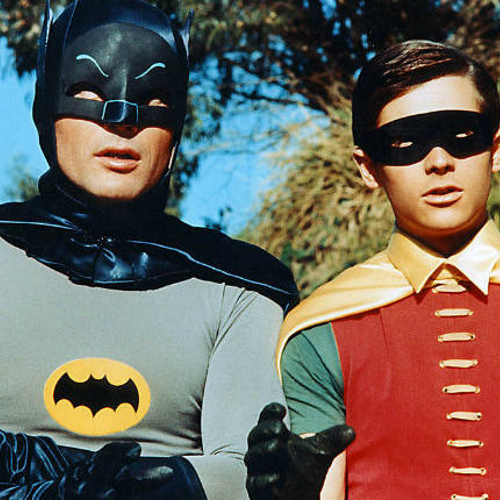
Jake Rossen and Mental_Floss present 15 Campy Facts About Batman. Here are three of my favorites…
1. A QUARTERBACK FOR THE L.A. RAMS ALMOST PLAYED BATMAN.
The kitschy approach of Adam West was not on producer Ed Graham’s mind when he optioned Batman for a television series from DC Comics (then National Periodical Publications) in 1962. Figuring he could capitalize on a Saturday morning kids’ series similar in tone to the George Reeves-starring Adventures of Superman from the 1950s, Graham struck a deal with CBS and enlisted former Los Angeles Rams quarterback Mike Henry for the title role. With CBS dragging their feet, Henry decided to opt out and play Tarzan instead; ABC was more ambitious about the idea, securing the license from National and moving ahead with producer William Dozier and writer Lorenzo Semple Jr., who agreed the show would work best if it didn’t take itself seriously. (Just seriously enough not to cast a football player.)
6. IT HAD THE LOWEST TEST SCORE OF ANY TV PILOT IN HISTORY.
Before its January 12, 1966 premiere, ABC screened the pilot for a test audience. Using knobs that could express their approval (or disapproval), the group verified the equipment was working when they gave the “control” footage, a Mr. Magoo cartoon, a favorable rating. When Batman ended, it scored in the upper forties, a disastrous number. (Most pilots of the day scored in the mid-sixties.) The national audience, prepared with weeks of advertising to help contextualize the humor, found it funnier: the show was an immediate success.
10. BRUCE LEE SCARED THE TIGHTS OFF OF BURT WARD.
Ward, who fancied himself something of a martial arts expert, once boasted to West that he had sparred with Bruce Lee. When Lee made an appearance on the show as part of a crossover with Dozier’s other series, The Green Hornet, he and Robin were scheduled to have a fight. According to West’s autobiography, Lee showed up to the set wearing a dour expression and looked ready to kill Ward, who put his hands up in a defensive reflex. Lee cracked a smile and called out, “Robin’s a chicken!” Everyone but Ward found this funny.