Buster Keaton: The Art of the Gag

Buster Keaton: The Art of the Gag is well worth a look for anyone interested in comedy or movie history.
Source: Mark Evanier.
Previews and Reviews that are Z's Views
Buster Keaton: The Art of the Gag is well worth a look for anyone interested in comedy or movie history.
Source: Mark Evanier.
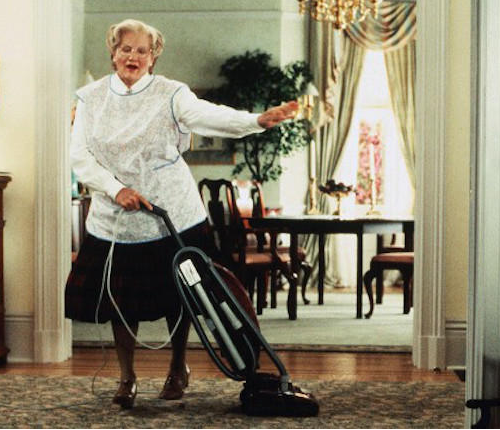
Roger Cormier and Mental_Floss present 16 Sure Facts About Mrs. Doubtfire. Here are three of my favorites…
3. THEY WENT THROUGH PHOTOGRAPHS OF OLD WOMEN.
Director Chris Columbus claimed that he and his fellow filmmakers looked through “hundreds and hundreds” of photographs until finding a 1940s-era English woman to base Mrs. Doubtfire’s look on.7. CHUCK JONES SUPERVISED THE OPENING ANIMATION.
Jones was the iconic animator of Looney Tunes and Merrie Melodies cartoons for Warner Bros. The full five minutes of Pudgy Parakeet and Grunge the Cat was released as a DVD feature.8. COLUMBUS USED MULTIPLE CAMERAS SIMULTANEOUSLY TO CAPTURE THE CAST WHEN WILLIAMS IMPROVISED.
The director mostly shot one or two takes of each scene as it was written in the script before shooting something Williams made up. Columbus said the resulting footage gave him the option of cutting a PG, PG-13, R, or NC-17 version of the movie. (He ended up going with the PG-13 version.)

Jeff Wells and Mental_Floss present 18 Epic Facts About Dances with Wolves. Here are three of my favorites…
1. IT STARTED AS A NOVEL THAT NOBODY WANTED TO PUBLISH.
Inspired by books he’d read about the Plains Indians, screenwriter Michael Blake (who died earlier this year) pitched Costner on the idea for Dances with Wolves. Costner told Blake, whom he’d met in a Los Angeles acting class, to write a novel instead of a screenplay, reasoning that a novel could generate studio interest more effectively than a cold script. So Blake spent months writing and sleeping on friends’s couches (including Costner’s). “I wrote the entire book in my car, really,” Blake said in a behind-the-scenes feature. Once finished, Blake submitted Dances with Wolves, to numerous publishers, all of whom passed on his manuscript. Finally, after more than 30 rejections, a small publisher called Fawcett accepted it.2. IT BECAME THE FILM THAT NO STUDIO WANTED TO FINANCE.
Turned down by American studios, Costner looked abroad for help, eventually securing startup funds from a handful of foreign investors. With only a fraction of the movie’s $15 million budget secured, he began filming. Orion Pictures eventually stepped in with $10 million, but Dances with Wolves ended up going more than $3 million over budget. Costner covered the overage out of his own pocket.18. THERE’S A SEQUEL.
A sequel to the book, that is. In 2001, Blake published The Holy Road, which continues the story of John Dunbar, now a full-fledged Sioux warrior, as he tries to protect his tribe from encroachment by white settlers. Critics praised the novel for the ways it portrayed westward expansion and the plight of Native Americans without coming off heavy-handed. There have been rumblings about a possible miniseries, but nothing is confirmed at this time.
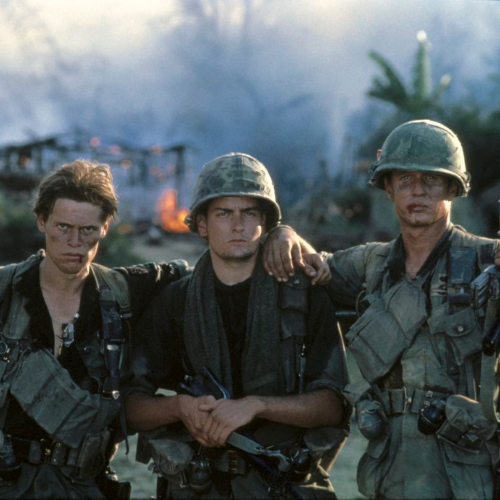
Eric D. Snider and Mental_Floss present 12 Intense Facts About Platoon. Here are three of my favorites…
6. IT TOOK MORE THAN A DECADE TO GET THE FILM PRODUCED.
Stone wrote a screenplay based on his experiences in Vietnam as soon as he got back from the war, in 1969. (He sent a copy of it to Jim Morrison, hoping the Doors frontman would star in it.) By 1976, that draft morphed into what he was then calling The Platoon. Stone couldn’t find anyone willing to make the movie, though. The war was still too fresh in people’s minds; it would be another few years before films like Apocalypse Now and The Deer Hunter addressed it. And after that, studios had another excuse not to make Platoon: why bother, when Apocalypse Now and The Deer Hunter had already covered it?8. IT CHANGED THE WAY HOLLYWOOD LOOKED AT WAR.
A much-decorated retired Marine named Dale Dye, who loved war movies but was disappointed by their failure to convey the mental and emotional realities of combat, offered Stone his services as an advisor. Dye had been turned down by other filmmakers, who felt the way Hollywood had been doing it—you hire a consultant to make sure the medals, guns, and uniforms are accurate, and you don’t worry about the less tangible details—seemed to be working just fine. (Dye said: “They had been making zillions of dollars making war films for decades, and here was some clown coming in to tell them they had a better mousetrap? Go away.”) But Dye’s vision matched Stone’s, and the psychological authenticity they created together was a major factor in Platoon’s success. For the first time, Vietnam veterans were seeing their experiences portrayed realistically. Dye has since become the foremost military consultant in Hollywood, advising (and occasionally acting in) everything from Saving Private Ryan to the Medal of Honor video games.11. CHARLIE SHEEN ALMOST LOST THE LEAD ROLE TO HIS OWN BROTHER.
Sheen auditioned during one of Stone’s earlier, unsuccessful attempts to get the movie made, and didn’t impress him. The guy Stone really liked was Sheen’s older brother, Emilio Estevez. But financing fell through and the film was shelved. By the time Sheen auditioned again a few years later, he had grown into the role. “This time I knew in 10 minutes he was right,” said Stone.
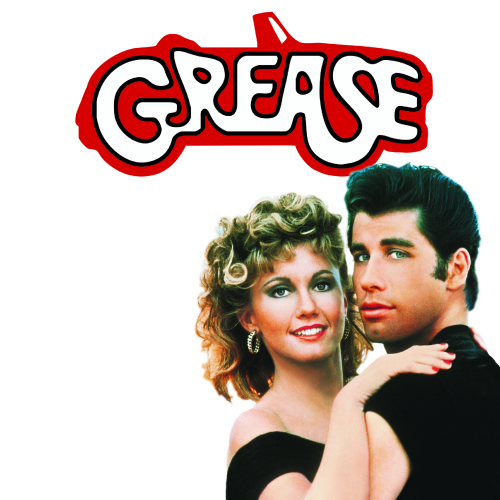
Hollywood.com presents 25 Facts You Didn’t Know About Grease. Here are three of my favorites…
1. Elvis was initially offered a role in the film.
It is believed he would play the Guardian Angel role, but he did not accept.3. In “Look at Me I’m Sandra Dee” they changed the reference and it has a freaky coincidence.
In the stage play, the song had a reference to Sal Mineo, who was murdered in 1976. For the movie, they changed the lyric to “Elvis, Elvis, let me be! Keep that pelvis far from me!” In reference to Elvis Presley, who died the same day the scene was filmed. The day was August 16, 1977.10. Lucille Ball is the reason her daughter was not cast as Rizzo and the part went to Stockard Channing.
Lucie Arnaz was dropped from consideration after Lucille Ball called and said “I used to own that studio; my daughter’s not doing a screen test!” But actually, she owned the studio Desilu which was bought by Paramount.
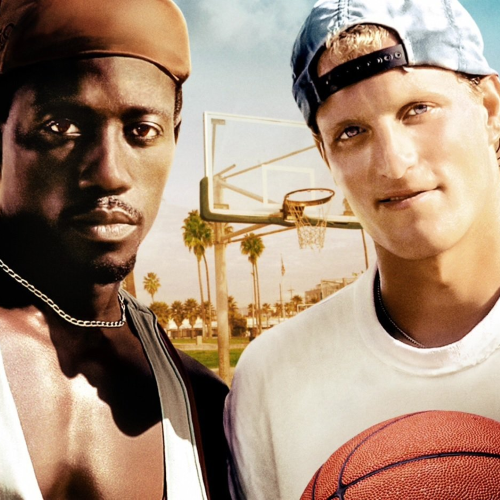
Roger Cormier and Mental_Floss present 15 Elevated Facts About White Men Can’t Jump. Here are three of my favorites…
2. DENZEL WASHINGTON WAS THE ORIGINAL CHOICE FOR SIDNEY.
Denzel Washington was dead set on playing Malcolm X next and turned them down. Shelton considered Cylk Cozart for the lead role, too. Ultimately, Cozart was cast in the role of Robert.3. KEANU REEVES, CHARLIE SHEEN, AND DAVID DUCHOVNY WERE CONSIDERED FOR BILLY.
Part of the audition involved shooting hoops at a basketball court at a Culver City casting office. Reeves just didn’t cut it, and Woody Harrelson acknowledged that Reeves’ lack of talent in the sport helped change his career. “I probably would’ve just been Woody Boyd but for the fact that Keanu Reeves didn’t play great basketball,” Harrelson told the Daily Express. Sheen was offered the part after Reeves’ failed audition but passed. Duchovny said he auditioned and really wanted the role.
10. HARRELSON HUSTLED SNIPES OUT OF MONEY.
There was constant gambling on set. Cozart threatened to take all of Woody’s Cheers money and estimated he won $5000 off of him. Harrelson won money off of Snipes though when he successfully dunked. Snipes never realized that the crew lowered the rim before Harrelson’s attempt.
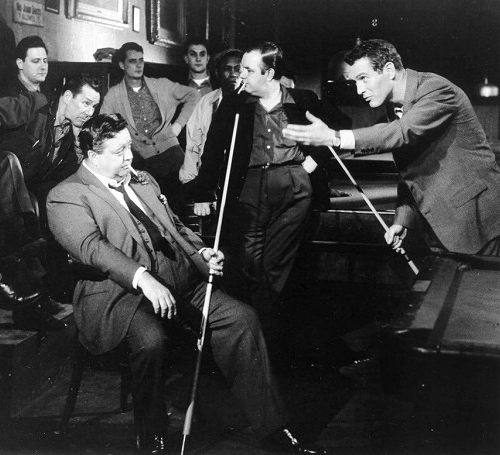
Eric D. Snider and Mental_Floss present 12 Smooth Facts About The Hustler. Here are three of my favorites…
2. JACKIE GLEASON DID HIS OWN TRICK SHOTS, THANK YOU VERY MUCH.
The comedian, best known for playing working-class loudmouth Ralph Kramden on The Honeymooners (which he created), had grown up in Brooklyn. Like Rossen, Gleason mixed it up with neighborhood toughs and got to be a pretty good pool hustler. He required no assistance for his trick shots in the film, and Rossen always positioned the camera so we’d be able to see that for ourselves.4. THERE WAS A REAL MINNESOTA FATS … BUT ONLY BECAUSE A GUY STARTED CALLING HIMSELF THAT AFTER THE MOVIE.
When the movie came out, Rudolf Wanderone was up there with Willie Mosconi as one of America’s best pool players. A hefty gentleman, Wanderone had several nicknames, including Double-Smart, New York Fats, and Chicago Fats. There was no Minnesota Fats; The Hustlernovelist Walter Tevis had made the character up. But in a promotional interview for the movie, Mosconi said Wanderone had been Tevis’s inspiration (which Tevis denied for the rest of his life, adamantly and with great annoyance). Wanderone seized the opportunity, perhaps flattering himself into thinking Tevis really had had him in mind. He embraced the nickname and declared himself the real Minnesota Fats for the rest of his career.7. THE MOVIE ISN’T VERY LONG, BUT IT WAS WIDER THAN USUAL.
The Hustler was shot in Cinemascope, the widescreen technique that had been in use since 1953. But it was mainly used for lavish epics and colorful musicals, not black-and-white dramas set in dingy pool halls. Yet as film critic Michael Wood pointed out, Rossen used Cinemascope “to create an oppressive, elongated world in which ceilings always seem terribly low; and people terribly separate from each other; in one shot Newman is even separated from his own image in a mirror by the whole width of a very wide screen. It is a world in which the pool table seems the one natural shape, while human beings seem untidy intruders.” Neat, huh?

Tara Aquino and Mental_Floss present 10 Not-So-Scary Facts About Monsters, Inc. Here are three of my favorites…
5. PAUL DOCTER’S ORIGINAL PITCH WAS TO HAVE A GROWN MAN BE HAUNTED BY THE MONSTERS HE DREW AS A KID.
On Jeff Goldsmith’s Creative Writing podcast, director Pete Docter recounted his original pitch: “My idea was that what it was about was a 30-year-old man who is like an accountant or something, he hates his job, and one day he gets a book with some drawings in it that he did when he was a kid from his mom. He doesn’t think anything of it and he puts it on the shelf and that night, monsters show up. And nobody else can see them. He thinks he’s starting to go crazy, they follow him to his job, and on his dates … and it turns out these monsters are fears that he never dealt with as a kid … And each one of them represents a different kind of fear. As he conquers those fears, the guys who he slowly becomes kind of friends with, they disappear … It’s this bittersweet kind of ending where they go away, and so not much of that stayed.”6. THE FILM WAS THE FIRST TO INTRODUCE THE ONSCREEN REPRESENTATION OF FUR.
In order to animate each individual strand of hair on Sulley, which reportedly took 12 hours to fill a single frame, Pixar developed a new software program called Fizt. According to WIRED, the software was extremely advanced for its time, as it had the power to simulate each of the three million hairs that covered the lovable monster. “We made the simulator able to digest anything,” said Andy Witkin, one of the studio’s senior animation scientists.7. JOHN GOODMAN AND BILLY CRYSTAL RECORDED THEIR LINES TOGETHER—A RARITY IN ANIMATION.
Typically, voice actors get into the booth at separate times to record their dialogue. But Billy Crystal pushed for the opportunity to work alongside his co-star, John Goodman. “I did the first two sessions alone and I didn’t like it,” Crystal told Dark Horizons. “It was lonely and it was frustrating.” Goodman was also a fan of the joint process; he told the BBC: “When Billy and I got together, the energy just went through the roof, so it was great.”

Over at Film School Rejects, Jack Giroux weighs in on which version of Payback is the best in his piece: Exploring Brian Helgeland’s Payback, a Tale of Two Movies.
Award-winning screenwriter and director Brian Helgeland was fired from the production of the Mel Gibson starrer Payback when the studio and Gibson felt Helgeland’s version was too dark. Gibson ended up directing the re-shoots and it was his version that was released to theaters. Years later Helgeland’s movie was released on dvd.
I’ve got both versions in my collection, so it should be clear that I dig both takes on the film. If I had to choose one, I’d go for the theatrical release [by a hair] but thankfully, since both versions rest in my collection, that isn’t a choice I’ll ever have to make.

Hollywood.com presents 15 Facts About Silence of the Lambs. Here are three of my favorites…
3. The moth cocoons Buffalo Bill placed in his victims throats were actually made from a combination of Tootsie Rolls and gummy bears, in case they were swallowed.
9. Jonathan Demme always had characters speak directly into the camera for conversations with Clarice, yet he always filmed Jodie Foster looking slightly off camera.
The idea was to make audiences directly experience her point-of-view to more easily empathize with her character. We think anyone who has watched those gripping last few moments of the film can confirm the success of this technique.10. Anthony Hopkins is only on screen for 24 minutes and 52 seconds. This makes his performance the second shortest to ever receive a nomination for Best Actor.

Matthew Jackson and Mental_Floss present 12 Stately Facts About The American President. Here are three of my favorites…
1. IT BEGAN AS A ROBERT REDFORD VEHICLE.
Though the film ultimately starred Michael Douglas, it started as a vehicle for another of Hollywood’s great leading men: Robert Redford. So, what happened? Well, Redford was reportedly more interested in the film’s love story, while director Rob Reiner was leaning more toward the political subplots. So the two parted ways, and the part of President Shepherd ultimately landed with Douglas.2. ANNETTE BENING WAS NOT THE FIRST CHOICE FOR THE LOVE INTEREST.
Just as the film began as a project that would star Robert Redford, so too did it originally feature other leading ladies. Redford himself had hoped to land Emma Thompson for the role of lobbyist-turned-President’s girlfriend Sydney Ellen Wade. Susan Sarandon and Michelle Pfeiffer were also considered for the meaty role, and by the time Douglas came onboard Jessica Lange was also up for the part. Ultimately, Bening won it.11. MANY CAST MEMBERS ULTIMATELY ENDED UP ON THE WEST WING.
The American President wasn’t just a template for The West Wing in terms of theme; it also featured a number of actors who would ultimately play key roles in the series. Martin Sheen,The American President’s A.J. MacInerney, went on to play the President himself, Josiah Bartlet, on The West Wing. Anna Deavere Smith eventually played The West Wing’s National Security Advisor Nancy McNally while Joshua Malina went on to play Communications Director-turned-Congressman Will Bailey. The list goes on.
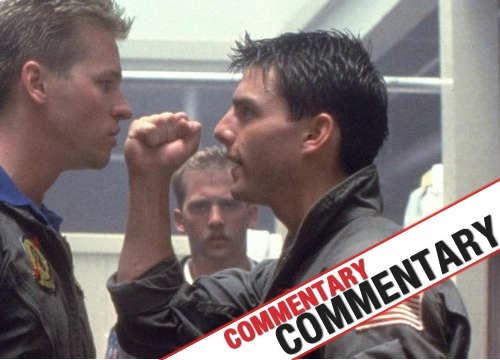
Rob Hunter and Film School Rejects present 36 Things We Learned from the Top Gun Commentary. Here are three of my favorites…
15. The advisors agree that a person can’t give themselves a call sign. Pettigrew recalls one poor fellow who did just that with the call sign “‘Shark,’ so of course he was known as ‘Minnow’ for the rest of his Navy career.”
19. The earlier shot of Maverick and Goose flying upside down just a few feet above a MiG is obviously unrealistic, but McCabe does share that American pilots were known to “communicate” back and forth with their Soviet counterparts. They weren’t flipping each other the bird though. “It was always very positive,” and included holding up vodka and Playboy magazines. “They’re doing their job, we’re doing our job, we don’t set the policy, we just execute it.”
27. The elevator scene between Charlie and Maverick was shot five months after production wrapped when they decided the characters’ relationship needed to be strengthened. McGillis is wearing a hat because her hair was different due to filming on a different movie, and even Cruise’s hair is noticeably longer. “Kelly had lost like 60 pounds and Tom was actually shooting Color of Money,” says Scott, so they had to shoot the scene in Chicago. They did some pick-ups for the love scene then as well.

Kara Kovalchik and Mental_Floss present 20 Fun Facts About I Love Lucy. Here are three of my favorites…
1. CBS DIDN’T THINK AMERICANS WOULD BUY THAT LUCY WAS MARRIED TO A “FOREIGN” MAN.
When CBS approached Lucille Ball with the offer of turning her popular radio show My Favorite Husband into a television show, she was agreeable with one condition: that her real-life husband, Desi Arnaz, would be cast in the role of her spouse (played on the radio by Richard Denning). The network balked—there was no way that American viewers would accept average housewife Liz Cooper (her character’s name on the radio series) being married to a “foreign” man with an indecipherable accent. Never mind the fact that Lucy and Desi had been married more than a decade; such a “mixed” marriage was unbelievable.3. THE SHOW BROKE GROUND IN SEVERAL WAYS, SIMPLY BECAUSE THE ARNAZES WOULDN’T MOVE TO NEW YORK.
Lucille and Desi wanted to work in Los Angeles, near their home and their new baby daughter Lucie. But in 1951 the majority of television shows were broadcast from New York, and that’s where sponsor Philip Morris wanted their show to originate as well. In those days the U.S. wasn’t wired for television from coast-to-coast; shows broadcast live could only be transmitted so far. As a result, such shows were preserved on kinescopes (a movie camera aimed at a TV monitor that recorded the show in negligible quality) and shipped to distant stations.Philip Morris objected to I Love Lucy being performed in California and the kinescopes sent to New York; their biggest cigarette market was up and down the east coast and they wanted the best TV picture quality for that area. Desi Arnaz suggested that the show be filmed with three cameras, like a stage play, which would provide the same quality picture for every market. But multi-cameras had never been used on a situation comedy before, and there were many obstacles involved, not the least of which was accommodating a live studio audience (Desi knew that Lucille worked best when she got immediate audience feedback).
Desi hired legendary cinematographer Karl Freund to help solve the dilemma, and along with writer-producer Jess Oppenheimer and director Marc Daniels, they built a set, and the necessary filming equipment was strategically placed. CBS balked at the additional expense involved in this undertaking, so Arnaz struck a deal: he and Lucille would take a large cut in their salaries and their company, Desilu Productions, would retain ownership of the films in exchange. The enduring high quality of the 35 millimeter film was part of the reason that I Love Lucy became so popular in rerun syndication, and Desilu’s 100 percent ownership of the series made Lucille and Desi the first millionaire TV stars.
9. DESI ARNAZ HAD LIFTS IN HIS SHOES (AND HIS LOVESEAT).
Arnaz listed his height as 5’11” in most official biographies, but those who worked with him knew that in reality he was 5’9” and wore four-inch lifts in his shoes. Lucille Ball stood 5’7” in her stocking feet, and when she wore heels she seemed to tower over her husband. Desi Arnaz Jr. would later explain to an interviewer that his father “was a Cuban with a Latin male’s pride,” which is why it was important to him to be taller than his wife. A dual-purpose, subtle additional cushion (undetectable by the viewing audience) was added to the Ricardo’s loveseat so that Ricky would be taller than Lucy while seated, and would also give him the extra boost needed to gracefully rise from a sitting position up onto his elevator shoes.

Roger Cormier and Mental_Floss present 16 Thrilling Facts About the Bourne Movies. Here are three of my favorites…
3. BRAD PITT, SYLVESTER STALLONE, AND RUSSELL CROWE COULD HAVE BEEN BOURNE.
Pitt was offered the part, ultimately turning it down to work on Spy Game. Liman met with Crowe and Stallone, too. Matt Damon was the actor Liman thought best understood what he wanted to do with the material.8. LIMAN INSTRUCTED DAMON TO WALK LIKE A BOXER.
Damon said it really helped in finding his character. He spent six months learning boxing for the first movie, in addition to six months of martial arts training, and hundreds of hours of gun training.9. THE MARTIAL ARTS STYLE USED IS CALLED KALI.
In Kali, one uses the energy of his or her opponent against them. Liman figured that’s what Bourne would use.
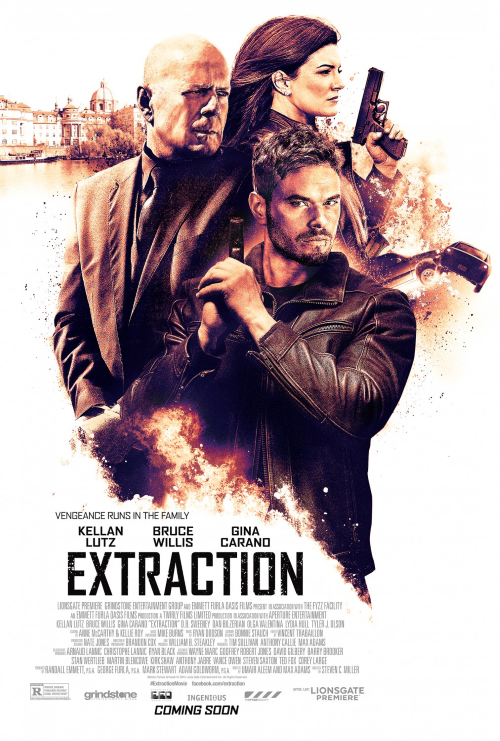
How about The Extraction poster and trailer starring Kellan Lutz, Bruce Willis and Gina Carano?