Category: Celebs

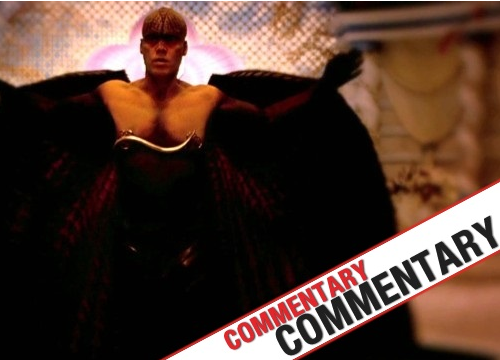
30 Things We Learned from Tarsem Singh’s “The Cell” Commentary

Rob Hunter and Film School Rejects present 30 Things We Learned from Tarsem Singh’s The Cell  Commentary. 

I’ve always thought The Cell was an under-rated film.  Here’s three of my three favorite things learned…

5. Tarsem recalls when Vincent D’Onofrio arrived for lighting tests, “and he came in and he just got into character and he came out with that look, and mmm, just how he moved, how he breathed, his base, just so so perfect throughout.”

13. He recalls a problem with actress Tara Subkoff that bled into her appearance in the film. She was asked if she could swim, and after stumbling briefly she said yes adding “I’m a lifeguard.” Tarsem had already lost the actress he had wanted for the role, and they were nearing the shooting date, so he hired her. “You can lie to a certain extent when somebody says ‘are you a horse rider’ and say yes and then go learn it, but you don’t say you’re a jockey!” He says it ended up being a disaster because he ended up having to do long shots. “I feel no sympathy for the girl when she gets saved in the end, and you can tell because of how I covered her. I just could not get near her.” She couldn’t go in the water without holding her nose, and it resulted in time lost and mounting frustrations. By contrast, the girl playing the bleached corpse, Catherine Sutherland, was great, and he wishes he had switched the two.

15. Peter Sarsgaard makes an uncredited appearance in the film, and Tarsem says he wishes he had more for him to do. “That guy is a great actor.”


10 Things You May Not Know About P.T. Barnum

Evan Andrews and History.com present 10 Things You May Not Know About P.T. Barnum.   Here are three of my favorites…

1. Barnum was an entrepreneur from an early age.
Barnum’s knack for moneymaking first manifested during his youth in Bethel, Connecticut. The future showman sold snacks and homemade cherry rum during local gatherings, and by age 12, he had made enough money to purchase his own livestock. By 21, his holdings also included a general store, a small lottery and even his own newspaper called the “Herald of Freedom.”

2. He first rose to prominence by engineering a famous hoax.
In 1835, Barnum launched his career in entertainment by purchasing Joice Heth, a blind slave touted as being the 161-year-old former nurse of George Washington. After billing Heth as “the most astonishing and interesting curiosity in the world,” Barnum put her on display in New York and took her on a small tour of New England. Visitors lined up to gawk at her withered body and hear her tales of “dear little George,” and Barnum helped fuel popular interest by spreading a rumor that she was actually an automaton controlled by a ventriloquist. The truth about Heth didn’t emerge until after her death in February 1836. During a public autopsy—staged by Barnum at the price of 50 cents for admission—it was revealed that she was most likely no older than 80.

3. Barnum didn’t go into the circus business until relatively late in life.
Barnum is best known for his traveling three-ring circuses, but he didn’t make his first forays under the big top until he was 60 years old. Before then, he was better known as the owner of the Manhattan-based American Museum, a sprawling collection of historical artifacts, aquariums, animal menageries, zoological curiosities and freak shows. Some of the museum’s most notable exhibits included General Tom Thumb, a child dwarf who Barnum famously brought to audience with Queen Victoria of Britain; and the “Fejee Mermaid,” which was actually the upper half of a monkey sewn to the bottom of a fish. Barnum only launched his traveling circus after his museum was twice destroyed by fire. He later teamed with his famed partner James Bailey in 1881, and the two went on to make a fortune running their “Greatest Show on Earth.”

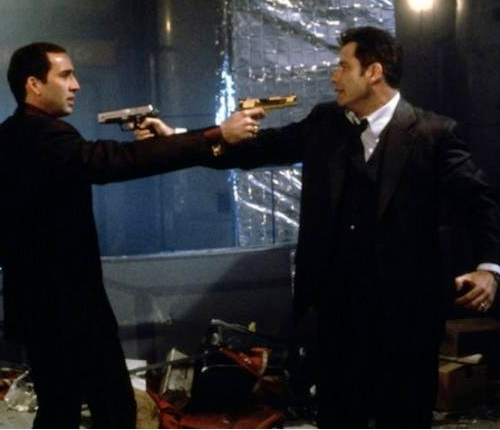
15 Peachy Facts About “Face Off”

Eric D. Snider and Mental_Floss present 15 Peachy Facts About Face Off.  Here are three of my favorites…

2. IT WAS WRITTEN WITH STALLONE AND SCHWARZENEGGER IN MIND.
Separately, they were among the top action stars of the day (the day being the early ’90s), so teaming them up was an irresistible idea. Moreover, they were both really famous, and as Colleary once said, “The movie doesn’t work unless the actors have a well-established persona” so audiences can appreciate them impersonating each other. (Editorial note: there’s no way Schwarzenegger and Stallone could have imitated one another’s mannerisms as well as Cage and Travolta do.) The two didn’t make Face/Off, but they did eventually make Escape Plan, in which they escape from a futuristic, off-the-grid, middle-of-the-ocean prison very much like the one in Face/Off.

12. THE JOKE ABOUT TRAVOLTA’S “RIDICULOUS CHIN” WAS TRAVOLTA’S OWN IDEA.
He said, “Nic [Cage]’s character is such an egomaniac. He loves himself—the way he talks, acts, walks, everything about himself. So, we just figured that it follows that he would hate being in my body, having my face. So I added a lot of lines where he makes fun of the way I look—like ‘this ridiculous chin,’ things like that.”

6. THE EPILOGUE, WHERE THE ARCHERS ADOPT CASTOR TROY’S ORPHANED SON, ALMOST DIDN’T HAPPEN.
It was part of the writers’ original story and survived all of their many rewrites, but Paramount didn’t think audiences would like an ending where the hero adopts his enemy’s son. Woo’s alternate idea was for the film to end with some ambiguity about whether or not Eve Archer had her real husband back. When a test audience found that unsatisfying—and, moreover, wanted to know what happened to Castor Troy’s kid—the studio ponied up the money to get the necessary cast members back to film the original ending. According to Werb, “The next time we tested, the numbers went through the roof. There was spontaneous and thunderous applause at the end.”

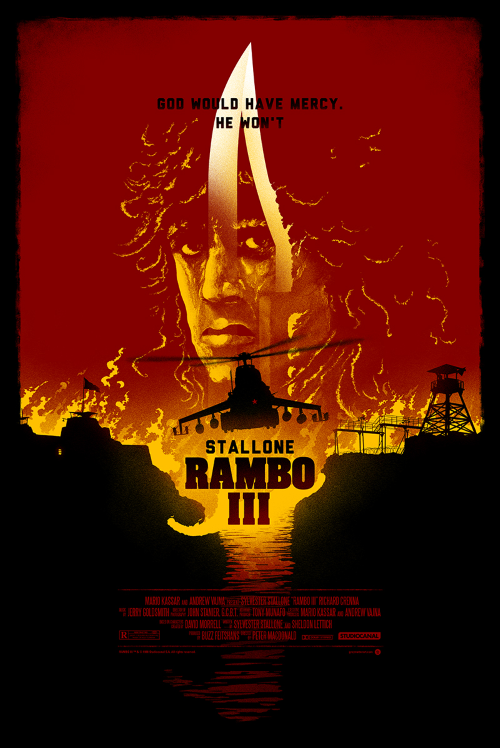
“Rambo III” by Marko Manev

Grey Matter Art under license from StudioCanal, is pleased to announce the final poster in our officially licensed Rambo series. A limited edition screen print for the iconic 80’s action film, “Rambo III”, by artist Marko Manev. Below are details for the release:

Artist: Marko Manev
Size: 24X36
Regular Edition: 100/$50.00

Regular Edition Set of all 3 Rambos: $120
Printed by: D&L Screen Printing
This poster was released on Thursday, July 9th.Follow Grey Matter Arts on Twitter to get a jump on future drops. Also, follow Grey Matter Arts on Facebook and Instagram, and sign up for their website newsletter for all future news & information.

RAMBO III ™ & © 1988 Studiocanal S.A
RAMBO ® is a Registered Trademark owned by Studiocanal S.A.

10 Facts You (Probably) Didn’t Know About The Beatles

and Neatorama present 10 Facts You (Probably) Didn’t Know About The Beatles. Here are three of my favorites…

2) Most “takes” on a Beatles song.
The Beatles were known as perfectionists in the studio, often recording dozens of takes on a specific song. The Beatle song with the most attempted takes was actually never released by the Beatles.

“Not Guilty,” a George Harrison song, took 102 takes, before it was ultimately rejected for the Beatles 1968 album The Beatles.

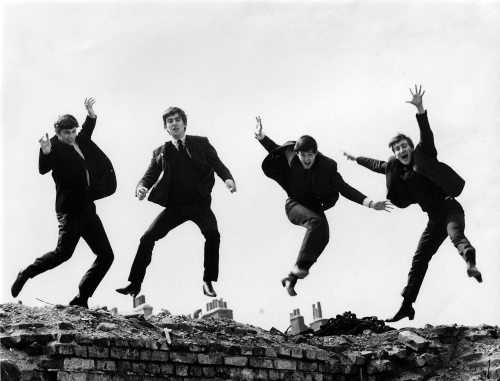
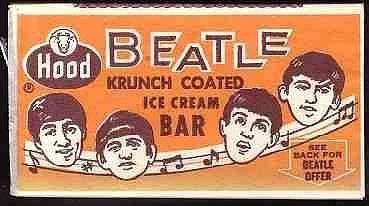
5) Strange Beatles products sold.

After the Beatles landed in America in 1964, Beatle products (both licensed and unlicensed) flooded the markets. Beatle t-shirts, wigs, books, hats, guitars, wallpaper, notebooks, board games, were just a few of the successful Beatle-related products sold on the market. In one city, Beatle bedsheets were sold from slicing up the sheets the boys had slept on. Beatle pillowcases were sold in the same manner. Beatle razor stubble and Beatle bathwater were attempted too.

One enterprising salesman in New York supposedly made a profit selling bottles of “Beatle Breath.”

10) John and Paul once composed the score for a ballet.

In 1963, John Lennon and Paul McCartney actually composed the score for a ballet- for the first and only time in their careers. The ballet was called Mods and Rockers.

It opened on December 18, 1963 and ran through January 11, 1964 at the Prince Charles Theater in London. Even by this early point in their careers, the Sunday Times declared John and Paul “the greatest composers since Beethoven.”

16 Hardcore Facts About “Full Metal Jacket”

Roger Cormier and Mental_Floss present 16 Hardcore Facts About Full Metal Jacket. Here are three of my favorites…

2. VINCENT D’ONOFRIO GAINED 70 POUNDS TO PLAY LEONARD “GOMER PYLE” LAWRENCE.
In addition to the weight gain, D’Onofrio also shaved his head for the role, and was surprised by how much it affected him. ”It changed my life,” D’Onofrio told The New York Times in 1987. ”Women didn’t look at me; most of the time I was looking at their backs as they were running away. People used to say things to me twice, because they thought I was stupid.” To this day, it’s the most weight any actor has ever gained for a movie role.

5. ARNOLD SCHWARZENEGGER AND BRUCE WILLIS TURNED DOWN ROLES.
Schwarzenegger claimed he was too busy to play Animal Mother (the part that eventually went to Adam Baldwin). Bruce Willis was offered a part two days before he was to start shooting the first six episodes of Moonlighting, so he had to say no, too. Denzel Washington wanted in, but didn’t like that Kubrick didn’t send out a script beforehand to audition.

9. JOKER HAD A NAME.
It was J.T. Davis. In 1961, Specialist James T. Davis was the first recorded American battlefield casualty in Vietnam.

14 Facts About “Flashdance”

Garin Pirnia and Mental_Floss present 14 Facts About Flashdance.  Here are three of my favorites…

8. KEVIN COSTNER AUDITIONED TO PLAY NICK HURLEY.
Costner, who didn’t become famous until the mid-1980s, auditioned for the role of Nick Hurley, Alex’s boss and love interest in the film. Lyne paid Costner $200 to lie in bed with Beals, but it apparently didn’t work for him as the part went to Michael Nouri. In a strange twist of fate, prior to auditioning for Flashdance, Costner starred in an Apple commercial directed by Lyne. The commercial aired a few months after the film was released and has an uncanny resemblance to Flashdance: Costner on a bike, with a brown pit bull running beside him.

12. THE STUDIO WASN’T BANKING ON A HIT.
Lyne told Entertainment Weekly how Paramount thought the movie would be a flop. “In the two weeks before Flashdance came out, I literally couldn’t get anybody on the phone,” he said. “It was like everybody had run for the hills because they thought it was gonna be a total disaster. I didn’t know either. Paramount sold at least a quarter of their interest in the film in those two weeks. In other words, they saw the film, and thought, ‘Well, this is gonna go down the toilet.’” Luckily for Paramount and Lyne, the film opened to a healthy $4 million gross, which would be almost $10 million today. The film remained in the top 10 weekend box office for 15 weeks straight.

2. THE SONG “MANIAC” WAS ORIGINALLY COMPOSED FOR THE 1980 HORROR FILM MANIAC.
Michael Sembello and Dennis Matkosky’s original lyrics for “Maniac” were as follows: “He’s a maniac, maniac that’s for sure / He will kill your cat and nail him to the door.”

“That direction obviously wasn’t going to work,” Sembello told Song Facts. “Phil Ramone, producer of the soundtrack, [had] the vision to see the potential of the song, [and] asked us to change it to the present concept of a girl possessed with the passion of a gift for dance.” Which is how the far less gruesome lines “She’s a maniac, maniac on the floor / And she’s dancing like she’s never danced before” came about. “Without Phil it would not have happened,” says Sembello.

Z-View: “Glen Campbell: I’ll Be Me”

I saw Glen Campbell perform live when I was a kid.  Glen Campbell was one of the first celebrities that I can remember seeing “in person.”  The concert took place at the Indiana State Fair.   At the time Mr. Campbell was a recording star, but would go on to have his own television series and appear in movies.

Glen Campbell always came across as a nice guy.  Mr. Campbell seemed like someone you’d enjoy sharing a meal with or just talking to.  That made the news that he was suffering from Alzheimer’s even more tragic.  Not that you’d want anyone to get the disease, but especially not one of the good people.

Last October I posted about Glen Campbell’s song, I’m Not Gonna Miss You.  At the time I said it was one of the saddest songs that I’d ever heard.  I still think it is.  Perhaps even more so after watching the documentary Glen Campbell: I’ll Be Me.

Glen Campbell: I’ll Be Me takes us behind the scenes for a look at how Alzheimer’s wrecks the life of not only the person with the disease but also everyone who is close to the him/her.

Luckily for Mr. Campbell he has a devoted wife, family and friends and the financial resources to provide him a superior support system.  Still even with all of that, the disease is unstoppable.

Mark Evanier wrote about being at a party a few years ago and the excitement that went through the crowd as it became known that Glen Campbell was going to sing a few songs… and the initial discomfort when they realized the toll Alzheimer’s was taking on him.  Mr. Evanier goes on to say, heck, instead of me telling you what he said, why don’t you just click on over and read his words for yourself.  Like everything Mark Evanier posts, it is more than worth a read.  I’ll be here when you get back.

I want to echo Mark Evanier’s recommendation that you check out Glen Campbell: I’ll Be Me.

Rating:   

As I was posting this, I noticed (and it was probably unintentional) that the title of the documentary Glen Campbell: I’ll Be Me can also read like Glen Campbell: Ill Be Me.
15 Fun Facts About “Weird Science”

Eric D. Snider and Mental_Floss present 15 Fun Facts About Weird Science.  Here are three of my favorites…

9. THE SCENE WHERE GARY TALKS LIKE AN OLD AFRICAN-AMERICAN BLUESMAN WAS INSPIRED BY RICHARD PRYOR.
Hall recounted in an interview that he and John Hughes would “watch Richard Pryor movies on the weekend. And we would imitate this character called Mudball that Richard Pryor would do. And so it was really just a product of being Richard Pryor fans that John said, ‘Hey, why don’t we create this scene where you go into a bar and do that?’”
11. IT TAKES ITS TITLE FROM A 1950S COMIC BOOK, BUT OTHER SIMILARITIES ARE COINCIDENTAL.
EC Comics published 22 issues of Weird Science between 1950 and 1953, alongside more popular anthology titles like Tales from the Crypt. Hollywood mega-producer Joel Silver got the rights to all the old EC stuff in the ’80s, and Hughes was in his office one day when boxes of the comics were being delivered and unpacked. Seeing the title Weird Science, and thinking of a beautiful woman he and Silver had seen earlier that day, Hughes said, “What if two kids figure out a way to make that girl that was in the commissary?” This is according to Silver’s recollection, anyway. “I already had rights to the EC books, so that’s how I convinced them to let me have the title.” Now, there was a story in an issue of Weird Science that bore a superficial resemblance to Hughes’ idea—“Made of the Future,” in which a man builds a wife from a kit he got on a trip to the year 2150.

13. BILL PAXTON GOT HIS CHARACTER’S DISTINCTIVE MILITARY-STYLE HAIRCUT WITHOUT HUGHES’ PERMISSION.
His first day on the set, “I told [the film’s makeup artist] I wanted to do a haircut that was really intense,” Paxton told The AV Club in 2012. “He’s the one who suggested the flattop, but long on the sides and slicked back. And he was afraid he was going to lose his job to cut it like that without having it approved by the producer or the director, but I said, ‘Just do it.’” Fortunately, Hughes loved it, along with everything else Paxton brought to the character.

13 Interesting Facts About M. Night Shyamalan Movies

Hollywood.com recently posted 13 Interesting Facts About M. Night Shyamalan Movies.  Here are three of my favorites…

1. Sixth Sense was inspired by an episode of Are You Afraid of the Dark?.

M. Night Shyamalan
GIPHY/Hollywood Pictures

According to M. Night, the film is based on the episode “The Tale of the Dream Girl”, where the premise was: the lead characters are being ignored by the friends/family and don’t understand that they are dead until the end of the episode.

5. M. Night wrote the screenplay for Unbreakable with Bruce Willis and Samuel L. Jackson in mind.

Touchstone Pictures

He always anticipated the two actors agreeing to do the film. This was also their fourth film together, after Loaded Weapon 1 (1993), Pulp Fiction (1994), and Die Hard: With a Vengeance (1995).

6. The Happening is the only movie of his in which M. Night does not physically appear.

GIPHY/20th Century Fox

He’s the voice of Joey, who calls out to Alma a few times in the film.

7. All of his films are set in, or very close to, Philadelphia.