Category: Crime

12 High Stakes Facts About “Casino”

Eric D. Snider and Mental_Floss present 12 High Stakes Facts About Casino.  Here are three of my favorites… [Beware of Spoilers!]

1. IT ONLY EXISTS BECAUSE THE REAL GUY IT’S BASED ON WAS A BIG DE NIRO FAN.
The main character, Sam “Ace” Rothstein, is based on Frank “Lefty” Rosenthal, who was retired and living in Florida when writer Nicholas Pileggi came around wanting to write a book about his career. Rosenthal didn’t actively oppose the project, but he had no interest in helping, either—until he found out that Martin Scorsese planned to make Pileggi’s eventual book into a movie, and that Robert De Niro would probably be the star. Then he perked up, asking Pileggi (who also wrote GoodFellas) if he could arrange a meeting with De Niro. Next thing Pileggi knew, formerly reticent associates of Rosenthal’s were coming out of the woodwork, offering their cooperation.
5. JOE PESCI LOOKED SO MUCH LIKE THE REAL GUY THAT SOME CASINO PIT BOSSES DID DOUBLE-TAKES.
Pesci bore some natural resemblance to Tony “The Ant” Spilotro, the violent psychopath who busted heads for Rosenthal, and upon whom his character—Nicky Santoro—was based. In makeup, he looked even more like Spilotro—so much so that, according to Pileggi, when Pesci entered the casino where the movie was being shot, some pit bosses who’d had personal dealings with Spilotro “almost fainted.”

6. ACCORDING TO SCORSESE, THE FILM HAS “NO PLOT AT ALL.”
“There’s no plot at all,” Scorsese said in an interview included on the Blu-ray. “It’s three hours, no plot. So you know this going in. There’s a lot of action, a lot of story, but no plot.”

14 Crazy Facts About “Psycho”

Scott Weinberg and Mental_Floss present 14 Crazy Facts About Psycho.  Here are three of my favorites… [Beware of Spoilers!]

5. HITCHCOCK FINANCED THE FILM.
Paramount had all sorts of cold feet regarding the project, which prompted Hitchcock to both pay for the film out of his own pocket and forgo his (rather substantial) director’s fee in exchange for 60 percent ownership of the film. This highly uncommon arrangement put a whole lot of money in Hitchcock’s pocket. (Bad move, Paramount.) Plus the film doesn’t even belong to Paramount anymore; it’s been a Universal title since 1968.

12. LATE MOVIEGOERS WEREN’T ALLOWED IN.
Not only was Hitchcock intent on keeping the film under wraps until the last possible minute—he also instructed theaters to not allow anyone in once the film had started. And they did it!

14. THE MOVIE EARNED HITCHCOCK HIS FINAL OSCAR NOMINATION.
Psycho marked the fifth and final time that Hitchcock would earn an Oscar nomination for Best Director. (The Academy gave him the Irving G. Thalberg Memorial Award in 1968.) Yes, you read that right: Alfred Hitchcock never won an Oscar for directing. Let that sink in for a bit. [Hard to believe, isn’t it? – Craig]

18 So Cool Facts About “True Romance”

Roger Cormier and Mental_Floss present 18 So Cool Facts About True Romance.  Here are three of my favorites… [Beware of Spoilers!]

2.TONY SCOTT WANTED TO DIRECT BOTH TRUE ROMANCE AND RESERVOIR DOGS.
Because he was still new to the business, Tarantino knew he couldn’t direct both movies. So he gave both scripts to Tony Scott and told him to pick one. Though Scott wanted both of the films, he ended up choosing True Romance, leaving Tarantino to make Reservoir Dogs.

7. TOM SIZEMORE GOT JAMES GANDOLFINI IN THE MOVIE.
Sizemore was initially cast as Gandolfini’s character, Virgil. But he wasn’t comfortable with a scene that required him to beat up Patricia Arquette, so he asked to play Cody Nicholson instead. When Scott asked Sizemore who should play Virgil instead, he suggested Gandolfini, a then-unknown actor whom he knew from the New York theater world.

16. SCOTT CHANGED TARANTINO’S ENDING.
Quentin had Clarence die; Scott decided that the movie deserved a happier ending. The only other difference between Tarantino’s script and Scott’s interpretation was presenting the movie linearly; Tarantino wrote True Romance as a nonlinear adventure, similar to the style ofReservoir Dogs and Pulp Fiction.

11 Clever Moments of Movie Foreshadowing You May Have Missed

Rudie Obias and Mental_Floss present 11 Clever Moments of Movie Foreshadowing You May Have Missed.  Here are three of my favorites… [Beware of Spoilers!]

1. PSYCHO (1960)
After Marion Crane (Janet Leigh) checks into the Bates Motel, she overhears the motel’s owner, Norman Bates (Anthony Perkins), get into an argument with his mother, who is emotionally abusive toward him. Nevertheless, Norman defends her when Marion suggests that their relationship might be toxic. Norman explains that his mother is “as harmless as one of those stuffed birds.” The line foreshadows the film’s twist when it is revealed that Norman killed and taxidermied his mother.

4. TOTAL RECALL (1990)
Paul Verhoeven’s 1990 science fiction film Total Recall is full of clever clues that keep audiences guessing as to whether Doug Quaid’s (Arnold Schwarzenegger) adventure as a secret agent on Mars was real or merely a memory implanted into his brain. One of the biggest hints comes at the beginning of the film, when Quaid visits Rekall and one of the engineers tells him that he will experience “blue skies on Mars.” At the end of Total Recall, the Red Planet is terraformed and there is now a blue sky on Mars.

5. RESERVOIR DOGS (1992)
Quentin Tarantino’s Reservoir Dogs follows a small group of criminals brought together to pull off a diamond heist. But when the police show up in the midst of the job, it’s clear that one of the men is an informant. The criminals are unknown to each other and are only referred to by colorful aliases (i.e. Mr. White). However, if you pay close attention to the opening scene, you can figure out that Mr. Orange (Tim Roth) is the police informant who set up the rest of the gang.

During the breakfast scene, when Joe (Lawrence Tierney) leaves the table to pay the bill, everyone contributes a dollar for the waitress’ tip—everyone except for Mr. Pink (Steve Buscemi), who refuses to tip based on principle. When Joe comes back to the table, he notices that the tip is short and asks who didn’t contribute. Without hesitation, Mr. Orange rats out Mr. Pink.

Additionally, when Nice Guy Eddie (Chris Penn) rushes to the hideout after the heist-gone-wrong, there’s an orange balloon following his car, which is a nod to the fact that Mr. Orange is after him.

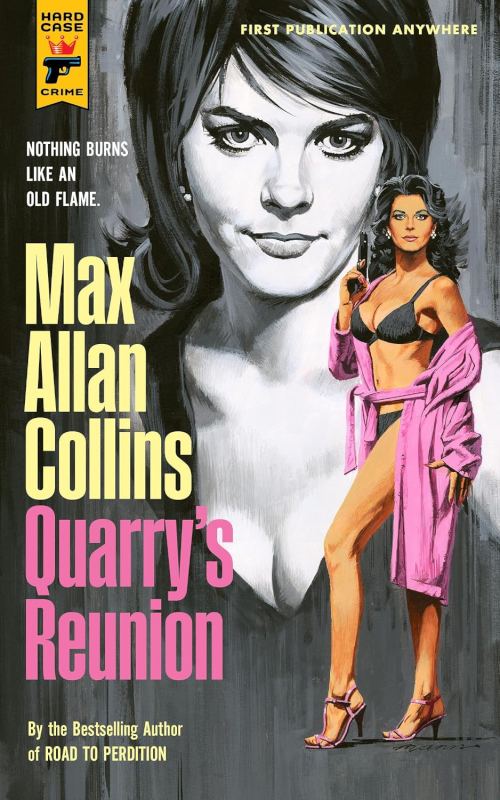
Max Allan Collins’ Interview: Nate Heller, Batman, Quarry, Wild Dog and More!

Max Allan Collins is one of my favorite novelists.  Collins’ Nathan Heller historical novels are buy-as-soon-as-they-come-out must reads.

Collins discusses…

  • the soon to be released trade for Wild Dog [co-created with artist Terry Beatty]
  • Ms. Tree [also co-created with Terry Beatty]
  • the upcoming Quarry tv show [based on Collins’ hitman Quarry novels]

“Lookinglass” aka “The Frankenstein Code” Trailer is Here!

Lookinglass has been through a couple of name changes.  It was originally called The Frankenstein Code.

I like The Frankenstein Code title  but understand why it was changed — it sounds like a horror movie.  Of course since the series was inspired by Mary Shelley’s Frankenstein, the title wasn’t too much of a stretch.

At any rate, a rose monster by any other name and all that, the trailer for Lookinglass is below and looks interesting enough to be added to my list of shows to watch.

17 Things You Never Knew About “The Shawshank Redemption”

Hollywood.com presents 17 Things You Never Knew About The Shawshank Redemption.   Here are three of my favorites…

3. Clint Eastwood, Harrison Ford, Paul Newman, and even Robert Redford were considered for the part of Red, who is a middle-aged Irishman in the original story… Darabont had Freeman in mind all along because of his presence, demeanor, and, of course, that voice.

16. When the cut-out hiding space for his digging tool was discovered in Andy’s Bible, it’s clear the book is open to Exodus.

Shawshank Redemption
Columbia Pictures

The word literally means “to escape or depart.”

5. The mugshot of Red attached to his parole papers looks just like a young Morgan Freeman for a reason: it’s Freeman’s son, Alfonso in the photos.

Shawshank Redemption
Columbia Pictures

Alfonso Freeman also appears in the film as a convict yelling, “Free fish! Free fish today!”

15 Fascinating Facts About “The Departed”

Sean Hutchinson and Mental_Floss present 15 Fascinating Facts About  The Departed.  Here are three of my favorites…

2. IT’S BASED ON A REAL-LIFE GANGSTER.
Jack Nicholson’s character is based on infamous Boston mob boss Whitey Bulger. Before he was captured in 2011, he was second only to Osama bin Laden on the FBI’s Most Wanted List and had a reward of $1 million for his capture.

6. MARK WAHLBERG WASN’T THE FIRST CHOICE TO PLAY DIGNAM.
Ray Liotta (who was also in Scorsese’s Goodfellas) and Denis Leary were initially considered for the role, which eventually went to Wahlberg. Wahlberg was nominated for a Best Supporting Actor Oscar for his performance.

8. THE FILM TAKES A WHILE TO GET GOING.
The title card doesn’t appear until 18 minutes after the movie starts.

14 Tricky Facts About “The Sting”

Eric D. Snider and Mental_Floss present 14 Tricky Facts About The Sting.  Here are three of my favorites…

2. REUNITING BUTCH AND SUNDANCE WASN’T THE NO-BRAINER YOU’D EXPECT.
Separately, Robert Redford and Paul Newman were two of the biggest movie stars in the world in the early 1970s. As a duo, they were perhaps even more popular, with mega-hit Butch Cassidy and the Sundance Kid (1969) fresh in people’s memories. When the director of that film, George Roy Hill, signed on for The Sting, Redford soon followed. Then came Newman, as described above. But while a Butch and Sundance reunion sounded tempting (and lucrative), the studio had a concern: In the movie, the two con men’s partnership hinges on the possibility that one (or both) will try to double-cross the other. With Redford and Newman so famously chummy, Universal was concerned that audiences wouldn’t believe such a betrayal was possible, and the film would thus lose some of its suspense. Hill assuaged their fears.

6. ROBERT SHAW’S LIMP WAS REAL.
Shaw, who played crime boss Doyle Lonnegan in the film, hurt his leg playing racquetball two days before shooting began. Director Hill decided to work with it and had Shaw turn his injury into a character trait.

8. THE DIRECTOR ISN’T AS FAMOUS AS YOU’D THINK, CONSIDERING HE MADE TWO OF THE HIGHEST-GROSSING FILMS OF ALL TIME.
George Roy Hill’s Butch Cassidy and the Sundance Kid made $102 million in 1969, or about $575 million at today’s ticket prices. When Hill reunited with his Butch and Sundance for The Sting, the result took in $156 million ($723 million adjusted for inflation). The Sting was the fourth highest-grossing film in history at the time, behind The Exorcist (which was released the same week), Gone with the Wind, and The Sound of Music, and ahead of The Godfather.Butch Cassidy and the Sundance Kid was number eight, making Hill the only director to have two movies in the top 10. But Hill was reclusive compared to most Hollywood directors, disliking publicity tours and talk show interviews. As a result, despite his successes (he also made Slap Shot and The World According to Garp), he never quite became a household name.

12 Dusty Facts About “Unforgiven”

Eric D. Snider and Mental_Floss present 12 Dusty Facts About Unforgiven.  Here are three of my favorites…

4. EASTWOOD WAS INITIALLY STEERED AWAY FROM THE MOVIE.
Sonia Chernus, a longtime associate of Eastwood’s (and screenwriter of The Outlaw Josey Wales), read The Cut-Whore Killings in the 1980s and was appalled by it. She wrote Eastwood this memo: “We would have been far better off not to have accepted trash like this piece of inferior work … I can’t think of one good thing to say about it. Except maybe, get rid of it FAST.” (It may be worth noting that Chernus was in her seventies at the time, and the script was full of profanity and violence.) Eastwood took her advice and didn’t read the script. Then, while looking for someone to rewrite a different project, he read The Cut-Whore Killings as a sample of Peoples’ work, not realizing it was the screenplay Chernus had warned him away from.

7. THEY BUILT A PRETTY CONVINCING WESTERN TOWN.
Eastwood’s production designer, Henry Bumstead, and his team built the main set for the 1880s town of Big Whiskey, Wyoming on a lonesome prairie in Alberta from which no signs of modern civilization could be seen in any direction. The nearest big city was Calgary, 60 miles away. For authenticity—and since so much of the movie was to be shot on this set—all of the buildings were fully functional (and expensive), not just facades.

11. THE FINAL PRODUCT SHOWS ALMOST NO CHANGES FROM THE ORIGINAL SCRIPT.
That’s a rarity in Hollywood, where even the best screenplays are tinkered with as they’re converted from words on a page into images on a screen. Eastwood had some ideas for revising Peoples’ script, too, only to discover that “the more I fiddled with it, the more I realized I was screwing it up.” All he ended up changing was the title. According to Peoples, Frances Fisher—who plays Strawberry Alice—told him “that this was the first time she saw a shooting script that was entirely in white. Most of them are multicolored, full of blue and red pages or whatever representing various changes in the screenplay.”

12 Nosy Facts About “Chinatown”

Eric D. Snider and Mental_Floss present 12 Nosy Facts About Chinatown.  Here are three of my favorites…

1. IT WOULDN’T EXIST IF ROBERT TOWNE HADN’T BEEN FRIENDS WITH JACK NICHOLSON. 
The screenwriter and the actor were good friends, even roommates at one point, and they’d studied acting together. Towne has said repeatedly that he wrote the lead role specifically for Nicholson: “I could not have written that character without knowing Jack.” Furthermore, it was while visiting Nicholson in Oregon, where he was directing Drive, He Said, that Towne started reading Raymond Chandler detective novels and a book about the history of California water rights, all of which led to Chinatown.

9. WE DON’T KNOW ANYTHING THAT J.J. GITTES DOESN’T KNOW. 
This is the sort of detail that’s either “well, duh” obvious, or that blows your mind a little when you realize it. The film is entirely from Gittes’ point of view: he’s in every scene, and there’s no information that we learn before he does. When he gets a phone call, we hear the voice but don’t see the person at the other end. When he gets knocked unconscious in the orange grove, the movie fades with him, fading back in when he wakes up. To emphasize the point that we’re seeing everything from Gittes’ perspective, Polanski often put the camera behind Nicholson, so we see his back and shoulders. Watch for it.

12. THERE’S A RECURRING VISUAL MOTIF THAT SHOWS UP OVER AND OVER—AND IT’S THERE ACCIDENTALLY.
Chinatown frequently shows us images of two things that are identical, except that one is flawed: Two pocket watches side by side, one broken. A pair of eyeglasses, one lens cracked. Gittes’ nostrils, one sliced. Gittes smashes one taillight on Evelyn’s car. He loses one shoe in the reservoir. Evelyn has a flaw in one of her irises. Katherine looks like a duplicate of Evelyn, but is the product of incest. The list goes on. But when Towne is asked about this on the DVD commentary, he says it was totally unintentional; he and Polanski never discussed using such images as a recurring theme. Whatever meaning we may ascribe to the symbolism, the filmmakers didn’t put it there on purpose.

“The Six” by George Pelecanos & Andrew Ewington and Mack Chater

I am going to be all over this one.

From master author George Pelecanos, (HBO’s The Wire, The Pacific, Treme), comes a searing tale of warfare at its worst and fighting soldiers at their best. When the wife of a former Marine buddy finds herself a target of a vicious Mexican cartel, she ends up turning to her husband’s old squad for help. Sergeant James McQuade and five former members of the Five-One Sand Scorpions find themselves outnumbered and outgunned against the most lethal and unpredictable enemy they ever went head-to-head with.  It was someone else’s war but it was their fight.  Just the way they like it.

The Six, written by George Pelecanos with Andrew Ewington, art by Mack Chater  from Michael Bay‘s 451 Media Group this November.

Source: Bleeding Cool.