Category: Movies

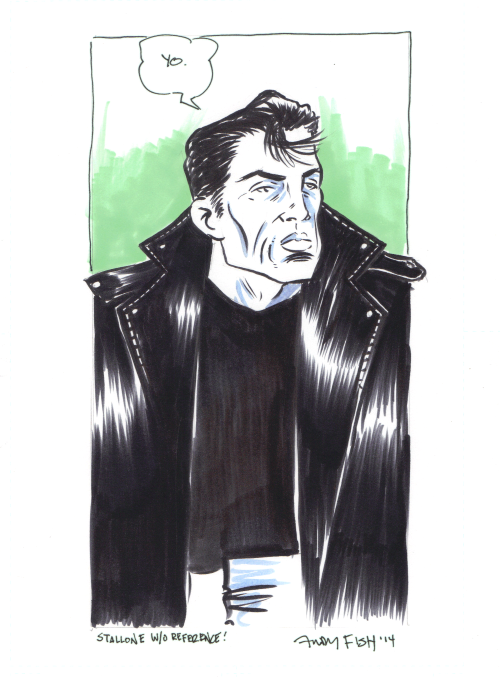
Thomas Boatwright Goes “Over the Top”

Thomas Boatwright is back and this time he went Over the Top!

Over the years I’ve gotten several Stallone pieces from Thomas.  Here is what has been posted so far… there are more to come.

If you’d like to see more of Thomas Boatwright’s art check out his blog and his DA site. Send him some love.

If you get commissions, you should consider a piece from Thomas. He keeps you totally in the loop on his progress, finishes his commissions on or ahead of schedule, has very reasonable prices, is a fantastic artist and always gives you more than you’re expecting!   – Craig

14 Surprising Facts About “Say Anything”

Garin Pernia and Mental_Floss present 14 Surprising Facts About Say Anything.  Here are three of my favorites

1. CAMERON CROWE BASED THE SCRIPT ON A REAL-LIFE HEARTBREAK.
Until Say Anything…, Crowe hadn’t written a love story. He told the San Diego Union Tribunethat the movie’s “a love story for people who don’t say I love you” and in 2009 told the Los Angeles Times that, “It’s a very personal movie, and it reminds me of falling in love, falling out of love, and falling back in love with life and all the unexpected glories and pain that happen along the way.”

The “personal” part references his first love and heartbreak: “She fell for me, and I fell for her, but not at the same time,” Crowe said. “And yes, I used to drive by her house late at night, listening to music, feeling like a sap and somehow heroic at the same time. She was already with someone new, but I was going to wave the flag of our great love, even if I was the only one at the ceremony.”

4. IONE SKYE WAS THE OPPOSITE OF DIANE COURT.
The actress had trouble identifying with the A-student Diane Court because she wasn’t like that. “I wasn’t a good student,” she told the Los Angeles Times. “I grew up with my mother, not my father. I kind of had a wild childhood. Even the father stealing money from old people, I was saying to Cameron, ‘I can’t access why this would upset me.’ That didn’t seem bad to me at the time.” Skye’s real-life father is famed Scottish musician Donovan. Two years after the movie came out, Skye married Beastie Boy Adam Horovitz; the couple divorced him in 1999.

13. A SITCOM VERSION OF SAY ANYTHING… WAS IN THE WORKS, UNTIL CROWE PUT A STOP TO IT.
In 2014, Fox gave the green light for producers to adapt the movie into a single-camera TV sitcom that would take place 10 years after the film’s events, but they apparently didn’t bother to ask Crowe for his blessing. Once Crowe found out about it, he tweeted his dismay about the project and said, “I have no involvement … except in trying to stop it.” Cusack also cried foul about the project; the backlash prevailed and the project was canceled.

20 Facts About Your Favorite Quentin Tarantino Movies

Mental_Floss presents 20 Facts About Your Favorite Quentin Tarantino Movies.  Here are three of my favorites

10. MICHAEL KEATON PLAYED HIS JACKIE BROWN CHARACTER IN ANOTHER MOVIE.
Keaton plays FBI agent Ray Nicolette in Jackie Brown. One year later, he reprised the role for Steven Soderbergh’s Out of Sight (both movies were based on Elmore Leonard novels).

5. THE CONCEPT FOR DEATH PROOF GREW OUT OF TARANTINO’S DESIRE TO BUY A VOLVO.
In a 2007 interview with Newsweek, Tarantino explained the genesis of the idea for Death Proof, the director’s half of Grindhouse: “About 10 years ago, I was talking to a friend about getting a car. And I wanted to get a Volvo because I wanted a really safe car. I remember thinking that I didn’t want to die in some auto accident like the one in Pulp Fiction … So I was talking to my friend about this, and he said, ‘Well, you could take any car and give it to a stunt team, and for $10,000 or $15,000, they can death-proof it for you.’ Well, that phrase ‘death proof’ kinda stuck in my head.”

11. TARANTINO DIRECTED RESERVOIR DOGS BECAUSE TONY SCOTT DIDN’T.
Because he was still new to the business, Tarantino knew he couldn’t direct both True Romance and Reservoir Dogs. So he gave both scripts to Tony Scott and told him to pick one. Though Scott wanted both of the films, he ended up choosing True Romance, leaving Tarantino to make Reservoir Dogs.

17 Truthful Facts About “A Few Good Men”

Roger Cormier and Mental_Floss present 17 Truthful Facts About A Few Good Men.  Here are three of my favorites

2. LINDA HAMILTON AND JODIE FOSTER AUDITIONED FOR THE ROLE OF LT. COMMANDER GALLOWAY.
A then-eight-months-pregnant Demi Moore ended up getting the part, and was paid $2 million for the role.

3. JASON ALEXANDER WAS SET TO PLAY LT. SAM WEINBERG.
But when Seinfeld was renewed by NBC for a second season, he was no longer available. Reiner then gave Kevin Pollak the part after he read with Cruise.

8. JACK NICHOLSON WAS PAID $5 MILLION FOR 10 DAYS OF WORK.
Nicholson, as Colonel Nathan R. Jessup, was in just three scenes in the entire movie. Technically he worked an extra morning for free when Reiner and crew didn’t get all of his footage shot in time.

Editors Guild Selects 75 Best Edited Films of All Time

ComingSoon posted Editors Guild Selects 75 Best Edited Films of All Time.  Movie editors selected their choices for the best edited movies of all time [hence the title, right?].

The decade of the 70’s led the way with director Alfred Hitchcock coming in first spot with five films and editor George Tomasini coming in number one with four films.

Of the 75 films I’ve seen 56.

“In Cold Blood” (1967) written & directed by Richard Brooks, starring Robert Blake, Scott Wilson and John Forsythe / Z-View

In Cold Blood (1967)

Director: Richard Brooks

Screenplay: Richard Brooks (based on Truman Capote’s book of the same name)

Stars: Robert Blake, Scott Wilson and John Forsythe

The Pitch: “Let’s make a movie based on the best-selling book In Cold Blood!”

The Tagline: “Written for the screen and directed by Richard Brooks.”


The Overview:  Beware of Spoilers…

Dick Hickcock [Scott Wilsion] and Perry Smith [Robert Blake Perry] have a plan to steal $10,000 cash from a rich farmer’s safe and then high-tail it to Mexico where they will live out their days safe from extradition.  The two ex-cons violate their parole and drive through the night to Holcomb, Kansas where according to one of Hickcock’s past cellmates, a fortune sits in the Cutter safe.

 The only thing Hickcock and Smith find at the Cutter house are Mr. Cutter, Mrs. Cutter and their two teenage children.  Hickcock and Smith place the family members in separate rooms, tie them up and search for the safe.  There is no safe, no fortune and just a little over forty dollars in cash in the house. Hickcock and Smith brutally kill the Cutter family and then head back towards Kansas City.

The discovery that the Cutter family was brutally murdered makes national news and as the investigation grows, Hickcock and Smith decide to head to Mexico.  They pass bad checks, pawn the items they buy and use the money to get across the border.  It isn’t long before they’re low on cash and decide to go to Vegas to raise more. In Vegas  Hickcock and Smith are picked up on a parole violation.

The cops interrogate them separately.  Neither admits to knowing anything about the Cutter family murders.  As the evidence begins to pile up, Hickcock suddenly tries to pin the murders on SmithSmith then turns on Hickcock and the case is made.  A trial, a death sentence and the gallows are all that Hickcock and Smith have left to look forward to.  Sadly, one is left with the feeling that either man alone would not have committed the murders.

Wilson (probably best known to folks as Hershel from The Walking Dead) and Blake (probably best known as the crazy old celebrity acquitted of killing his second wife in 2005) are excellent as the leads.  Robert Brooks deserves kudos for his screenplay and direction.

Watch for cameos by: Will Geer [Grandpa from The Waltons] and music by Quincy Jones!

Award Nominations:

Academy Awards –

  • Best Director
  • Best Cinematography
  • Best Original Music Score
  • Best Adapted Screenplay

Rating:

Z-View: “Anatomy of a Murder”

Anatomy of a Murder (1959)

Director: Otto Preminger

Screenplay: Wendell Mayes, John D. Voelker (based on his novel written as Robert Traver)

Stars: James Stewart, Lee Remick, Ben Gazarra, Arthur O’Connell and George C. Scott

The Pitch: “Let’s make a movie based on the best-selling novel Anatomy of a Murder!”

The Tagline: “Last year’s No.1 best-seller … This year’s No.1 motion picture.”


The Overview:  Beware of Spoilers…

Stewart plays small town attorney Paul Biegler who’d rather be fishing than practicing law.  Biegler’s mentor is Parnell McCarthy (Arthur O’Connell) who’d rather be boozing it up than just about anything.  When Biegler is offered the chance to defend Fredrick Manion (Ben Gazara), against a murder charge, he sees it as a way to get McCarthy off the booze.  Manion is a soldier accused of murdering the man who raped his wife (Lee Remick).

We spend the first part of the movie learning about the case.

Biegler meets Manion, a quick-tempered, hard-to-like soldier who admits to killing the man who raped his wife about an hour after finding out about it.  This wasn’t a heat of the moment murder.  After meeting Manion’s wife who is sporting a beat-up face and a casual attitude, Biegler finds himself in a case where nothing is clear cut.

Manion is a jealous, thuggish man who likes his wife to dress provocatively and then gets jealous when men give her attention.  Laura Manion likes men, booze and fun.  Being married doesn’t stop her from having a good time where she can find it.  She married Manion three days after divorcing her first husband and admits that Manion was the reason for the divorce.

Was Laura raped?  She was beat-up, but did that happen during the rape or when he husband found out she had been with another man.  The clinical evidence is inconclusive.  Something happened but under what circumstances?

The second part of the movie takes us into the courtroom for one of the best courtroom dramas ever filmed.

The acting across the board is excellent.  Stewart (Best Actor), O’Connell (Best Supporting Actor) and Scott (Best Supporting Actor) were all nominated for Academy Awards.  I’m surprised Lee Remick wasn’t as well, because she is that good.  The film went on to be nominated for seven Oscars as well as other honors.

To the movie’s credit, the jury comes back with a verdict, but knowing the evidence of the case and the things that we see that the jury doesn’t, the audience may come away with a different verdict.  At the very least, there is room for discussion.

The last scene is a treat and adds another layer to the puzzle.

Watch for cameos by: Howard McNear [Floyd the Barber from The Andy Griffith Show] and Duke Ellington!

Awards Won:

New York Film Critics Circle Awards –

  • Best Actor, James Stewart
  • Best Screenplay, Wendell Mayes; 1959.

Venice International Film Festival –  

  • Volpi Cup
  • Best Actor, James Stewart; 1959.

Grammy Awards –

  • Best Performance by a Dance Band
  • Best Musical Composition First Recorded and Released in 1959
  • Best Sound Track Album.

Producers Guild of America Awards –  

  • Top Drama
  • Top Male Dramatic Performance, James Stewart
  • Top Male Supporting Performance, Arthur O’Connell; 1960.


Award Nominations:

Academy Awards –

  • Best Actor in a Leading Role: James Stewart
  • Best Actor in a Supporting Role: Arthur O’Connell
  • Best Actor in a Supporting Role: George C. Scott
  • Best Cinematography, Black-and-White: Sam Leavitt
  • Best Film Editing: Louis R. Loeffler
  • Best Picture: Otto Preminger
  • Best Writing, Screenplay Based on Material from Another Medium: Wendell Mayes; 1960

British Academy Film Awards –

  • Best Film from any Source Otto Preminger, USA
  • Best Foreign Actor James Stewart, USA
  • Most Promising Newcomer Joseph N. Welch, USA; 1960.

Directors Guild of America Awards –

  • DGA Award Outstanding Directorial Achievement in Feature Film, Otto Preminger; 1960.

Golden Globe Awards –

  • Best Motion Picture – Drama
  • Best Performance By An Actress In A Motion Picture – Drama: Lee Remick
  • Best Director – Motion Picture: Otto Preminger
  • Best Performance By An Actor In A Supporting Role In A Motion Picture: Joseph N. Welch; 1960.

Rating:

10 Wild Facts About “Butch Cassidy and The Sundance Kid”

Eric D. Snider and Mental_Floss present 10 Wild Facts About Butch Cassidy and The Sundance Kid.  Here are three of my favorites

2. PAUL NEWMAN WAS IN FROM THE BEGINNING, BUT FINDING HIS CO-STAR TOOK SOME WORK.

When he wrote it, Goldman had in mind Newman—then perhaps the biggest movie star in the world—and Jack Lemmon, who’d done a 1958 Western called Cowboy and seemed like a good fit. Lemmon turned out not to be interested, and numerous other candidates were approached, including Steve McQueen (see below), Warren Beatty, and Marlon Brando. Newman’s wife, Joanne Woodward, suggested Robert Redford, a stage actor who’d been in a few films but was considered something of a lightweight. Woodward, Newman, and director George Roy Hill all pestered the reluctant 20th Century Fox bosses until they conceded to casting Redford.

4. STEVE MCQUEEN DROPPED OUT OVER BILLING.

If Newman was the biggest movie star in the world at the time, Steve McQueen was right up there with him. The idea of casting not one but two mega-stars as Butch and Sundance made perfect sense, but there was a problem: whose name would go first in the credits? Fox president Darryl F. Zanuck later said that he proposed an unusual arrangement where half the prints of the film would list Newman first, the other half McQueen, but McQueen (or his representatives) wouldn’t accept anything other than top billing across the board. And that was that.

5. IT WAS “THE SUNDANCE KID AND BUTCH CASSIDY” UNTIL THE CASTING WAS SETTLED.

Once they’d settled on Redford as Newman’s costar, a new (minor) issue arose. Newman thought he was playing Sundance in what had heretofore been known as The Sundance Kid and Butch Cassidy. It turned out Hill, the director, actually wanted him to play Butch, and Redford to play Sundance. No problem; Newman was fine with the switch. But now they had a situation where the character being played by the less-famous actor came first in the title. The obvious Hollywood solution: reverse the title. “The Sundance Kid and Butch Cassidy” sounds weird to us now (as does the notion of Redford being significantly less famous than Newman), but there you go.

10 Fascinating Facts About “Thunderball”

Matthew Jackson and Mental_Floss present 10 Fascinating Facts About Thunderball.  Here are three of my favorites

1. IT STARTED AS A FILM, THEN BECAME A BOOK, THEN BECAME A FILM AGAIN.

In 1959, Bond creator Ian Fleming began considering a film version of his character, andcollaborated with producer Kevin McClory and writer Jack Whittingham on a screenplay treatment. Fleming eventually tired of the movie business, and went back home to Jamaica to write his next Bond novel, Thunderball. McClory later sued, claiming the novel used elements from the film they’d worked on together. The suit settled out of court, but McClory was granted certain rights to Thunderball in the process, and ultimately served as a producer on the movie. Nearly two decades after Thunderball was released, he served as an executive producer on Never Say Never Again, a Bond film that saw the return of Sean Connery in the title role for the first time in more than a decade (produced by Warner Bros. and not Bond’s home studio of MGM). The plot is in many ways identical to Thunderball.

4. THE JETPACK REALLY WORKED, BUT THE PILOT WOULDN’T FLY WITHOUT A HELMET. 

The Bell Rocket Belt used in the film’s opening sequence was a real working jetpack, and two qualified pilots were flown to France to operate it for the moment when Bond lifts off. Bill Suitor, who flew the jetpack on camera, was initially asked if he would mind flying without a helmet so that Bond could look cooler. Suitor refused for safety reasons, which is why Connery wore a helmet in the final film.

6. THE BRITISH MILITARY THOUGHT BOND’S MINIATURE OXYGEN TANK WAS REAL. 

Early in the film, Q gives Bond a tiny breathing apparatus that allows him to survive underwater for several minutes, and Bond puts it to good use when trapped in a closed pool with a bunch of sharks. The scene was so convincing that a member of the Royal Engineers called chief draftsman Peter Lamont and asked him how long the apparatus actually worked. Lamont replied “as long as you can hold your breath.” When the engineer countered that Bond was underwater for several minutes onscreen, Lamont replied it was “the skill of the editor.” The engineer eventually hung up.

21 Things We Learned from the “Reindeer Games” Commentary

Rob Hunter and Film School Rejects present 21 Things We Learned from the Reindeer Games Commentary.  Here are three of my favorites

1.    Test screenings resulted in audience feedback that was “not bad, but not what the producers had expected,” and it led to immediate pressure on Frankenheimer to cut the film. The distributors believed the issue was entirely due to length. “In retrospect, I should not have cut the movie.” He believes the theatrical release lost a lot of its edge.

2.    Re-shoots inspired by audience reactions at test screenings took more time than planned and left them unable to open during the holiday season. Frankenheimer regrets that decision and would have rather skipped the re-shoots so they could have opened in December. “We missed our optimum time to play the movie.”

17.    The scene where Rudy and Ashley fall through the ice was filmed in a field. They dug a hole, filled it with warm water, and added plastic “ice” over it. The underwater scenes were filmed in a tank. Frankenheimer says it’s preferable to the way he did it on 1990’s The Fourth War in which he actually dropped Roy Scheider and Jurgen Prochnow into icy water.