“Dumb & Dumber” Trailer as an Oscar-Worthy Drama!

Music and editing impact a movie so much. Don’t believe it? Check out Dumb & Dumber as an Oscar-Worthy Drama!
Previews and Reviews that are Z's Views
Music and editing impact a movie so much. Don’t believe it? Check out Dumb & Dumber as an Oscar-Worthy Drama!

Mark Mancini and Mental_Floss present 10 Witty Facts About The Marx Brothers. Here are three of my favorites…
2. THEY RECEIVED THEIR STAGE NAMES DURING A POKER GAME.
In May of 1914, the five Marxes were playing cards with standup comedian Art Fisher. Inspired by a popular comic strip character known as “Sherlocko the Monk,” he decided that the boys could use some new nicknames. Leonard’s was a no-brainer. Given his girl-crazy, “chick-chasing” lifestyle, Fisher dubbed him “Chicko” (later, this was shortened to “Chico”). Arthur loved playing the harp and thus became “Harpo.” An affinity for soft gumshoes earned Milton the alias “Gummo.” Finally, Julius was both cynical and often seen wearing a “grouch bag”—wherein he’d store small objects like marbles and candy—around his neck. Thus, “Groucho” was born. For the record, nobody knows how Herbert Marx came to be known as “Zeppo.”
3. GROUCHO WORE HIS TRADEMARK GREASEPAINT MUSTACHE BECAUSE HE HATED MORE REALISTIC MODELS.
Phony, glue-on facial hair can be a pain to remove and reapply, so Groucho would simplypaint a ‘stache and some exaggerated eyebrows onto his face. However, the mustache he later rocked as the host of his famous quiz show You Bet Your Life was 100 percent real.
9. GROUCHO TEMPORARILY HOSTED THE TONIGHT SHOW.
Jack Paar bid the job farewell on March 29, 1962. Months before their star’s departure, NBCoffered Paar’s Tonight Show seat to Groucho, who had established himself as a razor-sharp, well-liked host during You Bet Your Life’s 14-year run. Though Marx turned the network down, he later served as a guest host for two weeks while Johnny Carson prepared to take over the gig. When Carson finally made his Tonight Show debut on October 1, it was Groucho whointroduced him.

Roger Cormier and Mental_Floss present 18 Simple Facts About Tropic Thunder. Here are three of my favorites…
3. ROBERT DOWNEY JR. BASED KIRK LAZARUS ON THREE ACTORS.
At a press conference, Downey said he based Lazarus on three actors: Russell Crowe and Daniel Day-Lewis, “with a little” Colin Farrell. Lazarus was originally written as Irish; Downey changed him into an Australian because he was more comfortable improvising in that accent. When Stiller first pitched the idea of the character, Downey called it “The stupidest idea I’ve ever heard!” Stiller screened the movie to the NAACP, and received mostly positive feedback.
5. TOM CRUISE CAME UP WITH THE IDEA OF HAVING A STUDIO HEAD CHARACTER.
Stiller approached Cruise about playing the agent Rick Peck and sent him the script. Cruise thought it was funny, but wondered what the studio would be doing while all of the film’s events transpired, so the role of studio head Les Grossman was created. It was also Cruise’s idea to give Grossman really big hands. After four days of makeup tests, Grossman’s look was finalized.
15. CRUISE’S INVOLVEMENT WAS MEANT TO BE A SURPRISE.
Cruise wasn’t in the trailer and no images of Grossman were in the press kits on purpose. Cruise’s lawyer threatened legal action to media outlets that posted leaked images of Cruise as Grossman before the movie debuted. It was traced back to an INF staff photographer.

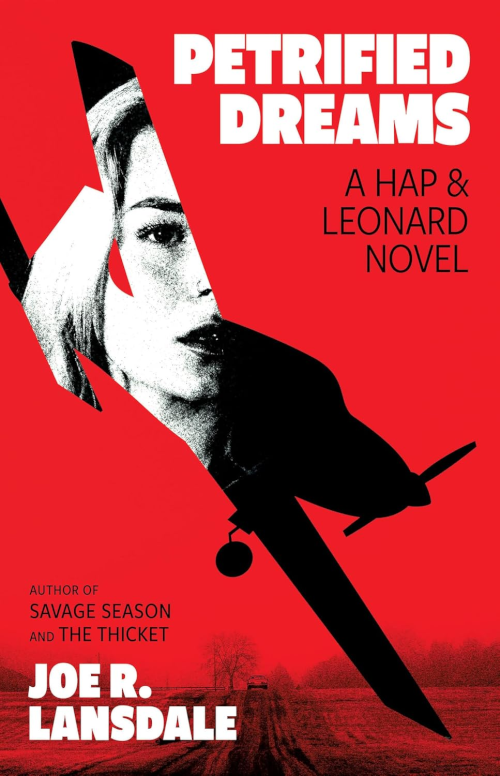
Hap and Leonard is a new series coming to the Sundance Channel.
Based on the novels by Joe Lansdale, Hap and Leonard stars James Purefoy (The Following), Michael Kenneth WIlliams (Boardwalk Empire) and Christina Hendricks (Mad Men).
The Wrap has some exclusive photos and The Sundance Channel has a trailer and more.

Garin Pernia and Mental_Floss present 14 Surprising Facts About Say Anything. Here are three of my favorites…
1. CAMERON CROWE BASED THE SCRIPT ON A REAL-LIFE HEARTBREAK.
Until Say Anything…, Crowe hadn’t written a love story. He told the San Diego Union Tribunethat the movie’s “a love story for people who don’t say I love you” and in 2009 told the Los Angeles Times that, “It’s a very personal movie, and it reminds me of falling in love, falling out of love, and falling back in love with life and all the unexpected glories and pain that happen along the way.”The “personal” part references his first love and heartbreak: “She fell for me, and I fell for her, but not at the same time,” Crowe said. “And yes, I used to drive by her house late at night, listening to music, feeling like a sap and somehow heroic at the same time. She was already with someone new, but I was going to wave the flag of our great love, even if I was the only one at the ceremony.”
4. IONE SKYE WAS THE OPPOSITE OF DIANE COURT.
The actress had trouble identifying with the A-student Diane Court because she wasn’t like that. “I wasn’t a good student,” she told the Los Angeles Times. “I grew up with my mother, not my father. I kind of had a wild childhood. Even the father stealing money from old people, I was saying to Cameron, ‘I can’t access why this would upset me.’ That didn’t seem bad to me at the time.” Skye’s real-life father is famed Scottish musician Donovan. Two years after the movie came out, Skye married Beastie Boy Adam Horovitz; the couple divorced him in 1999.
13. A SITCOM VERSION OF SAY ANYTHING… WAS IN THE WORKS, UNTIL CROWE PUT A STOP TO IT.
In 2014, Fox gave the green light for producers to adapt the movie into a single-camera TV sitcom that would take place 10 years after the film’s events, but they apparently didn’t bother to ask Crowe for his blessing. Once Crowe found out about it, he tweeted his dismay about the project and said, “I have no involvement … except in trying to stop it.” Cusack also cried foul about the project; the backlash prevailed and the project was canceled.

This is a really clever video using only movie titles for dialogue, it presents a clear story with a nice twist at the end.
More, please.

Meadow George Lemon III better known as “Meadowlark” Lemon of Harlem Globetrotters fame passed away today at the age of 83.
Meadowlark played “before Kings, Queens, Presidents, Popes,” and millions of fans in over 100 countries of the world during his career with the Globetrotters which ran from 1954 – 1979 and over 16,000 games. Dubbed the “Clown Prince of Basketball” Lemon became the face of the Globetrotters and one of the most recognized athletes in the world.
Lemon’s popularity led to commercials, tv and movie roles and two Harlem Globetrotter animated series. In 1993, fourteen years after retiring, Lemon returned to the Globetrotters for a 50 game come-back tour. In 2003, Lemon was inducted into the Naismith Memorial Basketball Hall of Fame which was just one of the many honor and awards Lemon earned throughout his life.
Lemon was a born-again Christian and in 1986 became an ordained minister.
Our thoughts and prayers go out to Meadow George Lemon III’s family, friends and fans.

Jennifer M. Wood and Mental_Floss present 14 Empowering Facts About 9 to 5. Here are three of my favorites…
2. IT WAS ORIGINALLY INTENDED TO BE A DRAMA.
Though it’s ranked number 74 on the American Film Institute’s list of the 100 Funniest American Movies of All Time, 9 to 5 didn’t start out as a comedy. “At first we were going to make a drama,” Fonda explained. “But any way we did it, it seemed too preachy, too much of a feminist line. I’d wanted to work with Lily [Tomlin] for some time, and it suddenly occurred to [producer] Bruce [Gilbert] and me that we should make it a comedy. It remains a ‘labor film,’ but I hope of a new kind, different from The Grapes of Wrath or Salt of the Earth. We took out a lot of stuff that was filmed, even stuff the director, Colin Higgins, thought worked but which I asked to have taken out. I’m just super-sensitive to anything that smacks of the soapbox or lecturing the audience.”
3. IT WAS A BLACK COMEDY BEFORE IT WAS A BROAD COMEDY.
“I had written a very dark comedy in which the secretaries actually tried to kill the boss, although they tried to kill him in sort of funny ways,” screenwriter Patricia Resnick told Rolling Stone. “Originally, Jane had been concerned that would be too dark. I screened an old Charlie Chaplin film called Monsieur Verdoux for her. In it, Chaplin’s wife is blind and he has a child. He’s kind of a Blackbeard, he romances a series of woman through the course of the movie and murders them in order to get money and support his family. It is a comedy, but at the end they hang him. I turned to Jane at the end of the movie and tears were rolling down her cheeks—but she was concerned the women wouldn’t be sympathetic enough. I said, ‘He really killed all these women and you’re crying. I just want them to try! They won’t be successful.’ And she said OK. But then when Colin came in, he was very influenced by Warner Bros. cartoons and things like that, and so their attempts to kill him became the fantasy scenes, and he made it a much broader comedy.”
8. PARTON WOULD ONLY STAR IN THE FILM IF SHE COULD WRITE THE THEME SONG.
Parton may have been a Hollywood newcomer, but she was savvy. She agreed to take the part in 9 to 5, but only if she could write the theme song as well. Fonda agreed, and Parton wrote the song while the movie was filming. In 1981, she earned an Oscar nomination for Best Original Song for “9 to 5.”
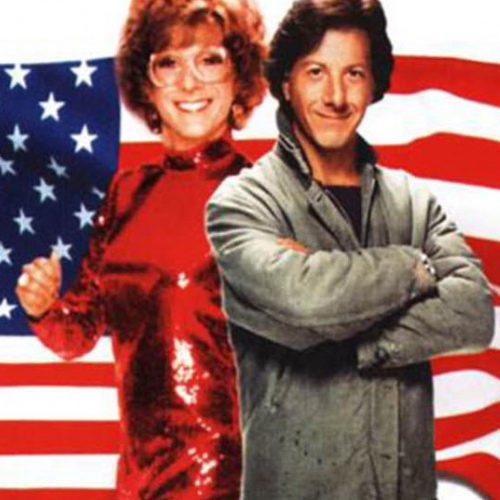
Roger Cormier and Mental_Floss present 16 Fun Facts About Tootsie. Here are three of my favorites…
13. IT WAS GEENA DAVIS’ FIRST MOVIE.
Davis landed the role of soap actress April Page despite never having auditioned for any other movie before. “But I didn’t know you’re only supposed to come on the days that you’re working,” Davis told The Frame. “And so I came every day for six weeks, because I thought that was just part of it. I’d get a chair and put it right next to Sydney Pollack and sit there all day.”14. BILL MURRAY INSISTED ON NOT BEING CREDITED.
Murray’s contract stipulated that he not be given any billing for the role, and Columbia agreed not to publicize his part in the film, because Murray thought it would be a “fun practical joke”to play. Hoffman insisted on casting Murray as his playwright roommate, even though Pollackwas unfamiliar with his work. Murray improvised most of his lines.10. POLLACK AND HOFFMAN HAD LOUD DISAGREEMENTS THROUGHOUT PRODUCTION.
The two would go to each other’s trailers, scream at one another, and then do it Pollack’s way (according to the late director). They had their biggest arguments on Mondays, because they had each separately been working on the script over the weekend.
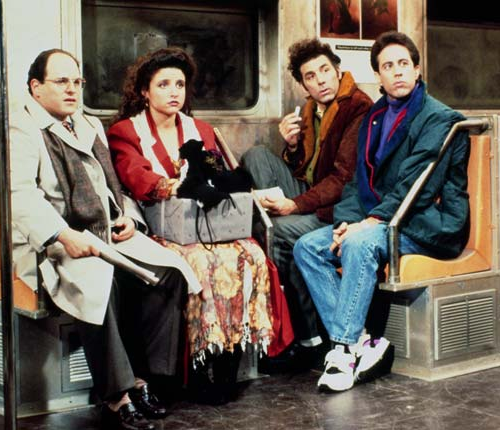
Worthy presents 20 of the Most Surprising Numbers About Seinfeld. Here are three of my favorites…
1. $40,000,
2. $1 million
3. $110 million
During the 1991 to 1992 season, Jerry Seinfeld was paid $40,000 per episode. During the show’s final season, 1997 to 1998, he was paid $1 million per episode. He was offered $110 million to do a tenth season, but he turned down NBC’s offer to continue. He decided that nine seasons completed the show, and that is another story about numbers that was revealed when Vanity Fair did a cover story of him in 1998 when the series finally ended. He was quoted as saying “Nine is cool.” He had discovered that the number nine means completion in numerology. Learning that the Beatles stayed together nine years and then broke up was also an inspiration to Seinfeld. It turns out that nine is also a highly significant number in his life:
• He was born in 1954 (5 plus 4 = 9).
• He graduated high school in 1972 (7 plus 2 = 9).
• His first Tonight Show appearance was in 1981 (8 plus 1 =9).
• His sitcom Seinfeld first aired in 1989 (1 plus 9 plus 8 plus 9 = 27; 2 plus 7 = 9).
• The show was shown at 9 P.M.
• The show ended in 1998, which also equals 27 and, of course 2 plus 7 =9.
Seinfeld also said that when he thought about the end of the show, he felt that nine was his number.
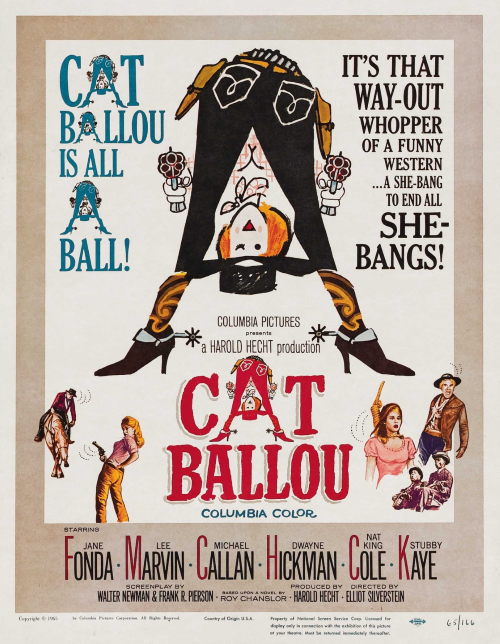
Cat Ballou [1965]
Director: Elliott Silversteen
Screenplay: Walter Newman and Frank Pierson from a novel by Roy Chanslor
Starring: Jane Fonda and Lee Marvin.
The Pitch: “Let’s make a funny western!”
The Tagline: “It’s That Way-Out Whopper Of A Funny Western…A She-Bang To End All She-Bangs!!”
The Overview: Beware of Spoilers…
If you’re going to make a funny western it needs to be two things: 1] A western and 2] funny. Cat Ballou manages to get one out of two right. It’s a western, but it’s not funny. Of course humor is all relative. If you’re a fan of the tv series F-Troup which premiered the same year and was set in the old west, you’ll definitely enjoy Cat Ballou more than I did.
Jane Fonda plays the daughter of a rancher who was killed by a hired gunfighter [played by Lee Marvin] for his land. Fonda sends for a gunfighter of her own and ends up with a drunk [also played by Lee Marvin] who shoots best when half lit.
The story is pretty much by-the-numbers except for the fact that every ten minutes or so there is the appearance of two minstrels [played by Nat “King” Cole and Stubby Kaye] who show up to sing us the next chorus of “The Ballad of Cat Ballou.”
Most folks enjoy this film more than me so remember your mileage could vary.

Rating:

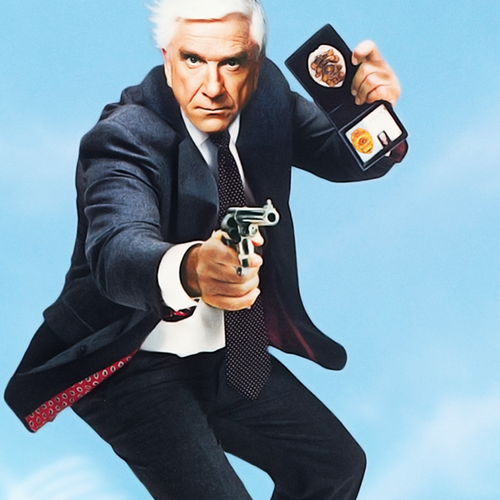
Roger Cormier and Mental_Floss present 18 Fun Facts About The Naked Gun. Here are three of my favorites…
6. THEY DREW FROM SEVERAL OLDER MOVIES.
The Charlotte Rampling and Robert Mitchum movie Farewell, My Lovely (1975) was where the scene of Priscilla Presley gliding down the stairs came from (the falling part was the comedic twist). The assassination attempt on Charles de Gaulle in The Day of the Jackal (1973) gave ZAZ the idea for the assassination plot against Queen Elizabeth II. Mad magazine, the Dirty Harry movies, and the cop series M Squad were other cited sources of satirization.8. IT WAS JOHN HOUSEMAN’S FINAL FILM ROLE.
Houseman played the middle finger-raising driving instructor. Houseman collaborated with Orson Welles on the infamous The War of the Worlds radio broadcast and on Citizen Kane. In 1974, he won a Best Supporting Acting Oscar for the his role in The Paper Chase. A week before The Naked Gun was released, Houseman also made a cameo in Scrooged.17. THE NAKED GUN THEME SONG PLAYED AT NIELSEN’S FUNERAL.
Nielsen passed away on November 28, 2010 at the age of 84 and was laid to rest in Fort Lauderdale. Dominik Hauser’s theme played as the Canadian Mounted Police carried his coffin.

The Cat and the Canary [1939]
Director: Elliott Nugent
Screenplay: Walter DeLeon and Lynn Starling based on the stage play by John Willard
Starring: Bob Hope and Paulette Goddard.
The Pitch: ”Hey, let’s team Bob Hope in a film with Paulette Goddard. We could do a remake of the 1927 silent film The Cat and the Canary which is based on the 1922 stage play of the same name.”
The Tagline: “A Chill-and-Chuckle Chase!… A Fortune at Stake and a Monster at Large!”
The Overview: Beware of Spoilers…
Ten years after the death of an eccentric millionaire, Cyrus Norman, his remaining family members are brought to his spooky-looking mansion deep in the bayou. Before the will is read, his former caretaker informs the group that the spirits have said one of them will die that night. Sadly there is no way to leave the mansion until the next day.
Norman left two wills: The first leaves everything to Paulette Goddard [much to the disappointment of all except Bob Hope]; the second will is to be opened only if Goddard dies or goes insane before the month is out. The second will leaves everything to one of the others [although who is unknown until Goddard dies] which of course puts Goddard’s life in danger. To make matters worse, the group learns that a homicidal maniac known as the Cat has escaped from a nearby insane asylum and is in the area.
As the night wears on things get progressively worse – lights go on and off, people disappear, real eyes in paintings are watching, secret passages are found and what? Someone has been murdered!

Rating:


Mark Mancini and Mental_Floss present 10 Back-And-Forth Facts About Abbott and Costello. Here are three of my favorites…
1. LOU COSTELLO WAS ONCE AN AMATEUR BOXER.
As a young competitor, Louis Cristillo fought in 12 matches under the alias “Lou King.” With 11 victories and one draw, Cristillo’s boxing career was off to an impressive start—until his father abruptly forced him into an early retirement. A multi-sport athlete, Cristillo could also light up a basketball court, despite his below-average height of 5’ 5”. In fact, he was once reportedly crowned Paterson, New Jersey’s foul shot champion.Athleticism would help Cristillo earn his first few Hollywood gigs. While struggling to become an actor during the late 1920s, he appeared as a stunt double in a handful of films, most notably The Trail of ’98 (1928). Unfortunately, Cristillo was seriously injured during that shoot and decided to move back east, where he planned on taking voice lessons. Since “talkies” were rising in popularity, this seemed like a smart move but Cristillo’s modest personal fortune only got him as far as St. Joseph, Missouri. It was there that he got his first taste of live theater and developed the bumbling persona he retained throughout his career. During this time, Cristillo chose yet another stage name: Lou Costello (a nod to silent film actress Helene Costello).
5. IN 1942, THEY RAISED $85 MILLION FOR AMERICA’S WAR EFFORT.
On their own dime, Abbott and Costello toured 78 cities in 34 days, with the proceeds funding Uncle Sam’s war bonds and stamps. En route, they were treated like national heroes—the good people of Lincoln even made them both honorary admirals in the fictitious Nebraska Navy.6. COSTELLO HATED THE SCRIPT FOR ABBOTT AND COSTELLO MEET FRANKENSTEIN.
Between 1940 and 1956, Abbott and Costello made nearly 40 movies together. By 1948, sheer overexposure weakened their popularity with filmgoers, who began to tire of their antics. Then along came this blockbuster horror-comedy, which rejuvenated the duo’s cinematic career and launched several genre-mixing follow-ups, including Abbott and Costello Meet the Invisible Man (1951), Abbott snf Costello Meet Dr. Jekyll and Mr. Hyde(1953), and Abbott & Costello Meet the Mummy (1955).However, Costello almost derailed Abbott and Costello Meet Frankenstein during pre-production. At one point, he barged into producer Robert Arthur’s office and claimed “My [five-year-old] daughter could write a better script than this. You’re not serious about making it, are you?” Arthur eventually calmed Costello by promising to hire the star’s favorite director, Charles Barton.