Category: Trivia

21 Things We Learned from “The Taking of Pelham One Two Three” Commentary

Rob Hunter and Film School Rejects present 21 Things We Learned from The Taking of Pelham One Two Three Commentary.  Here are three of my favorites…

7. The novel doesn’t spend much time at all with the transit cop character played here by Walter Matthau as Lt. Garber, and the book actually has a separate character named Garber as well. The actor loved the script, written by Peter Stone — who had written two previous films co-starring Matthau — and once he expressed interest they began beefing up the role.

19. Sargent recalled it being a “golden safety rule” during filming that no one get close to the electrified third rail despite the mostly confident belief that it was powered off by the transit authorities. There was apparently always a risk that someone might turn it back on again by accident or because they were unaware that it was off for a reason.

20. They rightly point out that today’s action films would rarely allow the villain to take his own life. “He would have to be shot eighteen times by Walter Matthau, and then fall and then a train would run him over, and that would propel him into the street where he’d get hit by a bus.”


9 Tough as Leather Facts About “Rawhide”

Me-TV presents 9 Tough as Leather Facts About Rawhide. Here are three of my favorites…

EASTWOOD WORE HIS ‘RAWHIDE’ BOOTS IN ‘UNFORGIVEN.’
No need for a wardrobe department when it comes to Clint. To bookend his career as a cowboy, Eastwood wore his same Rowdy Yates boots in his Oscar-winning 1992 masterpiece Unforgiven.

LOADS OF SOON-TO-BE-FAMOUS FACES APPEARED ON THE SHOW.
That’s Bewitched star Elizabeth Montgomery taking aim in “Incident at El Crucero,” in a guest role that would foreshadow her gig as Mrs. Sundance. Star Trek crew members Leonard Nimoy and DeForest Kelley appeared on the Western, too. Sitcom legends Buddy Ebsen, Barbara Eden, Alan Hale, Jr., June Lockhart, Gavin MacLeod, Marion Ross and William Schallert also pop up — just to name a few. Then there’s Martin Landau, Frankie Avalon, Anne Francis, Peter Lorre…

TWO EPISODES WERE SLAPPED TOGETHER TO FORM A MOVIE, UNTIL EASTWOOD PREVENTED ITS RELEASE.
Rawhide finished its run in the first week of 1966. By that year, Eastwood was a star of small and big screen. The classic Spaghetti Westerns A Fistful of Dollars (1964), For a Few Dollars More (1965) and The Good, the Bad and the Ugly (1966) revolutionized the genre. To further capitalize on Eastwood’s fame, Jolly Film, the studio behind A Fistful of Dollars, pieced together a couple old episodes of Rawhide, primarily “The Backshooter” with Louis Hayward and Slim Pickens, and labeled the flick The Magnificent Stranger, the original shooting title for A Fistful of Dollars. However, Eastwood sued and had the 1967 film withdrawn.

21 Things We Learned from Rob Reiner’s “Misery” Commentary

Rob Hunter and Film School Rejects present 21 Things We Learned from Rob Reiner’s Misery Commentary.  Here are three of my favorites…

2.  James Caan was not his first choice for the film, and he instead was turned down by Robert Redford, Warren Beatty, William Hurt (twice), Richard Dreyfuss, and others. “But at the end of the day you can’t imagine anybody else playing the part.”

13.  Bates was stage-trained and preferred excessive rehearsals while Caan is more “instinctive and naturalistic,” so they had to balance the rehearsal time to make it less than she wanted and more than he wanted.

18.  The novel has Annie chop off Paul’s feet and cauterize the stumps, but they opted to simply hobble him instead by having her break his feet with a sledgehammer. Their thinking was that they wanted him to be victorious in the end, and losing his feet would be too high of a price. “It was pretty darn painful to look at, so I don’t think we compromised it too much.”


The Making of the Spanish Language Version of “Dracula” (1931)

In 1931, as Universal Studios was preparing to film the now classic Dracula starring Bela Lugosi, it was decided that a Spanish version would be made at the same time.  Although the Spanish version would feature a different cast, the same screenplay and sets would be used as the English version.  Lugosi’s Dracula would film during the day and then that evening the Spanish crew would come in and film.  By all accounts the Spanish Dracula is excellent.

You can learn more about The Making of the Spanish Language Version of Dracula (1931) at Old Hollywood Films.

10 Things You Should Know About the Donner Party

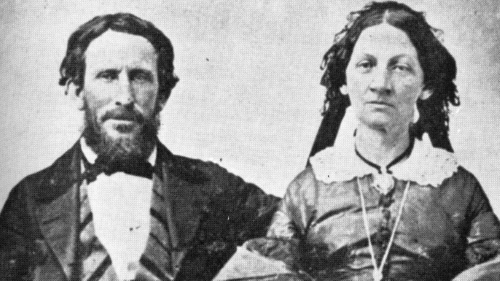
James and Margaret Reed, Donner Party members. (Credit: Public Domain)

In 1846, the Donner brothers led a wagon train of pioneers heading to California.  Caught in the Sierra Mountains in one of the worst winters ever recorded, the settlers were forced to hunker down.  As their food and supplies ran out, and over half of the party died, most of the survivors were forced to resort to cannibalism.

Evan Andrews and History.com present 10 Things You Should Know About the Donner Party.  Here are three of my favorites…

2.  They fell behind schedule after taking an untested shortcut.
After reaching Wyoming, most California-bound pioneers followed a route that swooped north through Idaho before turning south and moving across Nevada. In 1846, however, a dishonest guidebook author named Lansford Hastings was promoting a straighter and supposedly quicker path that cut through the Wasatch Mountains and across the Salt Lake Desert. There was just one problem: no one had ever traveled this “Hastings Cutoff” with wagons, not even Hastings himself. Despite the obvious risks—and against the warnings of James Clyman, an experienced mountain man—the 20 Donner Party wagons elected to break off from the usual route and gamble on Hastings’ back road. The decision proved disastrous. The emigrants were forced to blaze much of the trail themselves by cutting down trees, and they nearly died of thirst during a five-day crossing of the salt desert. Rather than saving them time, Hasting’s “shortcut” ended up adding nearly a month to the Donner Party’s journey.

7.  Not all of the emigrants engaged in cannibalism.
As their supplies dwindled, the Donner emigrants stranded at Truckee Lake resorted to eating increasingly grotesque meals. They slaughtered their pack animals, cooked their dogs, gnawed on leftover bones and even boiled the animal hide roofs of their cabins into a foul paste. Several people died from malnutrition, but the rest managed to subsist on morsels of boiled leather and tree bark until rescue parties arrived in February and March 1847. Not all of the settlers were strong enough to escape, however, and those left behind were forced to cannibalize the frozen corpses of their comrades while waiting for further help. All told, roughly half of the Donner Party’s survivors eventually resorted to eating human flesh.

9.  One rescuer singlehandedly led nine survivors out of the mountains.
Perhaps the most famous of the Donner Party’s saviors was John Stark, a burly California settler who took part in the third relief party. In early March 1847, he and two other rescuers stumbled upon 11 emigrants, mostly kids, who been left in the mountains by an earlier relief group. The two other rescuers each grabbed a single child and started hoofing it back down the slope, but Stark was unwilling to leave anyone behind. Instead, he rallied the weary adults, gathered the rest of the children and began guiding the group singlehandedly. Most of the kids were too weak to walk, so Stark took to carrying two of them at a time for a few yards, then setting them down in the snow and going back for others. He continued the grueling process all the way down the mountain, and eventually led all nine of his charges to safety. Speaking of the incident years later, one of the survivors credited her rescue to “nobody but God and Stark and the Virgin Mary.”

“The Thing” Got the Cinephilia & Beyond  Treatment.

John Carpenter / Horror fans are going to love it that The Thing Got the Cinephilia & Beyond  Treatment.

Click on the link and you’ll find…

  • the Original Script
  • John Carpenter interviewed by Erik Bauer, Creative Screenwriting, January/February 1999.
  • Dean Cundey ASC discusses the making of director John Carpenter’s 1982 sci-fi horror classic.
  • STARLOG 060—JOHN CARPENTER DIRECTING THE THING
  • STARLOG 058—BILL LANCASTER ON SCRIPTING THE THING
  • STARLOG 059—AN INTERVIEW WITH DP DEAN CUNDEY
  • JOHN CARPENTER WITH ENNIO MORRICONE
  • FANGORIA—THE THING ARTICLES
  • The Incredible Effects of The Thing, Cinefantastique issue
  • THE THING: STORYBOARDS
  • and much more!

34 Things We Learned from Matt Reeves’ ‘War for the Planet of the Apes’ Commentary

Rob Hunter and Film School Rejects present  34 Things We Learned from Matt Reeves’ ‘War for the Planet of the Apes’ Commentary.  Here are three of my favorites…

12. The “donkey” apes used by the humans are named not because they’re being used as animal workers (like I assumed) but as a reference to Donkey Kong.

15. The way the virus shifts after killing off 99.9% of humanity towards a mutation that leaves the survivors unable to speak was an idea that originated in the original Planet of the Apes franchise where the apes used mute humans as slave labor. Co-writer Mark Bomback researched viruses and discovered details on the Spanish flu that mutated into catatonia and other non-lethal physical effects. “The humans are beginning to devolve while the apes evolve.”
20. The Colonel’s (Woody Harrelson) greeting to Caesar includes a whole Wellington/Napoleon reference that was added by the actor himself. Reeves thought it wouldn’t work seeing as he’s speaking to an ape, so Harrelson added the “you’re probably not much of a reader” line. It was also his suggestion to shoot an ape early on to spur Caesar and the apes back to work.


The Art of the Sailor

When I was growing up the only people who had tattoos were sailors, marines, or circus folk.  Seems like almost everyone has some unique ink these days signifying something special to the wearer.

Back in the day a sailor’s tats had meaning and if you check out the chart above you’ll be in the know.  If you really dig the print by Lucy Bellwood you can get one here.

Source: Boingboing.

10 Things You Never Knew About “Maverick”

Me-TV posted 10 Things You Never Knew About Maverick.  Here are three of my favorites…

GARNER PLAYED BRET MAVERICK IN THREE DIFFERENT ‘MAVERICK’ TV SERIES.
It is the rare actor who can claim two iconic television characters and a successful big-screen career. Garner became a household name thanks to the witty and fun Maverick. The gambling Bret Maverick proved to be so beloved that numerous reboots followed over the decades. In 1979, a TV movie led to Young Maverick, an incredibly short-lived sequel that hardly featured Garner. In 1981, Maverick was dealt another hand in the series Bret Maverick. NBC surprisingly canceled the solidly performing show after a season.

THERE WAS A MASSIVE CROSSOVER EPISODE WITH OTHER WESTERNS.
The madcap season four episode “Hadley’s Hunters” trots out numerous cameos from other Warner Bros. Westerns. You can spot John Russell and Peter Brown from Lawman, Clint Walker from Cheyenne, Will Hutchins from Sugarfoot and Ty Hardin from Bronco. In addition, Edd Byrnes from 77 Sunset Strip also pops up — combing the mane of a horse called “77 Cherokee Strip.”

“SHADY DEAL AT SUNNY ACRES” WAS GARNER’S FAVORITE EPISODE.
Perhaps some of this had to do with the fact that Garner got to spend the episode comfortably whittling in a rocking chair. It’s also a flat-out brilliant piece of television, which carries many similarities to the classic film The Sting. Like we said, the outings with both Bret and Bart Maverick working together are quite special.


“Aliens” – 20 Facts You May Not Know

Neil Gaskin and Film ’89 present Fact File – No.1 – Aliens (1986).  Here are three of my favorites…

2. Sigourney Weaver salary for Aliens was 28 times more than that of the first film:  Weaver was paid $35,000 for the first film and $1 million for the sequel. (she went on to earn $4 million for Alien 3 and $11 million for Alien: Resurrection).

5. For a science fiction film, it did usually well at the Academy Awards:  Aliens was nominated for seven Academy Awards, including a Best Actress nomination for Sigourney Weaver. It unsurprisingly won for Sound Effects Editing and Visual Effects.

14. It was the last roll of the dice for one of its stars:  Lance Henriksen had privately pledged to quit acting if this part didn’t work out for him after years of journeyman roles. It proved to be one of his most successful films.

34 Things We Learned from Edgar Wright’s “Baby Driver” Commentary

Rob Hunter and Film School Rejects present 34 Things We Learned from Edgar Wright’s Baby Driver Commentary.  Here are three of my favorites…

10. Baby’s guardian, Joe, was written as a deaf African American man in his 80s, and CJ Jones was the only performer they auditioned who is actually deaf. “I started auditioning other very good actors who were pretending to be deaf, it made me feel immediately uncomfortable.”

13. The Michael Myers / Mike Myers mask gag originally featured two Halloween masks and one Austin Powers, but while Mike Myers had had granted permission “the Halloween people hadn’t said no, but they definitely hadn’t said yes.” Wright had to write an alternative for the scene and call Myers back to extend the permissions (for three masks). Myers shared a story with him about the first time he went to the bank with a paycheck from Saturday Night Live. It was made out to Michael Myers, and the teller said “Michael Myers? Are you gonna stab me?

21. The idea of having Doc’s nephew accompany Baby while casing the Post Office came from one of Wright’s interviews with ex-cons.


33 Things We Learned from the “Conan the Barbarian” Commentary

Kate Erbland and Film School Rejects present 33 Things We Learned from the Conan the Barbarian Commentary.  Here are three of my favorites…

The narration at the beginning of the film was intended to be for Schwarzenegger. Milius points out that certain executives at Universal – he doesn’t name any names – didn’t trust Schwarzenegger, and there were concerns about his accent. “I said, ‘Of course, he has an accent. That’s why he’s Arnold.’,” says the director.

Milius hired actors to play against Schwarzenegger specifically based on their size, as he didn’t want many of Conan’s enemies to be smaller than he was. The director felt it helped build Conan as this iconic hero if he continuously took on and bested men who were much larger. “To have an opponent for Arnold, the guy has to be huge,” says Milius. Even James Earl Jones and Max Von Sydow are taller than the 6’2″ Schwarzenegger.

Executive producer Dino De Laurentiis wanted Milius to take out the scene with Conan, Valeria, and Subotai getting drunk in an inn, because he didn’t think it was dignified enough for the characters, particularly Conan. “The idea is that it’s great. They aren’t dignified. They have money, and they’re totally drunk and excited with power,” explains Milius. De Laurentiis especially didn’t like the shot where Conan passes out in his soup. “It’s like an Alka-Seltzer commercial,” says Schwarzenegger.


58 Things We Learned from James Gunn’s “Guardians of the Galaxy Vol. 2” Commentary

Rob Hunter and Film School Rejects present 58 Things We Learned from James Gunn’s Guardians of the Galaxy Vol. 2 Commentary.  Here are three of my favorites…

24. Glen Campbell’s “Southern Nights” was one of his favorite songs as a child, and he recalls the joy of attending a 4th of July party a couple years ago “at Jane Seymour’s house of all places” where he got to meet Campbell and listen to some live music from the man.

42. Stan Lee with the Watchers “doesn’t mean Stan Lee is a Watcher,”, but “who knows what Stan Lee is.”

55. Stallone asked how his line at Yondu’s viking funeral should be delivered, and Gunn replied “‘Have you seen the movie Babe?’ and he said ‘Yeah!’ I’m like this is you saying ‘That’ll do pig.’” My favorite part of this anecdote is the image of Stallone watching Babe.


23 Things We Learned from Ridley Scott’s ‘Alien Covenant’ Commentary

Rob Hunter and Film School Rejects present 23 Things We Learned from Ridley Scott’s Alien Covenant Commentary.  Here are three of my favorites…

9.   At 24:26 he acknowledges this is the “same plot as the original Alien, there’s a transmission, they go and find out.”

11.   Astronauts and NASA scientists have told him that they sometimes get ideas from science fiction films because filmmakers have thought their way around problems in ways that they themselves don’t.

14. More than once Scott says he’s going to hold back from saying something so as not to spoil it for listeners — as if people are listening to the commentary for their first watch of the film.