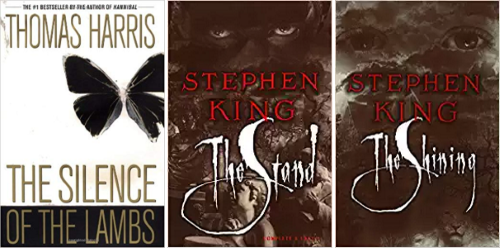
Steve Foxe and the Paste Staff recently posted their choices for The 50 Best Horror Novels of All Time. Here are three of my favorites…
22. The Silence of the Lambs by Thomas Harris (1988)
It’s a little odd getting around The Silence of the Lambs’ third-person present tense: “Starling looks down the corridor,” etc., but once you get used to it, it’s a device that ends up perfectly suiting the novel. The narrator’s impartial voice floats above the proceedings, never siding with one character or settling exclusively onto their perspective—at times, the third-person narration gives us glimpses into the minds of Clarice Starling, Hannibal Lecter and Buffalo Bill. What the novel also does particularly well is make us probe into the motivations and ambition of Starling, going beyond her desire to simply help people and catch a killer. Opposed at nearly every turn by the institutional roadblocks erected in the path of female FBI trainees, the reader can sense the desperation of Starling and her borderline selfish desire to stand out and prove herself to her entirely male superiors. You can also sense this is part of the reason that Lecter takes an interest in her, finding her ambitions an interesting character trait that he can use to wrap Starling around his finger. This is actually one of the cases where it’s helpful to have seen the film in advance, because you can read Lecter’s dialogue and imagine it being delivered by Sir Anthony Hopkins. That’s a damn good combination to make for a compelling reading experience. —Jim Vorel
19. The Stand by Stephen King (1978)
Stephen King’s magnum opus nearly didn’t make this countdown, fitting, as it does, more neatly into post-apocalyptic fiction or fantasy. At over 800 pages (more, if you’re reading the uncut edition), The Stand includes as much horror as any of King’s other novels, spurred by a viral outbreak that kills off 99.4% of the population. World-ending scenarios were on everyone’s minds in the ‘70s and ‘80s, as global tensions escalated and means of mass destruction proliferated. King isn’t content to simply explore a post-pandemic wasteland, though; The Stand is his most epic standoff between good and evil, the latter concept embodied by Randall Flagg, a recurring antagonist of King’s who becomes essential to the sprawling Dark Tower saga. Knowledge of that series isn’t necessary to undertake The Stand—just a month or so of dedicated reading time, and a hearty resistance to nightmares. —Steve Foxe
8. The Shining by Stephen King (1977)
For most modern readers, legendary director Stanley Kubrick’s stay at the Overlook Hotel looms large over Stephen King’s original novel. Nearly all of the moments lodged in the public consciousness—everything you’ve seen parodied on The Simpsons—are only in the film: the elevator of blood, the ghoulish twin girls, the typewriter, “Here’s Johnny!” Pushing past these iconic bits of pop culture reveals one of King’s greatest accomplishments, a hauntingly compelling look at a troubled man’s descent into madness. King’s novel is more sympathetic toward Jack Torrance, a recovering alcoholic writer (sound familiar?) trying to improve his family’s life by taking a job as caretaker of a remote off-season resort with a barely concealed violent history. The house wants Danny, Jack’s gifted young son, and puts the Torrance family through hell to get to him. King infamously hates Kubrick’s adaptation, and while it’s hard to debate the film’s quality or place in the horror movie pantheon, the novel is the more nuanced and, arguably, scarier version of the story, topiary monsters and all. —Steve Foxe