Jon Bernthal Interview

If you’re a fan of Jon [The Walking Dead; Sicario; Fury, Daredevil, Grudge Match, Mob City and, well, you get the idea…] Bernthal the you’ll probably want to check out Capone’s interview with him.
Source: Ain’t It Cool News.
Previews and Reviews that are Z's Views
If you’re a fan of Jon [The Walking Dead; Sicario; Fury, Daredevil, Grudge Match, Mob City and, well, you get the idea…] Bernthal the you’ll probably want to check out Capone’s interview with him.
Source: Ain’t It Cool News.

Darwyn Cooke’s James Bond painting must have a double-O license because it kills.
The Bond piece was created for the Lakes International Comics Art Festival and you can see a bigger version here.

Kara Kovalchik and Mental_Floss present 15 Awfully Big Facts About The Mary Tyler Moore Show. Here are three of my favorites…
4. GAVIN MACLEOD AUDITIONED FOR THE ROLE OF LOU GRANT.
Allan See started losing his hair at age 18, while he was studying drama at New York’s Ithaca College. By the time he graduated he was pretty much bald, which limited his roles as an actor. He changed his name to Gavin MacLeod and maintained a fairly steady career playing heavies, thanks to his bald pate and bulky physique. MTM co-founder Grant Tinker invited MacLeod to audition for the role of Lou Grant, which he did, but afterward he asked to read for the role of Mary’s co-worker, Murray Slaughter. He thought he could bring more to the affable Murray character than the gruff and imposing Lou. The producers agreed with him after Ed Asner tested for the role of Mary’s boss.6. TED KNIGHT WAS LIVING PAYCHECK-TO-PAYCHECK WHEN HE WAS CAST AS TED BAXTER.
The second choice for the role of the anchorman was Lyle Waggoner, but he was happily ensconced on The Carol Burnett Show and had no desire to leave a successful series for an untested one. Jennifer Aniston’s father, John, read for the part of Ted and was called back twice, but the producers were not quite sure he was “the one.” Producer Dave Davis happened to see Ted Knight performing in a local production of the Broadway comedy You Know I Can’t Hear You When the Water’s Running and reported to the rest of the team that Knight was hilarious and that they should have him read for the role of Ted Baxter.Even though the silver-haired Knight was a far cry from the hunky heartthrob-type they originally had in mind, Knight came to the audition wearing an anchorman-style blue blazer he had purchased from a thrift store with part of his rent money and impressed them with his booming voice and comedic chops. During that brief reading, he brought some layers to the anchorman character (cocky and arrogant on the outside, but secretly vulnerable and very human) that impressed the MTM staff and inspired some new newsroom story ideas for the show.
14. MARY REALLY DID HAVE TO STRUGGLE TO KEEP A STRAIGHT FACE DURING THE “CHUCKLES BITES THE DUST” EPISODE.
Often listed as one of the best sitcom episodes, this entry touched on a dark subject: the death of WJM children’s show host Chuckles the Clown. (He’d been dressed as Peter Peanut to serve as Grand Marshall of a circus parade and a rogue elephant tried to shell him.) Mary was supposed to remain grim and mournful while the rest of the newsroom made jokes about his unusual demise, but during every rehearsal she continually cracked up whenever Mr. Fee-Fi-Fo (one of Chuckles’ many characters) was mentioned. She recalled in her autobiography that the insides of her cheeks were almost raw from biting them so hard to keep from laughing during the actual taping of the episode.

Amy Sachs and Bustle present 11 Books That Scared the Master of Horror, Stephen King.
I haven’t read any of ’em. There are a few on King’s list I will want to check out. Truth be told, I’m still working my way through about four book cases full of books to be read… with more than a couple by Stephen King. (Of course there’s always room for another books to be read book case — just don’t tell my wife.)


Frank Miller is an artist whose style continued to evolve throughout his career.
It’s no secret I’m a huge Frank Miller fan. His work on Daredevil, Ronin, Dark Knight and Sin City are some of the best (and my favorite) comics of all time. I’ve enjoyed the ride and seeing the changes in his artistic choices.

Frank Miller and Dick Giordano’s Superman & Batman drawn in 1983.

If you’re a fan of Andy Weir’s novel, The Martian, or the Matt Damon movie adaptation [or like many of us, both] you’ll probably enjoy the extended interview with Mr. Weir conducted by Adam Savage.

Dario Rossi is a street performer from Amsterdam, The Netherlands. Rossi uses items he finds thrown out to make his drum sets and he’s really good.

Kara Kovalchik and Mental_Floss present 15 Behind-the-Scenes Facts About Taxi. Here are three of my favorites…
2. TONY DANZA WAS “DISCOVERED” IN THE BOXING RING.
In the mid-1970s “Tough” Tony Danza was a professional boxer who trained at Gleason’s Gym in Brooklyn. Gleason’s was home to many famous fighters, and the go-to place for filmmakers and authors who were researching the sport. That was how producers Larry Gordon and Joel Silver happened to be ringside one night when Danza knocked out Billy Perez and they invited him to audition for Walter Hill’s The Warriors, which they were producing. He was just about ready to ink a deal with them, too, when James L. Brooks called and asked him to read for the part of a boxer on his upcoming sitcom, Taxi.9. KAUFMAN’S CONTRACT STIPULATED THAT HIS ALTER EGO, TONY CLIFTON, WAS GIVEN A SEPARATE CONTRACT.
Tony Clifton was another of Kaufman’s characters, a sleazy, obnoxious Vegas lounge-lizard. Kaufman insisted not only that Tony Clifton be written into several Taxi episodes, he also insisted that Clifton be treated as a separate and unique entity, with his own contract, dressing room, and parking spot. Kaufman also required that all the staff and actors address him as “Tony,” never “Andy.”Clifton was cast as Louie’s brother in the episode “A Full House for Christmas,” and he didn’t endear himself to the cast when he arrived late and then retreated to his dressing room for over an hour to have very loud sex with two prostitutes he had brought with him. When rehearsals finally got underway, Tony kept changing the dialogue and announced that he’d written parts for his hooker friends as well. Jeff Conaway stormed off the set and Judd Hirsch got into a shouting match with Tony that ended up with punches thrown. Ed. Weinberger summoned security guards to escort Tony Clifton off the Paramount lot, which Andy Kaufman later stated had been his entire purpose behind that bit of “theater.”
10. REVEREND JIM’S LOOPY CHARACTER WAS ORIGINALLY ASSIGNED TO TONY.
The evolution of the show’s characters got a little confusing: In the beginning, Phil Ryan (the boxer) was supposed to be somewhat punch drunk and dim-witted. When Tony Danza was hired, the producers decided that he was more convincing playing a young, somewhat naive and innocent type, rather than a confused bumbler. Problem was, Randall Carver had already been cast as John Burns, a wide-eyed country bumpkin new to New York City. As season one progressed, the producers realized that the two characters were too similar and their lines were almost interchangeable. So John Burns was written out after the first season and Christopher Lloyd, who played 1960s drug casualty Reverend Jim Ignatowski, was added to the cast to provide the eccentric goofiness originally intended for Tony Banta.

The Dark Knight vs The Joker by Kelley Jones!

Kara Kovalchik and Mental_Floss present 10 Dangerous Toys from Decades Past (and the Commercials that Sold Them).
Of the ten shown I had (or at least played with) Sixfinger, Slip ‘N Slide, Water Wiggle, Johnny Seven One Man Army, Creepy Crawlers, Wham-O Air Blaster, Wham-O Wheeler Bar and Super Elastic Bubble Plastic. My favorite was the Johnny Seven One Man Army. The most dangerous was probably the Creepy Crawlers (that metal got hot!).
I loved seeing these commercials again. Click over and check them out for a laugh. Ah, the golden days of youth.

A new photo of Jesse James has surfaced. Not only that, but James is seated next to Robert Ford, the “coward” who shot James in the back.
Lois Gibson, a forensic analyst who has compared the “new” photo to other verified images of James has given it her seal of approval. If this photo turns out to be legit, then the owner, Sandy Mills, will make out like a, uh… bandit, when she decides to sell it.
Source: Mental_Floss.

Although I grew up in the 60’s and 70’s, I never carried a lunchbox. I either ate at home or bought a school lunch.
However, it was the golden age for cool lunchboxes as you’ll see if you check out Maribeth Keane and Lisa Hix’s look at Vintage 1970’s Lunch Boxes: When Pop Culture Ruled the Playground.

Source: Mental_Floss.

Last month I posted a link to two dozen painted covers by Neal Adams or Boris done for the Edgar Rice Burroughs’ Tarzan paperback series posted by The Golden Age.
Today we have a link to an interview with Neal Adams explaining how he came to get the Tarzan covers assignment and why he didn’t do all 24.

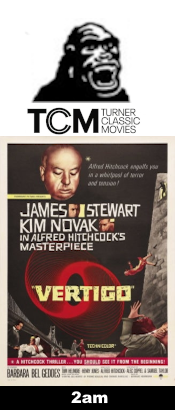
Tara Aquino and Mental_Floss present 11 Dizzying Facts About Vertigo. Here are three of my favorites…
1. ALFRED HITCHCOCK BLAMED JIMMY STEWART FOR VERTIGO’S FAILURE.
Marred by mixed reviews, the $2.5 million Vertigo did comparatively less than Hitchcock’s previous movies, and was widely recognized as a failure. Frustrated with its reception, Hitchcock partly blamed star Jimmy Stewart’s aging appearance. At the time of filming, Stewart—who had starred in Hitchcock’s three previous films—was 50 years old which, according to the director, was too old to convincingly play then-25-year-old Kim Novak’s love interest.5. AN UNCREDITED CAMERAMAN CAME UP WITH THE FAMOUS “VERTIGO EFFECT.”
According to associate producer Herbert Coleman, it wasn’t Hitchcock who came up with the film’s famous camera technique (which essentially involves zooming forward while pulling the camera backward); rather, it was an uncredited second unit cameraman, Irwin Roberts. “He didn’t get screen credit on Vertigo because they gave the screen credit to another close friend of ours [Wallace Kelley] who did all the process work on the stage,” Coleman said.9. ALFRED HITCHCOCK CHANGED THE SETTING FROM PARIS TO SAN FRANCISO.
The French source novel, D’entre les Morts, was set in Paris, but Hitchcock believed that San Francisco was more interesting. As noted by Auiler, with the city’s vertiginous streets and hilly landscape, the location perfectly matched the film’s themes. In a city where there were such extreme physical highs and lows, awful for anyone with acrophobia, Scottie’s vertigo became a character in and of itself.

Rebecca Pahle and Mental_Floss present Here’s Looking at 10 Facts About Casablanca. Here are three of my favorites…
3. THE SHOOT GOT OFF TO A ROUGH START.
The first scene that director Michael Curtiz and company shot was one of the flashback scenes in Paris, which caused some problems for stars Humphrey Bogart and Ingrid Bergman. Bogart because, in his own words, “I’m not up on this love stuff and don’t know just what to do,” and Bergman because, as the script had not yet been finished, she didn’t know whether her character was supposed to be in love with Rick or Victor Laszlo. Curtiz, who did not know himself, covered marvelously and told her to “play it in between.”5. PART OF THE POSTER IS FROM ANOTHER BOGIE MOVIE.
In many of Casablanca’s better-known posters, the shot of a trench coat- and fedora-wearing Bogart wielding a gun was pulled almost exactly from a publicity shot from earlier Bogie film,Across the Pacific, by poster artist Bill Gold, who repainted it in a photorealistic style.7. THE FIRST SCENE WAS SHOT BY ANOTHER FAMOUS DIRECTOR.
Casablanca’s opening scene, the map sequence with a voiceover explaining how refugees from World War II came to be in Casablanca, was created by Don Siegel, who in later years would direct some classics of his own, including Invasion of the Body Snatchers (1956) and Dirty Harry (1971).