American Monster #2 by Azzarello & Doe / Z-View

American Monster #2 is part of an on-going series published by Vertigo Comics.

Writer: Brian Azzarello
Artist: Juan Doe
Colorist: Juan Doe
Letterer: Juan Doe
Regular Cover Artist: Juan Doe

*** Beware – spoilers may be found below ***

A man’s country can be both something to fight for…and to fight against. Just one of many difficult decisions punching Theo Montclair square in the face. Betrayal and rage are just some the easier emotions that Theo will suffer through on his long hard road towards redemption.

In American Monster #2 we begin to learn more about the characters and their relationships.  Thanks to Deputy Downs (a honest cop?) we learn that the disfigured man is Theodore Montclaire and that he sports the same back tats as the local gang leader.  And speaking of the local gang leader… somebody murdered his dog…
Azzarello and Doe are once again in top form.

American Monster isn’t for kids or those offended by mature language.


Rating:

American Monster #1 by Azzarello & Doe / Z-View

American Monster #1 is part of an on-going series published by Vertigo Comics.

Writer: Brian Azzarello
Artist: Juan Doe
Colorist: Juan Doe
Letterer: Juan Doe
Regular Cover Artist: Juan Doe

*** Beware – spoilers may be found below ***

In a small Midwestern town, a large man with a horribly scarred face gets off a bus, and takes a room. He spooks the locals–nobody knows him–or do they? It’s impossible to say be-cause he seemingly has no face. The man’s intentions remain unknown, until he takes on a corrupt sheriff and the rural crew of racist arms dealers. The town’s impression of the man changes, and he’s seen as a hero…until his real intentions bubble to the surface. The man isn’t there to end the gang, but to take it over. And he’s just getting started.

American Monster is a winner.  Not a done-in-one or by the numbers mini-series, American Monster is instead a crime/mystery story created by a talented team.  There are a lot of questions set up in this issue and my guess is that as the answers play out over the course of this yarn, they won’t always be what we’re led to believe.

Is the disfigured man, a war hero, a criminal or both?  Who blew up his vehicle?  Was that bank robbery money the disfigured man flashed?  And how does he tie in to the local gang leader who just brutally murdered two people?

Azzarello and Doe make for a great creative team.  It’s nice to have a comic with both a high level of artistry in the writing and art.  I’m looking forward to more of the same in each issue.

American Monster isn’t for kids or those offended by mature language.


Rating:

Dave Wachter and the Rhinestone Cowboy

Dave Wachter is back and he brought his take on Sly from the Rhinestone. I met Dave several years ago and became an instant fan. I wasn’t the only one to discover Dave’s fantastic sketches! How can you not like a great guy who is a terrific artist?

It has become a HeroesCon tradition that I get  Dave to draw his take on Sly.  Somehow this one was never posted until now.

You can see more of Dave’s art at his site. – Craig

13 Conspiratorial Facts About “The Manchurian Candidate”

Eric D. Snider and Mental_Floss present 13 Conspiratorial Facts About The Manchurian Candidate.  Here are three of my favorites…

1. JOHN F. KENNEDY HELPED IT GET MADE.
Frank Sinatra had a deal with United Artists and wanted the studio to make an adaptation of Richard Condon’s 1959 novel. But the execs at UA thought the subject matter was too politically controversial and wanted nothing to do with it. Lucky for Sinatra, he had friends in high places, including President John F. Kennedy. Frank visited JFK, who’d been a fan of the novel, and the president made a personal appeal to UA head Arthur Krim, who was especially apt to listen because he was also the Democratic Party’s finance chairman. Condon later told a Sinatra biographer, “That’s the only way the film ever got made. It took Frank going directly to Jack Kennedy.”

4. THE BLURRY SHOTS WEREN’T AN ARTISTIC CHOICE.
Near the end of the film, when Marco visits Raymond’s hotel room and interrogates him, trying to undo the effects of the brainwashing, some shots of Sinatra are out of focus. Director John Frankenheimer said he got a lot of praise from critics for this “artistic choice”—showing Marco the way the addled Raymond sees him—but, in fact, it was the assistant cameraman’s mistake. Frankenheimer was horrified when he saw the footage and called Sinatra back in to reshoot those scenes, but Sinatra couldn’t deliver a performance better than that first, blurry one.

5. SINATRA WANTED LUCILLE BALL TO PLAY THE CONNIVING MOTHER.
Frankenheimer, who’d worked with Angela Lansbury just a few months earlier on All Fall Down, always wanted her for the part of Mrs. Eleanor Shaw Iselin. But Sinatra had an interesting suggestion, too: Lucille Ball. Putting TV’s queen of slapstick in such a malevolent role would have been perversely amusing, but, alas, it was not to be.

The Twilight Children #4 by Hernandez and Cooke / Z-View

The Twilight Children #4 is part of a four-issue mini-series published by Vertigo Comics.

Writer: Gilbert Hernandez
Artist: Darwyn Coole
Colorist: Dave Stewart
Cover Artist: Darwyn Cooke

*** Beware – spoilers may be found below ***

The mysteries have been piling up for 3 previous issues and while we get some of them answered, many of the answers are going to be left to reader interpretation.  That could be a good or bad thing depending on your, uh, interpretation.

The story ends with the mysterious woman on the beach with the young scientist, one of the CIA agents, and Nicholas.  One of them is not what he seems.  If you’re looking for a totally satisfying happy ending, I didn’t find it… although it wasn’t a totally sad or terrible ending either.  I have no doubt I will find more hints of what’s to come and things to like with each re-reading of the series.  Then again, it could be one of those stories where the journey to the ending is more important than the ending itself.  I guess it is all in how you interpret it.

Rating:

You Betcha: 14 Polite Facts About TV’s Fargo

Jake Rosen and Mental_Floss present You Betcha: 14 Polite Facts About TV’s Fargo.  Here are three of my favorites…

2. THERE’S A REASON THEY DIDN’T USE MARGE.
One reason Littlefield was more supportive of this spin-off was because creator Noah Hawley had no desire to revisit McDormand’s Marge Gunderson character, the heavily-pregnant sheriff of Brainerd, Minnesota. In 2014, Hawley told IndieWire that he opted for an anthology format with a different narrative every season to avoid the show becoming about the “grim” day-to-day adventures of Marge.

4. THE SERIES IS ALL TAKEN FROM A (FAKE) TRUE CRIME BOOK.
Hawley has been quoted as saying he thinks of the Fargo-verse as being influenced by a big book of Midwestern crime tales, with each season being a different chapter. He cemented that idea in the ninth episode of the second season, opening with a close-up of a book titled The History of True Crime in the Midwest.

5. … WHICH MIGHT EXPLAIN THAT UFO.
Saving Patrick Wilson’s Lou Solverson character during the “Massacre at Sioux Falls” referenced in the first season was the appearance of what appeared to be a UFO hovering over a motel parking lot. Even by Fargo’s standards, it was a strange occurrence. According to Hawley, who was pressed for some kind of explanation during a June 2016 book signing, the scene stemmed from the idea that the show is taking cues from “true crime” books and all of the unbelievable details they often contain.

Speaking of a similar scene that felt disconnected from the narrative of the original film, Hawley said that he asked himself, “‘Why is this in the movie?’ It has nothing to do with the movie—except the movie says, ‘This is a true story.’ They put it in there because it ‘happened.’ Otherwise you wouldn’t put it in there. The world of Fargo needs those elements; those random, odd, truth-is-stranger-than-fiction elements.”

Rough Trade by Todd Robinson / Z-View

Rough Trade by Todd Robinson

Hardcover: 320 pages
Publisher: Polis Books

First sentence…

We were bored as ****.

The Overview:  Beware of Spoilers…

Rough Trade is the sequel to Robinson’s The Hard Bounce (which I loved) featuring Boo and Junior.  Boo and Junior have been best buds since their childhood days in a group home.  Although grown, neither has really matured.  By night they are bouncers at The Cellar (a local tavern / music venue ) and by day (and nights they’re not bouncing), they hire out as security for other bars, finding runaways, or whatever will pay some bills.

When Boo is asked by a waitress at the Cellar to scare off ex-boyfriend, Byron, you know that Junior is going to tag along.  One thing leads to another and Byron is left beaten, bloody but in no danger of taking the big sleep.  So when Byron is found dead all evidence points to our boys.

The police bring Junior in for questioning and Boo knows it won’t be long before the cops will pick him up.  The clock is ticking and it is up to Boo to figure out not only why Byron was killed but who did it.  Along the way there will be beatings, shootings, mysteries and secrets revealed and a lot of fun.

Fun for the reader that is. Robinson has a unique voice and turns the tough guy cliches into humorous situations without writing down to the genre.  I loved The Hard Bounce and think Rough Trade is an even better book.

Rating:

The Ultimate TV & Movies Car List

One of the fun things about movie and tv shows is that the characters in them (usually) get to drive the coolest vehicles.  I’ve always said I’d drive the ’66 Batmobile or the ’50 Merc that Cobra drove if I had the extra cash.

The folks at autoacessoriesgarage.com created The Ultimate TV & Movies Car List.  There are 114 vehicles on our list and a fun factoid about every single one.  Click over and enjoy!

The Twilight Children #3 by Hernandez and Cooke / Z-View

The Twilight Children #3 is part of a four-issue mini-series published by Vertigo Comics.

Writer: Gilbert Hernandez
Artist: Darwyn Coole
Colorist: Dave Stewart
Cover Artist: Darwyn Cooke

*** Beware – spoilers may be found below ***

Ok.  The mysteries continue to pile up.  Who is the beautiful woman?  Why does Tito go from man to man? What are the beautiful woman’s powers?  Where is she from?  Why did she freeze the CIA (are they?) agents?  Why did those that touch the agents also become frozen?  When the orbs appear and drop people off why do they quickly teleport them away again… and where do they go? What cause the town people appear to be sleep walking/talking at night?  When the beautiful woman says she’s here to save us, can we trust her?

The plot grows ever thicker.  I’m hoping for an ending that will satisfy the many questions that have been raised throughout the series.  Darwyn Cooke’s art continues to highly entertain.

Rating:

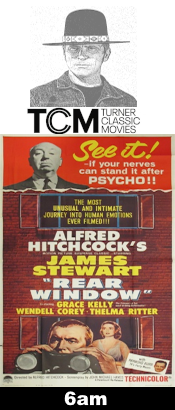
12 Thrilling Facts About “Rear Window”

Kristin Hunt and Mental_Floss present 12 Thrilling Fact About Rear Window.  Here are three of my favorites…

3. GRACE KELLY TURNED DOWN THE LEAD IN ON THE WATERFRONT TO STAR IN REAR WINDOW.
In the fall of 1953, Grace Kelly was offered the female lead in two films: one was Rear Window, the other was Elia Kazan’s On the Waterfront. Although she was dying to work with Hitchcock again, On the Waterfront would’ve allowed Kelly to stay in New York, which she preferred to Los Angeles. Still, she ultimately chose to play socialite Lisa Fremont over blue-collar Edie Doyle. Instead, the part went to Eva Marie Saint, who would become a Hitchcock blonde herself with North by Northwest.

4. HITCHCOCK MODELED THE VILLAIN ON A PRODUCER HE HATED.
Hitchcock had a long-standing grudge with his former producer, David O. Selznick. The director believed Selznick had meddled too much with his movies, so much so that Hitchcock effectively disowned his first film with the producer, Rebecca. His ties to Selznick ended with the 1947 movie The Paradine Case, though, so Hitch decided to enact a sly bit of revenge onscreen. It involved Raymond Burr, the actor playing Rear Window villain Lars Thorwald. Hitchcock gave Burr glasses just like Selznick’s and curly gray hair to match. He also instructed Burr to adopt many of the producer’s mannerisms, such as the way he cradled a telephone in his neck. When all was said and done, Burr’s murderous character looked a lot like Selznick, no doubt to the producer’s supreme annoyance.

11. HITCHCOCK DELIBERATELY MISDIRECTED HIS ACTORS FOR LAUGHS.
Each neighbor has a hook: Miss Torso is a dancer, Miss Lonelyhearts is severely single, the Songwriter is, well, a songwriter. Then there’s that random couple sleeping on the fire escape. Actors Sara Berner and Frank Cady played the unnamed pair, who spend most of the movie fidgeting on a mattress outdoors without incident. Until it rains. For this scene, Hitchcock intentionally messed with his actors. He told Berner to pull the mattress one way and Cady to pull it the other. Neither one knew the other had received conflicting directions. So when Hitchcock called “action,” the pair struggled with the mattress until Cady accidentally flew into the window. Hitchcock thought it was so funny, he kept it in the movie.

The Twilight Children #2 by Hernandez and Cooke / Z-View

The Twilight Children #2 is part of a four-issue mini-series published by Vertigo Comics.

Writer: Gilbert Hernandez
Artist: Darwyn Coole
Colorist: Dave Stewart
Cover Artist: Darwyn Cooke

*** Beware – spoilers may be found below ***

The town sheriff has his hands full this issue — there’s the new beautiful woman in town, who just may be an alien.  Then there’s two guys who just arrived and we’re pretty sure they’re CIA.  Tito (who was cheating with the fisherman) is now coming on to the young scientist.  Her husband Nicholas is more upset over that than Tito’s cheating with Anton so he enlists Anton’s aid to kill the scientist.  The children blinded by the orb last issue can remarkably see again, and for some reason (that we know) the scientist ends high up in a tree unconscious and in the nude.

The plot thickens as orbs secretly appear, people disappear and a murder attempt is set in motion.

Rating:

How to Tell Who is the Monster in John Carpenter’s “The Thing”

John Carpenter’s The Thing has an ambiguous ending that fans have argued about since the release of the film.  Seems the arguing can stop now thanks to the information provided by Dean Cundey, the cinematographer on The Thing.

Check out the ending and see if you can spot who (is either) is The Thing.  If you can’t and you want to know the secret, then click over to Fascinating Secret About the Monster in John Carpenter’s The Thing Revealed at GeekTyrant.