Category: Celebs

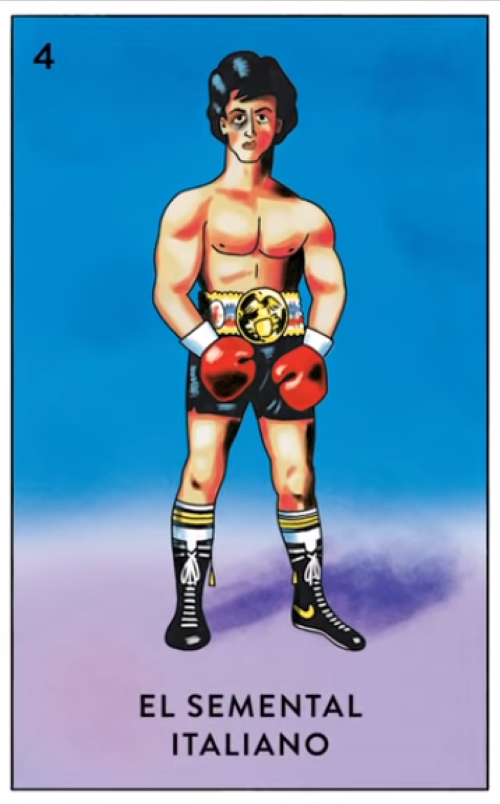
“Rocky” by JC Richard from Grey Matter Art Ready for Framing!

A couple of weeks ago I posted that Grey Matter Art, under license from MGM, was set to release a new officially licensed, limited edition screen print featuring “Rocky” by artist, JC Richard.  As you can see I can’t wait to get mine framed and up!
If you’re interested in getting a print here are the details:

“Rocky” by JC Richard
12″ x 36″ hand-numbered screen print
Regular Edition: 150/40.00
Variant Edition: 75/50.00
Printed by: D&L Screenprinting

This poster is released through www.greymatterart.com

Follow Grey Matter Art on Twitter, Facebook, and Instagram, and be sure to sign up for the GMA Newsletter for all future news & information.


10 Slap-Happy Facts About The Three Stooges

Jake Rossen and Mental Floss present 10 Slap-Happy Facts About The Three Stooges.  Here are three of my favorites…

3. HITLER WANTED THEM DEAD.

Having established their comic personas on film, the Stooges proceeded to make some accidental history. Their 1940 short, You Nazty Spy!, was the first American production to openly make a mockery of Adolf Hitler’s regime. (Charlie Chaplin’s The Great Dictator opened nine months later.) The short was perceived as a great insult by the Führer, who listed the Stooges as favored casualties on his own personal death list. (It’s not known whether he named each one individually.)

7. A REPLACEMENT STOOGE HAD A NO-VIOLENCE CONTRACT CLAUSE.
Sorting out the musical chairs of Stooges enrollment can be difficult: While Moe and Larry were largely engrained, the trio was originally rounded out with Shemp before he departed for a solo career: Curly was his replacement. Following Curly’s departure due to illness, Shemp stepped back in, but he died in 1955. After briefly considering a run as the Two Stooges, Moe and Larry recruited Joe Besser, a comic actor who already had a deal with Columbia, in 1956. But Besser wasn’t quite as game for the physical comedy as his predecessors. He insisted his contract contain language prohibiting him from being abused to excess, including anything pastry-related. “I never was the type of comic to be hit by a pie,” he said, a mentality that calls into question the decision to become part of The Three Stooges. Following Besser’s departure in 1959, the group roped in Joe DeRita for live shows and several feature films, including 1961’s Snow White and the Three Stooges.

10. THERE’S A STOOGES MUSEUM IN PENNSYLVANIA.

The Stooges’ vital contributions to pop culture have always deserved some archival recognition. They got it in 2004, when The Stoogeumopened its doors in Ambler, Pennsylvania, about 25 miles outside of Philadelphia. The museum’s founder is Gary Lassin, who married Larry Fine’s great niece in 1981. A Stooges fan, Lassin acquired over 100,000 items related to their careers and displays roughly 3500 pieces at a time. There’s a Hall of Shemp, a game area (with Whack-a-Moe), as well as countless artifacts.

11 Astonishing Facts About “Freaks”

Matthew Jackson at Mental Floss posted 11 Astonishing Facts About Freaks.  Here are three of the most interesting…

2. MGM WANTED IT TO RIVAL DRACULA AS A HORROR FILM.

Though there were certainly monstrous characters populating various silent films (particularly those portrayed by Chaney in The Phantom of the Opera and London After Midnight), the horror film as a genre didn’t really take off until the era of talkies began. Shortly after Chaney’s death due to complications from lung cancer, Browning was off at Universal Pictures, helping to lead the horror wave with his now-classic adaptation of Dracula. When Browning returned to MGM in the wake of Dracula’s success, head of production Irving Thalberg wanted to capitalize on the horror boom. The hope was that, with the director of Dracula back at the studio, MGM could best Universal with something even more horrifying, and so Browning was finally given the go-ahead to make Freaks, which had remained a pet project of his for years.

According to Skal, it became a classic lesson for Thalberg in being careful what you wish for: The story goes that after he was presented with the screenplay for the film, Thalberg reportedly hung his head and said, “Well, I asked for something horrible, and I guess I got it.”

10. IT DERAILED BROWNING’S CAREER.

Before Freaks, Browning was one of the most successful directors in Hollywood, and his success had earned him enough clout to get the ambitious and gutsy film made after Dracula hit big at Universal. After Freaks, he never quite recovered. According to Skal, this was not just due to that film’s failure, but due to Browning’s continued discomfort with the change in the filmmaking process that came from the rise of talkies. That discomfort, coupled with an increasing inability to get more personal projects approved by the studios in the wake of Freaks, led to his decline in the 1930s.

Browning directed just four more films (two of them uncredited), with his final directing credit coming on the MGM mystery Miracles for Sale in 1939. He retired with enough savings from his directorial successes to live comfortably in a pair of homes in Beverly Hills and Malibu, and died in 1962.

11. IT FOUND A NEW AUDIENCE IN THE 1960S.

After its critical and commercial failure in the United States, Freaks faded into the background as a kind of Hollywood curiosity, and was banned in several countries (including the United Kingdom) for decades. The film was licensed by distributor Dwain Esper in the late 1940s, and played on the grindhouse circuit at various independent theaters, but it wasn’t until the 1962 Cannes Film Festival that the film’s revival really began. After screening there, it was heralded as a kind of forgotten classic. Noted film collector and archivist Raymond Rohauer picked up the baton from there, landing the rights to Freaks and showing it as a cult film. It gained prominence on the midnight movie circuit, and found particular success with members of the 1960s counterculture movement, who saw kindred spirits in its cast.


15 Facts About John Carpenter’s “Christine”

Sean Hutchinson at Mental Floss posted 15 Facts About John Carpenter’s Christine.  Here are three of my favorites…

2. JOHN CARPENTER SIGNED ON SIMPLY BECAUSE HE WANTED A JOB.
Kobritz approached John Carpenter after the critical and financial failure of his 1982 adaptation of The Thing, which is now widely regarded as one of the filmmaker’s best.

The pair previously worked together on Carpenter’s 1978 TV movie Someone’s Watching Me! and Carpenter agreed to take on the project because he wanted to jump immediately into another movie after his first high-profile box office flop.

8. KEVIN BACON WAS ORIGINALLY CAST AS ARNIE.

Carpenter held auditions in California and New York, looking for the right fresh faces for the teen characters in the film, and he found the perfect newcomer for Arnie: Kevin Bacon.

The now-famous actor’s only other significant work at the time was bit parts in Animal House and Friday the 13th, and Kobritz and Carpenter thought Arnie’s transformation from dweeby hero to suave villain was a perfect fit for Bacon. But after being cast, Bacon dropped out when he was offered a starring role in Footloose.

Carpenter went back the the drawing board to cast Arnie, and eventually found actor Keith Gordon in a play in New York City. Carpenter initially took to Gordon as Arnie because of the actor’s previous appearance in Brian De Palma’s thriller Dressed to Kill.

7. CARPENTER DIDN’T WANT TO CAST MOVIE STARS.

Columbia execs wanted a star-studded cast to round out their King adaptation, and suggested that Brooke Shields—coming off the hit film The Blue Lagoonbe cast as Leigh, and Scott Baio be cast as Arnie. But Carpenter didn’t want recognizable faces in the movie as a way to stress that the titular car was the real star of the movie.

James Byron Huggins Podcast Interview!

Because we have so many James Byron Huggins fans here, I thought I’d let everyone know that James did a podcast interview and a reading from The Reckoning for The Other Stories.org.

Huggins is probably best known as the author of Hunter which he specifically wrote with Sylvester Stallone in mind as the book’s hero.  Hunter is one of my all-time favorite novels and I’m not alone in that regard.  Stallone fans continue to hope that Sly will helm a movie version of Hunter even if he doesn’t star in it.

Huggins also wrote The Reckoning, Cain, Leviathon, Rora, and other novels. I recommend each of them to fans of thrillers, action-adventure, horror and great writing.

27 Things You Might Not Know About Theodore ‘Teddy’ Roosevelt

Jake Rossen and Mental Floss present 27 Things You Might Not Know About Theodore ‘Teddy’ Roosevelt.  Here are three of my favorites and some thoughts about each…

1. HE WENT FROM WIMP TO WARRIOR.

Born on October 27, 1858, Roosevelt—often called “Teedie” or “Teddy” by friends—was a frail kid, prone to illness, asthma, and lacking physical strength. Despite his modest build, he was an avid outdoors enthusiast, and sometimes carried his fascination with wildlife indoors by practicing taxidermy. At 14, his family went on a tour of Egypt, and he traveled with his somewhat macabre tools of the trade, including arsenic. As a teen, Roosevelt put his stuffed birds aside and decided to become aggressive in his physical routine, training in gymnastics and weightlifting. Later, he would practice both boxing and judo. The intense interest he showed in combat sports made him a fitness advocate for the rest of his life.
Craig’s Thoughts:  His love of taxidermy before he was even in his teens makes me think of someone who would grow up to be a serial killer, not the President of the United States.

25. HE GAVE A SPEECH IMMEDIATELY AFTER BEING SHOT.

Roosevelt’s reputation as a “bull moose,” his term to describe anyone made of sturdy stuff, was never on better display than October 14, 1912, when the former president was giving a speech in Milwaukee and announced he had just been shot by a would-be assassin named John Schrank. A shocked crowd looked on as Roosevelt revealed a bloody shirt and a stack of prepared remarks with a bullet hole in them (above; you can see both the papers and the shirt at the Theodore Roosevelt Birthplace National Historic Site in New York City). Roosevelt spoke for 90 minutes before allowing his aides to take him to a hospital. The bullet had lodged itself near his ribs and would remain there for the rest of his life.
Craig’s Thoughts: This probably more than anything else would have been enough to give TR the reputation as a tough guy.  But when you add it to the fact that he went west as a young man (Shades of Horace Greeley) and made his living as a cowboy; that he volunteered to serve in the army, that he distinguished himself in battle, that he was a decorated war hero, that he boxed (and continued to spar at the age of 50, losing sight in one eye in the process), that he was an avid outdoorsman, then you have to admit that Teddy Roosevelt was a legitimate tough guy.

9. HE WAS A MASSIVE ENVIRONMENTALIST.

A lover of the outdoors, Roosevelt made protecting the natural wonder of American territory a priority. Over his tenure in the White House, he reserved 200 million acres of land for national forests and wildlife refuges; previous presidents combined had only done a fifth of that. “We have become great because of the lavish use of our resources and we have just reason to be proud of our growth,” he said in 1908. “But the time has come to inquire seriously what will happen when our forests are gone, when the coal, the iron, the oil and the gas are exhausted, when the soils have been still further impoverished and washed into the streams, polluting the rivers, denuding the fields, and obstructing navigation.

“These questions do not relate only to the next century or to the next generation. It is time for us now as a nation to exercise the same reasonable foresight in dealing with our great natural resources that would be shown by any prudent man in conserving and widely using the property which contains the assurance of well-being for himself and his children.”
Craig’s Thoughts:  I love that TR had the foresight and love of nature enough to work to preserve our natural resources for future generations.

Taco Bell Will Celebrate “Demolition Man” at Comic-Con 2018


2018 is the 25th anniversary of the Warner Bros. film Demolition Man, and to celebrate Taco Bell is bringing back Nacho Fries nationwide and planning a special set-up at Comic-Con.  Taco Bell…

…will offer a Demolition Man pop-up and a futuristic and upscale Taco Bell dining experience near the convention center, where you’ll presumably be able to pick up some Nacho Fries while you wait. You can stop by 658 Fifth Ave in San Diego from 6PM-12AM nightly for free food, and no badge is required. There will also be exclusive Taco Bell and Demolition Man merchandise available for purchase.

I wonder if Sly and Wesley Snipes will be involved?

If any readers of this site are going to Comic-Con and check this out, we’d love to hear a report!

Source: SDCCBlog.

31 Things We Learned from Tony Scott’s “Revenge” Commentary

Yesterday we looked at the films of Tony Scott.  That brought to mind one of my favorite Tony Scott movies, Revenge.   Today we take a look at Rob Hunter and Film School Rejects’ 31 Things We Learned from Tony Scott’s Revenge Commentary.  Here are three of my favorites and my thoughts…

1. John Huston apparently worked for ten years attempting to bring this adaptation to the screen, and when that was no longer a possibility Scott, who had kept a close eye on the project, came aboard. Huston’s big roadblock was his producer, Ray Stark, who felt squeamish as to the story’s harsher elements. Scott says the theatrical cut of this film is Stark’s while this director’s cut is his preferred version. “He should never have made Revenge,” says Scott, “because it was something that was very contrary to his taste.”
Craig’s Thoughts:  I could definitely have seen Revenge as a John Huston film.  Revenge feels like a modern throw-back to The Postman Always Rings Twice or Double Indemnity.  And did you notice Scott said the director’s version is his preferred version of Revenge?  I didn’t even know there was a director’s version.  There is and I’m ordering a copy today.

19. Rocky the dog’s death scene strikes me as something that probably wouldn’t fly these days. They attached “an explosive pack” aka a squib to the dog’s chest and a snatch wire to his back, and when the dog barked Scott instructed the effects guys to trigger the exploding pack and yank the cable so the dog would fly into the wall. Scott tried to get a second take, but Rocky refused to bark again. “But he’s still around, he’s sixteen,” he promises. He also notes that test audiences gave them grief for what they did to the dog without mentioning that Costner gets beat to near death and Stowe has her face slashed in the same scene.
Craig’s Thoughts:  Yeah, the dog death scene would never fly today.  I’m surprised it did then, but that’s what makes this film seem realistic.  What Costner goes through to rescue Stowe and what she endures until rescued… whew!

30. The final face-off between Cochran and Tibey was shot in Mexico, but Stark and the studio requested Scott shoot additional footage with more dialogue to help explain both men’s motivations. Scott hated it and cut all of the new footage from the film.
Craig’s Thoughts:  I am so stoked to see this film again, especially since it will be the director’s cut a version totally new to me.

Revenge Unrated Director’s Edition Blu-Ray