11 Astonishing Facts About “Freaks”
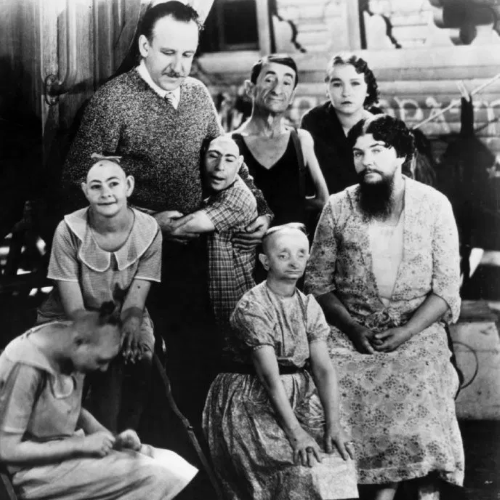
Matthew Jackson at Mental Floss posted 11 Astonishing Facts About Freaks. Here are three of the most interesting…
2. MGM WANTED IT TO RIVAL DRACULA AS A HORROR FILM.
Though there were certainly monstrous characters populating various silent films (particularly those portrayed by Chaney in The Phantom of the Opera and London After Midnight), the horror film as a genre didn’t really take off until the era of talkies began. Shortly after Chaney’s death due to complications from lung cancer, Browning was off at Universal Pictures, helping to lead the horror wave with his now-classic adaptation of Dracula. When Browning returned to MGM in the wake of Dracula’s success, head of production Irving Thalberg wanted to capitalize on the horror boom. The hope was that, with the director of Dracula back at the studio, MGM could best Universal with something even more horrifying, and so Browning was finally given the go-ahead to make Freaks, which had remained a pet project of his for years.
According to Skal, it became a classic lesson for Thalberg in being careful what you wish for: The story goes that after he was presented with the screenplay for the film, Thalberg reportedly hung his head and said, “Well, I asked for something horrible, and I guess I got it.”
10. IT DERAILED BROWNING’S CAREER.
Before Freaks, Browning was one of the most successful directors in Hollywood, and his success had earned him enough clout to get the ambitious and gutsy film made after Dracula hit big at Universal. After Freaks, he never quite recovered. According to Skal, this was not just due to that film’s failure, but due to Browning’s continued discomfort with the change in the filmmaking process that came from the rise of talkies. That discomfort, coupled with an increasing inability to get more personal projects approved by the studios in the wake of Freaks, led to his decline in the 1930s.
Browning directed just four more films (two of them uncredited), with his final directing credit coming on the MGM mystery Miracles for Sale in 1939. He retired with enough savings from his directorial successes to live comfortably in a pair of homes in Beverly Hills and Malibu, and died in 1962.
11. IT FOUND A NEW AUDIENCE IN THE 1960S.
After its critical and commercial failure in the United States, Freaks faded into the background as a kind of Hollywood curiosity, and was banned in several countries (including the United Kingdom) for decades. The film was licensed by distributor Dwain Esper in the late 1940s, and played on the grindhouse circuit at various independent theaters, but it wasn’t until the 1962 Cannes Film Festival that the film’s revival really began. After screening there, it was heralded as a kind of forgotten classic. Noted film collector and archivist Raymond Rohauer picked up the baton from there, landing the rights to Freaks and showing it as a cult film. It gained prominence on the midnight movie circuit, and found particular success with members of the 1960s counterculture movement, who saw kindred spirits in its cast.