Jackie Chan’s 7 Most Fearless Stunts!
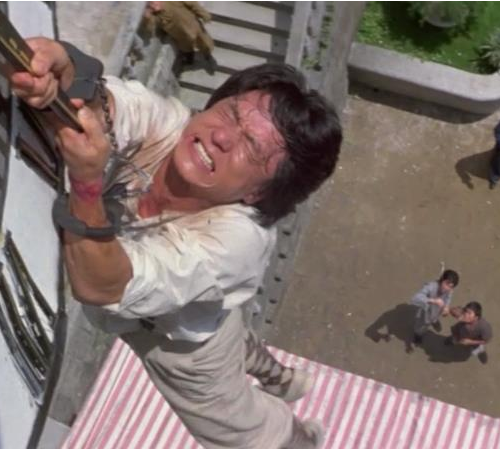
Meena Jang and The Hollywood Reporter have posted Jackie Chan: His 7 Most Intrepid Stunts with links to videos!
Previews and Reviews that are Z's Views
Meena Jang and The Hollywood Reporter have posted Jackie Chan: His 7 Most Intrepid Stunts with links to videos!

Sean Hutchinson and Mental_Floss have posted 17 Things You Might Not Know About Scarface. Here are three of my favorites…
5. A budding screenwriting star brought De Palma back.
Producer Bregman offered relative newcomer Oliver Stone a chance to overhaul the screenplay, and Stone agreed to do the movie for two reasons. First, his 1981 film The Hand had bombed at the box office, so he needed the work. He also wanted to work with Lumet, who eventually dropped out of the project because he felt Stone’s screenplay became too over the top and too violent. De Palma, who had moved on to potentially direct Flashdance, then read Stone’s script and loved how exaggerated it was, so he dropped Flashdance and rejoined Scarface.10. Tony is only referred to as “Scarface” once, and it’s in Spanish.
Hector, the Colombian gangster who threatens Tony with the chainsaw, refers to him as “cara cicatriz,” meaning “scar face” in Spanish.14. Steven Spielberg directed a single shot.
De Palma and Spielberg had been friends since the two began making studio movies in the mid ‘70s, and they made a habit of visiting each other’s sets. Spielberg was on hand for one of the days of shooting the Colombians’ initial attack on Tony Montana’s house at the end of the movie, so De Palma let Spielberg direct the low angle shot where the attackers first enter the house.
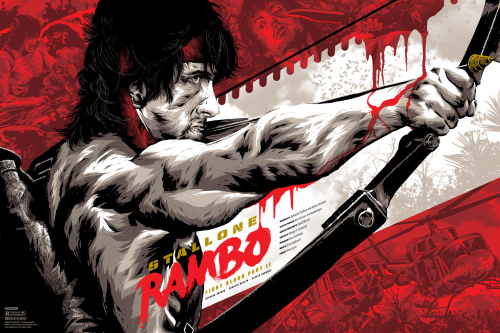
The very cool Rambo: First Blood, Part II poster was created by Anthony Petrie and is available from Grey Matter art…
“First Blood: Part II” By Anthony PetrieGrey Matter Art under license from StudioCanal, is pleased to announce the next poster in our officially licensed Rambo series. A limited edition screen print for the iconic 80’s film, “Rambo: First Blood Part II”, by the very talented artist, Anthony Petrie…

Erik van Rheenen and Mental_Floss have posted 15 Things You Didn’t Know About The Stand. As is our tradition, here are three of my favorites…
6. Christian Radio Made a Contribution As Well
King revealed a third inspiration for The Stand in Danse Macabre: A single line he heard in a radio broadcast of a sermon when he was living in Colorado. The line “Once in every generation the plague will fall among them” made such an impression on King that he wrote it down and pinned it over his typewriter. Later, when the author was struggling to write a fictionalized account of the Patty Hearst kidnapping (the unpublished The House on Value Street), he saw the gloomy quote and found the inspiration to start a new project that became The Stand.
8. The Extreme Length Led to Logistical Problems
The 1,200-page novel presented a serious problem – King’s publisher, Doubleday, couldn’t print a novel that long. Literally. In addition to whatever qualms the publisher might have had about trying to sell such a hefty book, its printing presses couldn’t create it. As King explained to Time in 2009, “Doubleday had a physically limiting factor in those days because they used a glue binding instead of a cloth binding, and the way it was explained to me was that they had so much of a thickness they could do before the glue just fell apart.”
10. The Cut Pages Weren’t Lost
Of course, when your fans are as rabid as King’s, it’s hard for lost pages to stay lost. In 1990 King restored the text he had hacked away to create The Stand: The Complete & Uncut Edition. King didn’t just slip all the cut pages back into the original manuscript, though – he retyped each one. He told Time he “had the manuscript on one side of an IBM Selectric typewriter and I had the pages of a book that I had torn out of the binding on the other side.” The restored edition had another quirk – King also updated the setting of the novel to the then-present day and included references to cultural touchstones like Freddy Krueger that had not existed in 1978.

Corey Mahoney and Hollywood.com present 21 Facts About the Movie Goodfellas You Never Knew. Here are three of my favorites…
5. When Joe Pesci was younger, he told a mobster that he was funny. The gangster’s ensuing anger was never forgotten and ended up inspiring Pesci to ask Scorsese to include it.
The director allowed Pesci and Liotta to improvise the now iconic “funny how?” scene. The other actors weren’t aware of the plan, so their reactions are genuine.6. The now legendary Steadicam shot through the kitchen of the nightclub was unplanned.
Scorsese was denied permission to use the front entrance, and the alternative is now film history.9. And while filming Spider’s death scene, actor Michael Imperioli had to be rushed to the hospital for breaking a glass in his hand; the doctors, however, attempted to treat what appeared to be a gunshot wound to his chest.
When they learned the real reason behind his hospital visit, he was forced to wait three hours before he was treated. Scorsese told Imperioli that he would one day share the story on The Tonight Show with Jay Leno, and, ten years after the film’s release, in 2000, Imperioli did just that.

Jake Rosen lists 14 Things You Might Not Know About Se7en. Here are three of my favorites…
1. From the Mind of a Record Store Employee
Screenwriter Andrew Kevin Walker was a graduate of Penn State’s film program. Several years later, however, he was no closer to achieving his goal of working in the industry. Making ends meet at a New York City Tower Records store, Walker was so depressed that he wrote a bleak and oppressive script about the hunt for a killer who uses the seven deadly sins as inspiration for his crimes.
Satisfied with the outcome, he sent it to professional writer David Koepp, and then followed up with a phone call. Koepp agreed to send it to his agent, who found a buyer in New Line Cinema. (After reading it, Koepp also advised Walker that he “needed professional help.”)
3. Brad Pitt Worked Himself to the Bone
During a scene in which Pitt’s character, Detective David Mills, is chasing the killer through a perpetually rainy backdrop, Pitt slipped and drove his arm through a windshield. The resulting injury (a severed tendon) was so deep it went down to the bone. Pitt had to wear a cast for the rest of filming, which was written into the script; for scenes that had to be shot that took place earlier than the chase, the actor had to conceal his arm as best he could.
4. Kevin Spacey Got No Credit
When Fincher hired Kevin Spacey to portray killer John Doe, Spacey thought it would be more interesting to keep his involvement a secret, figuring that if he were to be billed then it would be obvious who the “mysterious” antagonist was. As a result, Spacey—who had just become a hot commodity for his work in The Usual Suspects—did not appear in any advertising, nor was his name included in the opening credits. While the studio disliked the idea, the part was late to be cast and, in Spacey’s words, “I was either going to be on a plane to shoot the movie or I wasn’t.” He got his wish.
Source: Mental_Floss.

Esquire recently posted Ryan Bort’s 10 Things We Learned About Evel Knievel from Being Evel, the New Documentary About the Daredevil’s Unbelievable Life. Here are three of my favorites…
2. He was a legendary insurance salesman.
Knievel’s success was due just as much to his ability to sell himself as it was to his fearlessness. And if he could sell the appeal of a guy running his motorcycle off of ramp, you could damn well bet he could sell some insurance, which he did while still living in Butte, where he famously went into a mental hospital and sold 271 policies. But when he asked the president of the company if he could be the VP if he broke every sales record and the president said no, Knievel quit and moved to Moses Lake, Washington, to sell motorcycles.
4. There’s a story behind his name.
This may come as a shock, but “Evel” is not Knievel’s real name. Born Robert Craig Knievel, the future daredevil once found him in jail with a man named Knofel, where together they became known as “Awful Knofel and Evil Knievel.” The nickname stuck, and Knievel changed the “i” in evil to an “e” because he didn’t want it to sound too evil.
5. He conned his way into his famous jump at Caesar’s Palace.
Before Knievel could jump over the fountains at Caesar’s Palace in Las Vegas, he was going to have to convince the casino to let him make a spectacle of the death-defying feat on their property. Because at this point no one had heard of him, this was going to be difficult. Before even pitching the event to Caesar’s, Knievel called every news outlet he could think and told them that he’d be jumping the fountains and to make sure they came out and covered the event. Once he had the media interested, he called the casino owner repeatedly, pretending to be a different person clamoring to see the jump each time. Word spread to such a degree that Caesar’s had to let Knievel attempt the jump. He didn’t make it, of course, but in the long run it was for the best; the cringeworthy footage of his body tumbling across the concrete made him famous.
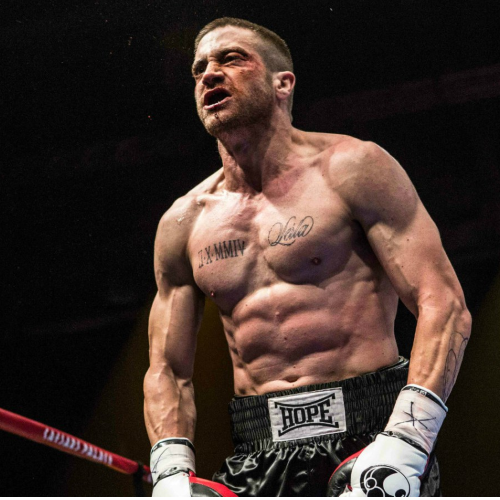
New trailer for Southpaw.
Directed by Antoine [Training Day] Fuqua and starring Academy Award® nominees Jake Gyllenhaal and Forest Whitaker from a story by Kurt [Sons of Anarchy] Sutter.
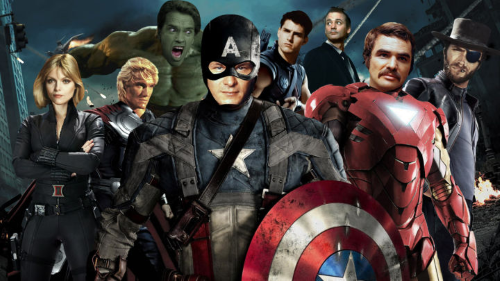
Chris Tilly at IGN.com decided to take a stab at casting with his piece What if The Avengers Had Been Made in 1985?
There’s not much to quibble with. Tilly’s choices are on point, although I’ll bet a part would have been found for Sylvester Stallone since he had two of the three top grossing movies in 1985.
The question is what part would he have played?

That’s the new poster to London Has Fallen [sequel to Olympus Has Fallen] and reunites Gerard Butler, Aaron Eckhart, Morgan Freeman, Angela Bassett, Robert Forster, Radha Mitchell with the new addition of Jackie Earle Haley to round out the cast.
Source: Flickering Myth.
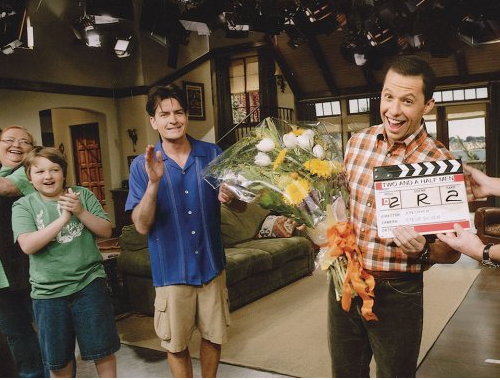
The Hollywood Reporter recently posted an excerpt from Jon Cryer’s So That Happened: A Memoir.
The THR piece, titled Jon Cryer Reveals the Inside, Insane Account of Charlie Sheen’s Infamous Meltdown, lives up to the billing. Be advised before you click over that adult language and topics are discussed.

Maggie starring Arnold Schwarzenegger and directed by Henry Hobson doesn’t look to be our typical zombie movie. Actually, it may be for that reason I want to see it even more.

SZoner, Gerardo Moreno is back with a new poster – Last Blood!
I’ve always enjoyed Gerardo’s Stallone art, and know that I can see more of his art here.

A new poster for Dwayne “The Rock” Johnson’s San Andreas premiered today. The poster is okay. I’m hoping the movie will be better than okay.