Category: Movies

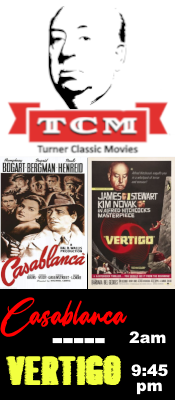
11 Dizzying Facts About “Vertigo”

Tara Aquino and Mental_Floss present 11 Dizzying Facts About Vertigo.  Here are three of my favorites

1. ALFRED HITCHCOCK BLAMED JIMMY STEWART FOR VERTIGO’S FAILURE.
Marred by mixed reviews, the $2.5 million Vertigo did comparatively less than Hitchcock’s previous movies, and was widely recognized as a failure. Frustrated with its reception, Hitchcock partly blamed star Jimmy Stewart’s aging appearance. At the time of filming, Stewart—who had starred in Hitchcock’s three previous films—was 50 years old which, according to the director, was too old to convincingly play then-25-year-old Kim Novak’s love interest.

5. AN UNCREDITED CAMERAMAN CAME UP WITH THE FAMOUS “VERTIGO EFFECT.”
According to associate producer Herbert Coleman, it wasn’t Hitchcock who came up with the film’s famous camera technique (which essentially involves zooming forward while pulling the camera backward); rather, it was an uncredited second unit cameraman, Irwin Roberts. “He didn’t get screen credit on Vertigo because they gave the screen credit to another close friend of ours [Wallace Kelley] who did all the process work on the stage,” Coleman said.

9. ALFRED HITCHCOCK CHANGED THE SETTING FROM PARIS TO SAN FRANCISO.
The French source novel, D’entre les Morts, was set in Paris, but Hitchcock believed that San Francisco was more interesting. As noted by Auiler, with the city’s vertiginous streets and hilly landscape, the location perfectly matched the film’s themes. In a city where there were such extreme physical highs and lows, awful for anyone with acrophobia, Scottie’s vertigo became a character in and of itself.

Here’s Looking at 10 Facts About “Casablanca”

Rebecca Pahle and Mental_Floss present Here’s Looking at 10 Facts About Casablanca.  Here are three of my favorites

3. THE SHOOT GOT OFF TO A ROUGH START.
The first scene that director Michael Curtiz and company shot was one of the flashback scenes in Paris, which caused some problems for stars Humphrey Bogart and Ingrid Bergman. Bogart because, in his own words, “I’m not up on this love stuff and don’t know just what to do,” and Bergman because, as the script had not yet been finished, she didn’t know whether her character was supposed to be in love with Rick or Victor Laszlo. Curtiz, who did not know himself, covered marvelously and told her to “play it in between.”

5. PART OF THE POSTER IS FROM ANOTHER BOGIE MOVIE.
In many of Casablanca’s better-known posters, the shot of a trench coat- and fedora-wearing Bogart wielding a gun was pulled almost exactly from a publicity shot from earlier Bogie film,Across the Pacific, by poster artist Bill Gold, who repainted it in a photorealistic style.

7. THE FIRST SCENE WAS SHOT BY ANOTHER FAMOUS DIRECTOR.
Casablanca’s opening scene, the map sequence with a voiceover explaining how refugees from World War II came to be in Casablanca, was created by Don Siegel, who in later years would direct some classics of his own, including Invasion of the Body Snatchers (1956) and Dirty Harry (1971).

21 Things You Didn’t Know About the “Fast and Furious” Franchise

Hollywood.com presents 21 Things You Didn’t Know About the Fast and Furious Franchise.  Here are three of my favorites…

13. Vin Diesel got the right to another movie franchise…just for showing up. 
In lieu of a paycheck for his cameo at the end of the film, Vin Diesel traded with Universal – his cameo, for the rights to the Riddick franchise.

18. The Rock’s part was written for…Tommy Lee Jones?
The role of Luke Hobbs was written with Tommy Lee Jones or Josh Brolin in mind for the part, but when Dwayne Johnson (née The Rock) approached the studio about joining the franchise, Universal had the filmmakers rework the part for him instead.

21. The films’ timeline makes no sense. 
On the surface, the Furious franchise seems pretty simple: Cars go fast, stuff gets smashed, beginning-middle-end. But the films are actually this weird non-linear series, told out of sequence. When you look at the whole story, it constantly jumps back and forth through time, and major plot points are told through flashbacks. Fast & Furious, Fast Five, and Furious 6 are an internal trilogy of prequels, that actually circle back to the third film,Tokyo Drift.

13 Fascinating Facts About “Natural Born Killers”

Roger Cormier and Mental_Floss present 13 Fascinating Facts About Natural Born Killers.  Here are three of my favorites…

1. QUENTIN TARANTINO WROTE THE ORIGINAL SCRIPT.
It was titled Mickey and Mallory and focused more on the media than on Mickey Knox and Mallory Wilson. He sold the rights to the movie for $10,000 because he was unable to get it made himself (this was before Pulp Fiction). Tarantino ended up getting a story credit forNatural Born Killers, while Richard Rutowski, Oliver Stone, and David Veloz each got a screenwriting credit.

3. MICHAEL MADSEN ALMOST TOOK THE LEAD.
Michael Madsen was considered for the lead role of Mickey: “Oliver Stone wanted me, but the studios offered him an extra $20 million to cast Woody Harrelson,” Madsen told The Guardian.

11. MICKEY AND MALLORY DIE IN THE ALTERNATE ENDING.
The killers survive in the final version because Oliver Stone believed that the 1990s were a time when the bad guys got away with it.

34 Things We Learned from the “Used Car” Commentary

Rob Hunter and Film School Rejects present 34 Things We Learned from the Used Car Commentary.  Here are three of my favorites…

6. Russell remembers Steven Spielberg visiting the set a few times which prompts Gale to point out that the idea for the film came while he (Gale) and Zemeckis were working on the script for Spielberg’s 1941. “[John] Milius told us this story that he and Spielberg wanted to do someday about used car salesmen outside of Las Vegas. He wanted to put George Hamilton in it…

7. The Fuchs brothers were originally going to be played by different actors, but after Jack Warden turned down the role of Roy Fuchs someone suggested making them twins and having one actor play both.

11. Joe Flaherty’s character was originally going to be played by John Candy, but they got a call after rehearsals and costume fittings had already begun. Apparently Candy’s agent had double-booked him onto two films filming at the same time — possibly Stripes? — so they had to replace him.

13 Fascinating Facts About “Dog Day Afternoon”

Eric D. Snider and Mental_Floss present 13 Fascinating Facts About Dog Day Afternoon.  Here are three of my favorites…

2. THE REAL BANK ROBBER LOOKED A LOT LIKE AL PACINO.
Fluge’s magazine article described John Wojtowicz as “a dark, thin fellow with the broken-faced good looks of an Al Pacino or Dustin Hoffman,” so naturally the screenplay found its way into both actors’ hands. (Pacino was Lumet’s first choice, but Hoffman was reportedly approached when Pacino, seeking to take a brief break from movies, initially turned it down.) We see a bit more De Niro in Wojtowicz than Pacino or Hoffman, but Pacino was a good fit, too.

9. THEY LOST A DAY’S WORK BECAUSE OF PACINO’S MUSTACHE.
One of the things the actor did as a means of getting into character was grow a mustache—not because the real robber had one, but because the character was gay, and in the mid-’70s, many gay men had mustaches. In Lumet’s words, however, Pacino’s mustache “looked terrible.” And after the first day of filming, Pacino agreed. Watching the footage, Pacino told Lumet, “The mustache has got to go,” and asked if he could shave it and redo that day’s work. Lumet agreed, and the mustache was gone—as was a day’s worth of footage.

10. IT’S THE ONLY TIME LUMET EVER INCORPORATED IMPROVISATION INTO ONE OF HIS MOVIES.
Sidney Lumet’s first film was 1957’s 12 Angry Men. He made 20 more between that and Dog Day Afternoon (and 22 more afterward), and by his own account, he never used improv. “I don’t like actors to improvise, to use their own language,” he said in the Dog Day AfternoonDVD commentary. “They are not going to come up with something … better than a really talented writer who has done months of work on something.”

But as Lumet and the cast rehearsed Dog Day Afternoon—especially the parts where the robbers and bank employees are just sitting around killing time—someone asked about the possibility of improv, and Lumet realized it could be useful for helping the actors bond, as well as making the characters’s interactions feel more natural. With screenwriter Frank Pierson present, Lumet let the actors improvise in rehearsal; recorded it; and ended up adding some of their conversations to the script (which won the film’s only Oscar, by the way).

10 Surprising Facts About Burt Reynolds

James L. Menzies and Mental_Floss present 10 Surprising Facts About Burt Reynolds.  Here are three of my favorites…

1. HE TURNED DOWN SOME MAJOR ROLES.
Over the course of a near-60-year career, one is bound to pass on some prime roles. And Reynolds has turned down a lot, including (by his own admission in the video above) Han Solo in Star Wars, R.P. McMurphy in One Flew Over the Cuckoo’s Nest, Edward Lewis in Pretty Woman, and John McClane in Die Hard. Although he doesn’t regret that final one: “I don’t regret turning down anything Bruce Willis did,” Reynolds told Piers Morgan.

More notably, and perhaps more regrettably, Reynolds turned down a chance to play James Bond in 1969. As Reynolds explains it: “In my infinite wisdom, I said to [producer] Cubby Broccoli, ‘An American can’t play James Bond. It just can’t be done.’ And they really tried to talk me into it. It was a 10-minute discussion. Finally they left. Every night, I wake up in a cold sweat.”
5. HE HAD AN IMPROMPTU PIE FIGHT WITH MARC SUMMERS ON THE TONIGHT SHOW.

Burt Reynolds had just finished up his segment as a guest on The Tonight Show with Jay Lenoin 1994 and had shifted over to make way for the next guest, TV show host Marc Summers (Double Dare, Unwrapped). Reynolds became visibly irritated with Summers for, ostensibly, turning his back on him while he was speaking to Leno. Summers then made the comment to Reynolds, “I’m still married, by the way.” This jab precipitated a water fight between the two combatants: Reynolds dumped his mug on Summers’s lap, Summers retaliated, so on and so forth. The donnybrook culminated in a rather violent pie fight followed by a very awkward hug.
“This was not a bit,” Summers explained. “I didn’t know what to expect. He was going through a divorce with Loni Anderson at the time and he was angry … He hugged me and said, ‘I only did that because I really like you.’ You wait to get on The Tonight Show your whole life. You’re sitting next to Burt Reynolds. He drops water on your crotch then you get into a pie fight!”
6. HE (TICKED) OFF ELMORE LEONARD.
Reynolds was a longtime admirer of writer Elmore Leonard. After reading Leonard’s novel,Stick, Reynolds decided that he wanted to direct and star in the film version. Things did not go well.

After watching Reynolds’s first cut of the film, the studio pushed back its release date and forced him to re-shoot the second half of the movie, much to the actor/director’s dismay. “I turned in my cut of the picture and truly thought I had made a good film,” Reynolds told theLos Angeles Times. “Word got back to me quickly that the [studio] wanted a few changes … I gave up on the film. I didn’t fight them. I let them get the best of me.”

The biggest blow came from Elmore Leonard. “Leonard saw the film the day he was interviewed for a Newsweek cover and told them he hated it,” Reynolds shared. “After his comment, every critic attacked the film and he wouldn’t talk to me. When I reshot the film, I was just going through the motions. I’m not proud of what I did, but I take responsibility for my actions. All I can say—and this is not in way of a defense—is if you liked the first part of Stick, that’s what I was trying to achieve throughout.”