13 Fascinating Facts About “Dog Day Afternoon”
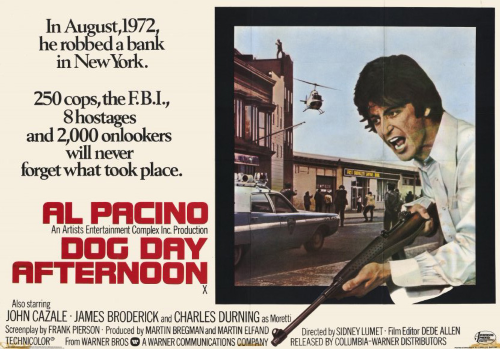
Eric D. Snider and Mental_Floss present 13 Fascinating Facts About Dog Day Afternoon. Here are three of my favorites…
2. THE REAL BANK ROBBER LOOKED A LOT LIKE AL PACINO.
Fluge’s magazine article described John Wojtowicz as “a dark, thin fellow with the broken-faced good looks of an Al Pacino or Dustin Hoffman,” so naturally the screenplay found its way into both actors’ hands. (Pacino was Lumet’s first choice, but Hoffman was reportedly approached when Pacino, seeking to take a brief break from movies, initially turned it down.) We see a bit more De Niro in Wojtowicz than Pacino or Hoffman, but Pacino was a good fit, too.
9. THEY LOST A DAY’S WORK BECAUSE OF PACINO’S MUSTACHE.
One of the things the actor did as a means of getting into character was grow a mustache—not because the real robber had one, but because the character was gay, and in the mid-’70s, many gay men had mustaches. In Lumet’s words, however, Pacino’s mustache “looked terrible.” And after the first day of filming, Pacino agreed. Watching the footage, Pacino told Lumet, “The mustache has got to go,” and asked if he could shave it and redo that day’s work. Lumet agreed, and the mustache was gone—as was a day’s worth of footage.10. IT’S THE ONLY TIME LUMET EVER INCORPORATED IMPROVISATION INTO ONE OF HIS MOVIES.
Sidney Lumet’s first film was 1957’s 12 Angry Men. He made 20 more between that and Dog Day Afternoon (and 22 more afterward), and by his own account, he never used improv. “I don’t like actors to improvise, to use their own language,” he said in the Dog Day AfternoonDVD commentary. “They are not going to come up with something … better than a really talented writer who has done months of work on something.”But as Lumet and the cast rehearsed Dog Day Afternoon—especially the parts where the robbers and bank employees are just sitting around killing time—someone asked about the possibility of improv, and Lumet realized it could be useful for helping the actors bond, as well as making the characters’s interactions feel more natural. With screenwriter Frank Pierson present, Lumet let the actors improvise in rehearsal; recorded it; and ended up adding some of their conversations to the script (which won the film’s only Oscar, by the way).