Category: Art

12 Things You May Not Know About Mad
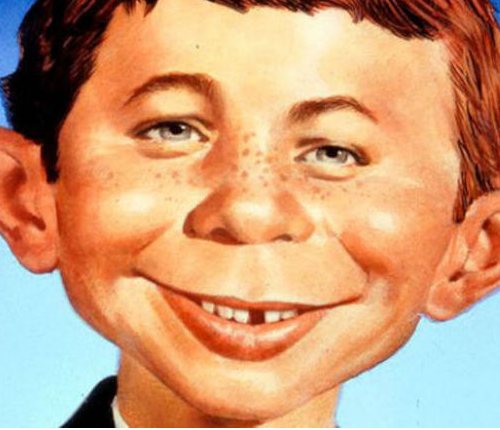
Jake Rossen and Mental_Floss present 12 Things You May Not Know About Mad.  Here are three of my favorites…

1. No One Knows Who Came Up with Alfred E. Neuman.
Mad creator Harvey Kurtzman was in the offices of a Ballantine Books editor discussing reprints for the fledging publication when he noticed a grinning, gap-toothed imbecile staring back at him from a bulletin board. The unnamed figure was ubiquitous in the early 20th century, appearing in everything from dentistry ads to depictions of diseases. A charmed Kurtzman adopted him as Mad’s mascot beginning in 1954. Neuman later become so recognizable that a letter was delivered from New Zealand to Mad’s New York offices without an address: the envelope simply had a drawing of Alfred.

3. They Predicted John F. Kennedy’s Election in 1960.
But it was a cheat. In the run-up to the 1960 Presidential election, Mad printed a cover that featured Neuman congratulating Kennedy on his victory with a caption that read, “We were with you all the way, Jack!” But the issue was shipped long before votes had been tabulated. The secret? It was a dual cover. Flip it over and Neuman is celebrating Richard Nixon’s appointment to office. Stores were told to display the “right” side of the magazine depending on the outcome.

5. They Didn’t Run Any (Real) Ads for 44 Years.
From the beginning, Gaines felt that printing actual advertisements next to the products they were lampooning would not only dilute their edge but seem more than a little hypocritical. After some back-and-forth, Mad cut ads starting in 1957. The decision was a costly one—most print publications survive on such revenue—but led to the magazine’s keeping a sharp knife against the throat of seductive advertising, including cigarettes. Faced with dwindling circulation in 2001, Mad finally relented and began taking ads to help pay for a switch to color printing.
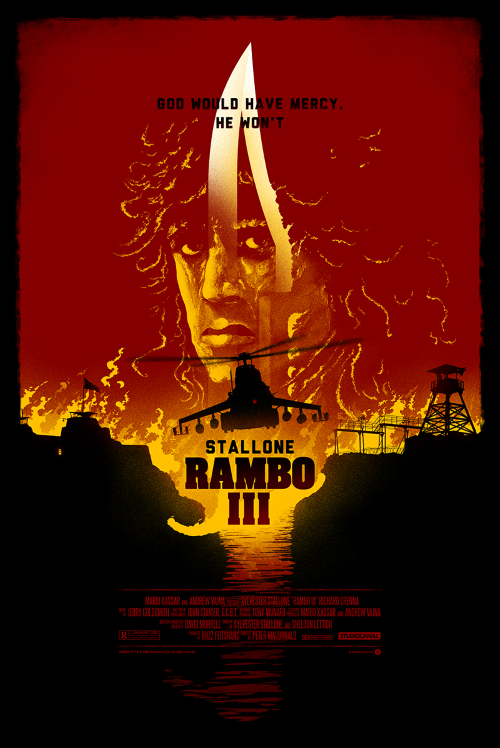
“Rambo III” by Marko Manev

Grey Matter Art under license from StudioCanal, is pleased to announce the final poster in our officially licensed Rambo series. A limited edition screen print for the iconic 80’s action film, “Rambo III”, by artist Marko Manev. Below are details for the release:

Artist: Marko Manev
Size: 24X36
Regular Edition: 100/$50.00

Regular Edition Set of all 3 Rambos: $120
Printed by: D&L Screen Printing
This poster was released on Thursday, July 9th.Follow Grey Matter Arts on Twitter to get a jump on future drops. Also, follow Grey Matter Arts on Facebook and Instagram, and sign up for their website newsletter for all future news & information.

RAMBO III ™ & © 1988 Studiocanal S.A
RAMBO ® is a Registered Trademark owned by Studiocanal S.A.

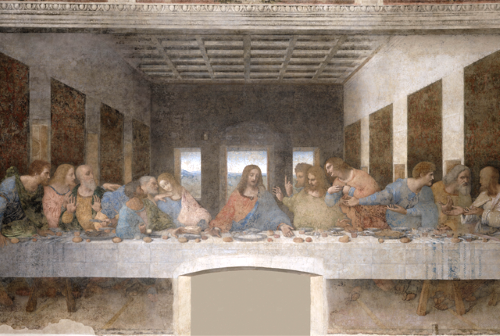
15 Things You Should Know About “The Last Supper”

Kristy Puchko and Mental_Floss present 15 Things You Should Know About The Last Supper.  Here are three of my favorites…

2. The Last Supper captures a climactic moment.

Everyone knows the painting depicts Jesus’ last meal with his apostles before he was captured and crucified. But more specifically, da Vinci wanted to capture the instant just after Jesus reveals that one of his friends will betray him, complete with reactions of shock and rage from the apostles. In da Vinci’s interpretation, the moment also takes place just before the birth of the Eucharist, with Jesus reaching for the bread and a glass of wine that would be the key symbols of this Christian sacrament.

6. Very few of da Vinci’s original brushstrokes remain.

Although the painting itself was beloved, da Vinci’s tempera-on-stone experiment was a failure. By the early 16th century, the paint had started to flake and decay, and within 50 years, The Last Supper was a ruin of its former glory. Early restoration attempts only made it worse.

Vibrations from Allied bombings during World War II further contributed to the painting’s destruction. Finally, in 1980, a 19-year restoration effort began. The Last Supper was ultimately restored, but it lost much of its original paint along the way.

3. You won’t find it in a museum.

Although The Last Supper is easily one of the world’s most iconic paintings, its permanent home is a convent in Milan, Italy. And moving it would be tricky, to say the least. Da Vinci painted the religious work directly (and fittingly) on the dining hall wall of the Convent of Santa Maria delle Grazie back in 1495.