15 Things You Should Know About “The Last Supper”
Kristy Puchko and Mental_Floss present 15 Things You Should Know About The Last Supper. Here are three of my favorites…
2. The Last Supper captures a climactic moment.
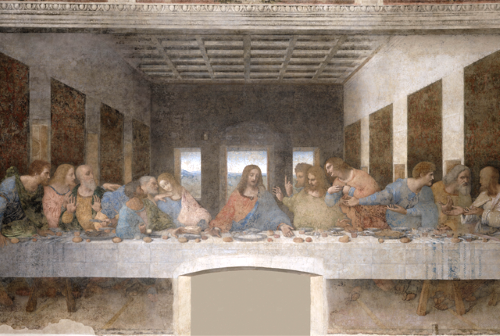
Everyone knows the painting depicts Jesus’ last meal with his apostles before he was captured and crucified. But more specifically, da Vinci wanted to capture the instant just after Jesus reveals that one of his friends will betray him, complete with reactions of shock and rage from the apostles. In da Vinci’s interpretation, the moment also takes place just before the birth of the Eucharist, with Jesus reaching for the bread and a glass of wine that would be the key symbols of this Christian sacrament.
6. Very few of da Vinci’s original brushstrokes remain.
Although the painting itself was beloved, da Vinci’s tempera-on-stone experiment was a failure. By the early 16th century, the paint had started to flake and decay, and within 50 years, The Last Supper was a ruin of its former glory. Early restoration attempts only made it worse.
Vibrations from Allied bombings during World War II further contributed to the painting’s destruction. Finally, in 1980, a 19-year restoration effort began. The Last Supper was ultimately restored, but it lost much of its original paint along the way.
3. You won’t find it in a museum.
Although The Last Supper is easily one of the world’s most iconic paintings, its permanent home is a convent in Milan, Italy. And moving it would be tricky, to say the least. Da Vinci painted the religious work directly (and fittingly) on the dining hall wall of the Convent of Santa Maria delle Grazie back in 1495.