The “Solace” Trailer is Here!

The Solace trailer is here. This just moved to my must-see list.
Previews and Reviews that are Z's Views
The Solace trailer is here. This just moved to my must-see list.

John Farrier and Neatorama present 28 Facts You Might Not Know About The Munsters. Here are three of my favorites…
2. Although the first pilot episode was shot in color, the rest of the series was shot in black and white to save money. It certainly adds to the horror ambiance, don’t you think?
6. Grandpa was Lily’s father, but Al Lewis was a year younger than Yvonne De Carlo.
9. Al Lewis’s long prosthetic nose was eliminated after a few episodes because he kept getting it wet in his cups of coffee.

Robert Clay Allison was a gunfighter in the old west and his epitaph makes it known that…
He never killed a man that did not need killing.
Allison’s is just one of 29 Unforgettable Epitaphs that make a final statement to the world. Some are humorous, some are angry, but they all give us insight into the person buried there.
Source: Mental_Floss.

Shaunacy Ferro and Mental_Floss present 11 Mischievous Facts About Bugs Bunny. Here are three of my favorites…
1. He first appeared as an extra in a Porky Pig cartoon.
The then-unnamed rabbit was created in 1938 for a cartoon in which Porky Pig went hunting, but the actual character wouldn’t appear until years later.4. His mannerisms were partially inspired by Clark Gable.
Bugs’ nonchalant, carrot-eating manner was inspired by a scene in It Happened One Night, when the fast-talking Clark Gable snacks on carrots while leaning on a fence. The character also took inspiration from Groucho Marx.5. The creators were worried he would seem like a bully.
“It was very important that he be provoked, because otherwise he’d be a bully,” director Chuck Jones said in an interview in 1998. “We didn’t want that. We wanted him to be a nice person.”

Tara Aquino and Mental_Floss present 11 Fascinating Facts About Mad Max. Here are three of my favorites…
2. MEL GIBSON WENT TO THE MAD MAX AUDITION TO ACCOMPANY HIS FRIEND, NOT FOR THE PART.
Gibson was black and blue after a recent brawl with “half a rugby team” when his friend asked him to drop him off at his Mad Max audition. Because the agency was also casting “freaks,” they took pictures of Gibson, who was simply waiting around, and asked him to come back when he healed. When he did, Miller gave him the role on the spot. In a clip for Scream Factory, Gibson recalled the moment: “It was real weird. [Miller] said, ‘Can you memorize this?’ and it was like two pages of dialogue with a big speech and stuff. I was like, ‘Yeah, sure.’ I went into the other room and just got a gist of what it was and I came out and just ad-libbed what I could remember. I guess they bought it.”4. REAL-LIFE MOTORCYCLE CLUB THE VIGILANTIES PLAYED TOECUTTER’S GANG FOR MAD MAX.
Forget the money required to train stuntmen; Miller and crew hired real bikers to professionally ride into production. In an interview with Motorcyclist Online, actor Tim Burns said about working with them: “[The Vigilanties] all wanted to ride the bikes as fast as possible, as often as possible, by their nature. Their riding was individually and collectively superb.” Additionally, stuntman Dale Bensch, a member of The Vigilanties, recalled seeing the ad for the shoot at local bike shop, and took a moment to clarify a mishap that had happened during production. Bensch said, “There’s an urban myth that a stuntman was killed, and that was me. The scariest thing was dropping the bike on that bridge. They took the speedo and tach off because they didn’t want to damage more than they had to. They wet the surface to make it easier, but I hung onto the bike too long and it flipped me over with it; that’s why it looked bad. But it’s a famous scene, so it worked out all right!”6. MEL GIBSON ONLY HAD 16 LINES OF DIALOGUE IN THE ROAD WARRIOR.
Upon Fury Road’s release, social media lit up with complaints that Tom Hardy was underutilized, only there to grunt and utter a couple of one-liners. But just to remind you, in Mad Max 2, Mel Gibson only has 16 lines of dialogue in the entire film.
On his use of sparse dialogue, Miller told The New York Times, “Hitchcock had this wonderful saying: ‘I try to make films where they don’t have to read the subtitles in Japan.’ And that was what I tried to do in Mad Max 1, and I’m still trying to do that three decades later with Fury Road.”
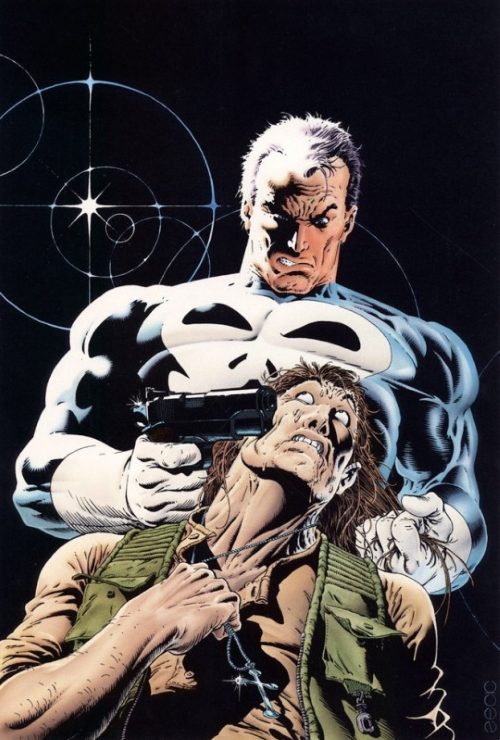
This is one of my favorite plates from the Punisher Portfolio Volume 1 by Mike Zeck.
Everything about this piece works… from the Punisher’s Clint Eastwood snarl to the creep grasping for his salvation knowing that he’s about to be sent to his damnation.
Isn’t it about time for a new Punisher Portfolio, Mr. Zeck?
Source: Brian Michael Bendis.
The Everest trailer [and cast] make it a potential winner!
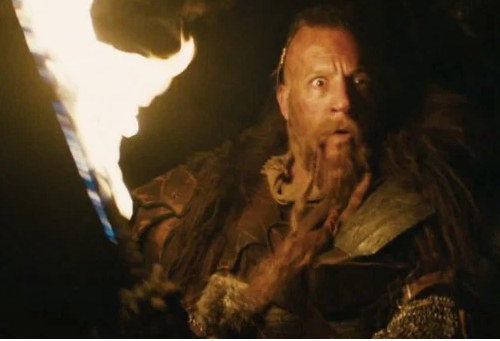
This Last Witch Hunter trailer looks better than previous ones, but still isn’t enough to convince me to rush to a theater.
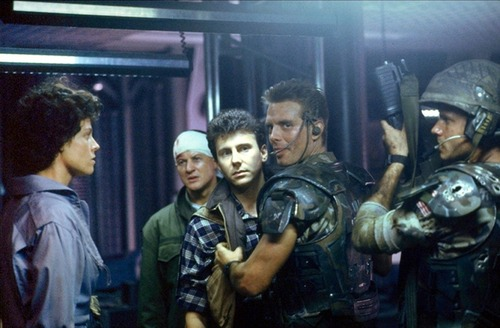
Eric D Snider and Mental_Floss present 14 Things You Might Not Know About Aliens. Here are three of my favorites…
1. CONAN THE DESTROYER HELPED IT GET MADE.
The movie, not the guy. Based on the strength of his script for The Terminator (then in pre-production), James Cameron was approached by 20th Century Fox to write an Alien sequel. But the outline he came up with for Alien II got a lukewarm reaction at Fox, and the idea was put on hold for the time being. Then, as luck would have it, the start date for The Terminator was pushed back nine months so that Arnold Schwarzenegger could make Conan the Destroyer, the sequel to his 1982 hit (in which Conan had been merely a Barbarian). This extra three-quarters of a year gave Cameron time to write three-quarters of a full screenplay for Alien II, not just an outline. (He also co-wrote Rambo: First Blood Part II during this time, by the way.) The Fox bosses liked what they read. Cameron was told that if The Terminator proved successful, he could write and direct the Alien sequel.3. SIGOURNEY WEAVER WAS PAID $35,000 FOR THE FIRST FILM, AND $1 MILLION FOR THE SEQUEL.
James Cameron and Gale Anne Hurd (who became Mrs. James Cameron during pre-production) helped Weaver get what she deserved—first by refusing to make the film without her, and also by refusing to keep it a secret that she was the only person in consideration for the lead role. Fox especially didn’t like that second point, as it put Weaver’s agent in a very strong bargaining position. Sure enough, Weaver got a million bucks and a percentage of the profits. It got better for Weaver as the franchise went on, with $4 million for Alien 3 and $11 million for Alien: Resurrection.9. IT’S THE ONLY ACTING THAT CARRIE HENN, WHO PLAYED YOUNG NEWT, EVER DID.
Henn was nine years old and living with her family at a U.S. Air Force base in England when casting agents found her. She loved the experience, remained friends with Sigourney Weaver afterward, was invited to the premiere of Alien 3 (even though she wasn’t in the movie) … and never acted again. Instead, she became a schoolteacher.
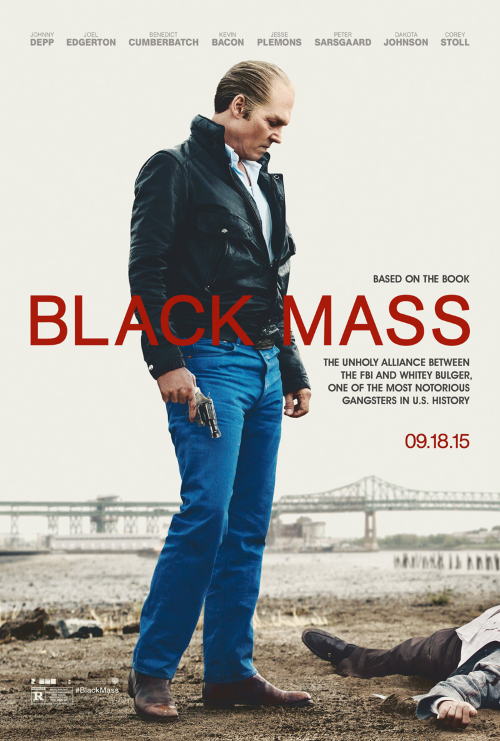
The Black Mass poster above does everything a movie poster should. It gives us an idea of the story, it draws us in, presents attitude and makes us want to see the movie.
The same can be said for the Black Mass trailer below!
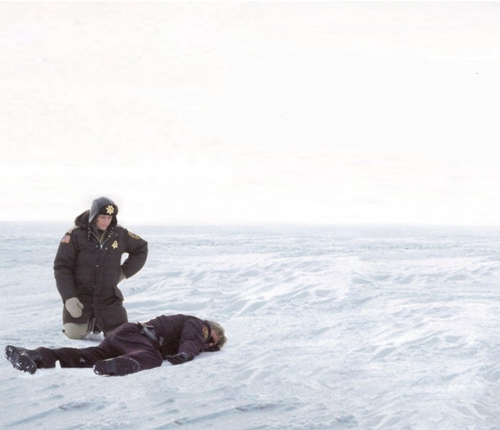
Adam D’Arpino and Mental_Floss present 21 Darn Tootin’ Facts About Fargo. Here are three of my favorites…
1. Fargo was almost a TV show back in 1997.
FX’s original series Fargo, which debuted last year to critical praise and enthusiastic viewership, has breathed new life into the funny-accents-meet-brutal-violence formula. However, FX’s take on the Coen Brothers classic actually marks the second major attempt to adapt Fargo for the small screen. In 1997, a pilot directed by Kathy Bates (yes, that Kathy Bates) and starring a pre-Sopranos Edie Falco as Marge Gunderson was passed on by the major networks. Although it never had a full run on television, this first made-for-TV version of Fargo wasn’t lost forever: it aired on the short-lived cable network Trio in 2003, as part of its Brilliant But Cancelled programming series.17. The film’s editor, Roderick Jaynes, is actually Joel and Ethan Coen.
Because the Coens found having their names appear on screen as directors, writers, producers, and editors a bit tacky, they credit their editing work to the fictional “Roderick Jaynes,” who’s listed on all of their films outside of Raising Arizona and Miller’s Crossing. When the fictional Jaynes was for nominated for his first Oscar on Fargo, the Coens wanted to have actor Albert Finney accept the award in character, but because the Academy doesn’t allow for surrogates to accept awards (presumably due to a 1973 incident involving Marlon Brando and a Native American named Sacheen Littlefeather) they had to scratch the plan. Jaynes ended losing to Walter Murch for his work on The English Patient, and would lose again in 2008 (with The Bourne Ultimatum‘s Christopher Rouse beating out the Coens and No Country for Old Men).11. An inside joke led to rumors that Prince had a cameo in the film.
The Coens provided anyone willing to stick around for the extended credits to a bit of a Minnesota insider joke. The role of “Victim in the Field” is credited to a scribble resembling Prince’s “Love Symbol,” which he went by between 1993 and 2000. This spurred rumors that Prince had a hidden cameo in the film. Anyone paying attention, however, would have noticed that the role was clearly played by a much huskier fellow, who also happened to be the film’s storyboard artist (and a longtime Coen collaborator) J. Todd Anderson.
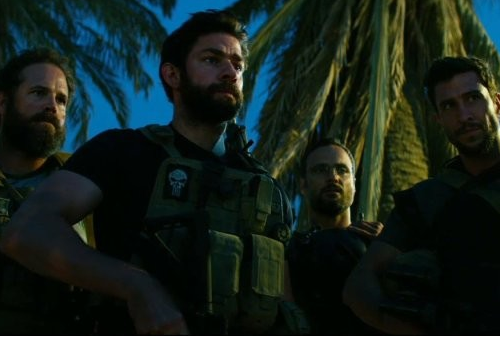
Today we have the trailer to 13 Hours: The Secret Soldiers of Benghazi.
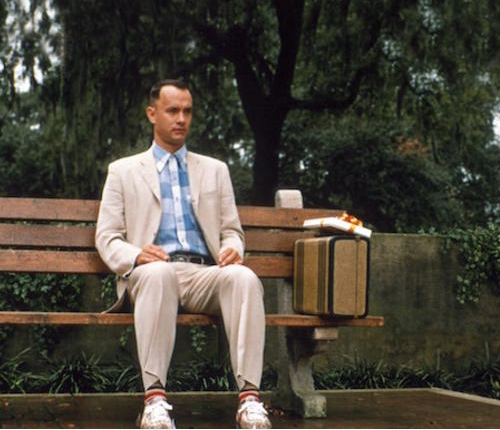
Garin Pirnia and Mental_Floss present 14 Things You Might Not Know About Forrest Gump. Here are three of my favorites…
2. THERE ARE BIG DIFFERENCES BETWEEN FORREST IN THE BOOK AND FORREST IN THE MOVIE.
In the book, Forrest ends up going into space, smoking weed, working with Raquel Welch, confronting cannibals, running for the United States Senate (his campaign slogan is “I Got to Pee”), and playing in a chess tournament. Also, in the book Forrest is described being 6’ 6” tall and weighing 240 pounds, which is why Groom wanted John Goodman to play Forrest in the movie.9. MYKELTI WILLIAMSON COULDN’T GET WORK AFTER THE MOVIE CAME OUT.
“I couldn’t get a job after Forrest Gump,” Williamson told USA Today. “The industry didn’t realize that I was wearing a lip device and that I was the same guy who had appeared in 11 TV series. They thought the director had discovered some weird-looking guy and put him in front of a camera.” He eventually went on Letterman and soon after people realized he wasn’t just some “weird-looking guy.” Williamson successfully obtained roles in Con Air and Heat and had a recurring role on Justified.10. FOR THE 20TH ANNIVERSARY OF THE MOVIE, THE FILMAKERS DISCUSSED FORREST’S POST-1980s FATE.
In September, USA Today caught up with Forrest Gump screenwriter Eric Roth, director Robert Zemeckis, and Tom Hanks to ask them what adventures Forrest would’ve experienced later on. Roth stated that in the script for his unproduced sequel Forrest meets O.J. Simpson and Princess Diana. Hanks thinks Forrest “would have chatted up both Mark Zuckerberg and the Winklevoss twins about how it would be nice if you had a book that would show a person’s face and make a friend,” and that Forrest would’ve helped out in Hurricane Katrina. “Forrest would be the reason that the Navy SEALs find Osama bin Laden,” added Zemeckis.
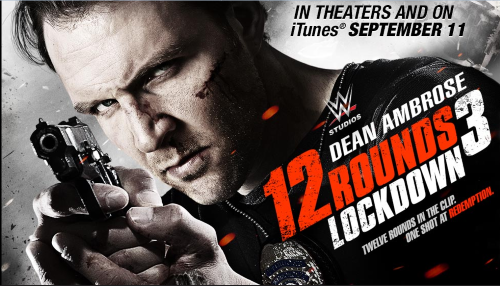
Today we have the trailer to 12 Rounds 3: Lockdown. If there was drive-in nearby, I’d head down to see this.
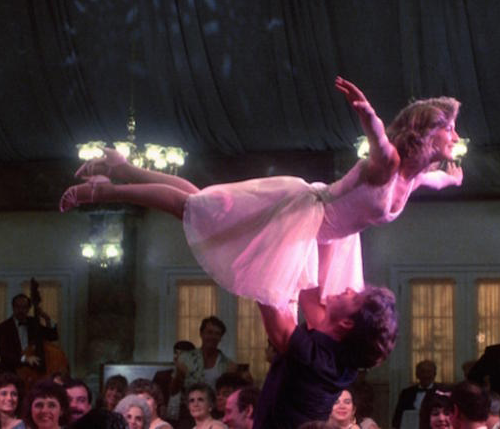
Garin Pirnia and Mental_Floss present 14 Not So Dirty Facts About Dirty Dancing. Here are three of my favorites…
3. THE FILM GAVE NEWMAN HIS FIRST BIG MOVIE ROLE.
Before starring as Stan, the resort’s social director, Wayne Knight had small roles in a few TV movies, including an uncredited role in the nuclear holocaust drama The Day After. Dirty Dancing showcased his talents, which in 1992 led him to be cast as Newman on Seinfeld.
10. PENNY BRIEFLY TRANSFORMED INTO A POP STAR IN THE LATE 1980s.
Cynthia Rhodes made a name for herself as dancer Tina Tech in 1983’s Flashdance and starred as John Travolta’s dance partner/love interest in Staying Alive that same year. But it was her role as Johnny Castle’s dancing partner, Penny, that garnered her the most notice. A couple of years after Dirty Dancing, she married singer Richard Marx (they’ve since divorced), and she briefly filled in as the lead singer of L.A. pop group Animotion, known for their hits “Room to Move” and “Obsession.”12. GREY PLAYED A VERSION OF HERSELF ON THE SITCOM IT’S LIKE, YOU KNOW…
The short-lived ABC sitcom (1999-2000) featured Grey as a member of a Seinfeld-like gang, except the show swapped out New York City for Los Angeles. She allowed herself to be self-deprecating, even poking fun at her nose job and her Dirty Dancing celebrity. Arthur (Chris Eigeman) meets “Jennifer Grey” and goes, “Oh, like the actress. Dirty Dancing. You spell it the same way as her?” “I am Jennifer Grey,” she responds, then she does a dance to prove it. “You look different,” he says. “Nose job!” She blurts. “Just one?” he retorts. (She had two of them.)