30 Movies That Stopped Filming and Started Over

Max Evry and ComingSoon.net took a look at 30 Movies That Stopped Filming and Started Over.   This is an interesting article.  It’s amazing how quickly directors can fall behind schedule and over budget to the tune of millions and millions of dollars.  Then there’s always the possibility of “creative differences” causing stars to clash with each other or the director.  Most of these films that started over still failed at the box office… but not always.  Here are three of my favorites from Evry’s list…

Back to the Future (1985)

Without question, the most famous case of a movie stopping and starting over again (as well as the most successful) was when director Robert Zemeckis and producer Steven Spielberg made the unthinkable decision to fire Eric Stoltz as lead character Marty McFly well into the shoot at a cost of $3 million dollars. Apparently Stoltz’s performance was deemed too dramatic and not light enough for the comedic film, as well as his being uncomfortable on a skateboard. Five weeks into the shoot, they let Stoltz go and hired Michael J. Fox, who was the original choice, and the rest was history. The film became a SMASH success and is now considered a classic, spawning two beloved sequels. Film stills and a small amount of footage has been released of Stoltz in the part, and while the actor went on to have a fine career afterwards, his version of those scenes is one of the most sought-after holy grails of geekdom.

Tombstone (1993)

The late screenwriter Kevin Jarre (Glory) was the original director on this story of Wyatt Earp, but he reportedly was in over his head on set, demanding a level of authenticity and length that proved unwieldy, falling behind on the shooting schedule. A month into filming, producer Andrew Vajna replaced Jarre with George P. Cosmatos, for whom he had ironically written the script for Rambo II. All of Jarre’s footage was scrapped with the exception of all scenes with Charlton Heston, who was unavailable to return. The script was parred down to make the shoot more manageable, and Kurt Russell acted as a kind of ghost director on set. The film was a surprise box office success, bringing in $56 million and besting Kevin Costner’s more expensive rival Wyatt Earp film.

Rambo III (1988)

Russell Mulcahy of Highlander fame was originally hired to helm this third installment of the Rambo franchise, with Sylvester Stallone at his physical (and egotistical) peak. Unfortunately, Mulcahy and Stallone clashed and after three weeks the director and much of his crew were sacked. One reason given was an incident where the director was supposed to hire vicious Russian troops but according to the actor hired “pretty boys.” Another reason was three weeks into production they were already two weeks behind schedule. Stallone promoted veteran second unit director Peter MacDonald, who had worked on Rambo II as well, to capable first-time director. The sequel became the most expensive movie ever made up to that time, but was unfortunately released after the Russians had already left Afghanistan and suffered at the box office.

I was surprised to learn that Spartacus and Phantom of the Opera started over.  Usually, when this happens it is pretty big news.

I always wanted to see footage from Rambo III directed by Russell Mulcahy.  I am a huge fan of the original Highlander and was interested in what he’d bring to Rambo… although “pretty boy” Russian troops wasn’t in the thought process.

A New (Old) “Cobra” Watercolor by Thomas Boatwright!

This is the first Cobra piece I ever received from Thomas Boatwright .  He did it for me several years ago, but somehow I missed scanning and getting it posted.

Over the years I’ve gotten several Stallone pieces from Thomas.  Click on the link to see what has been posted so far… there are more to come.

If you’d like to see more of Thomas Boatwright’s art check out his blog and his DA site. Send him some love.

If you get commissions, you should consider a piece from Thomas. He keeps you totally in the loop on his progress, finishes his commissions on or ahead of schedule, has very reasonable prices, is a fantastic artist and always gives you more than you’re expecting!   – Craig

17 Secrets of Magicians

Judy Colbert and Mental Floss present 17 Secrets of Magicians.  Here are three of my favorites…

2. THEY SPEND THOUSANDS OF DOLLARS ON BOOKS.
“Most magicians are serious scholars,” says Las Vegas magician Xavier Mortimer. “I don’t know any professional magicians who don’t have their own extensive libraries about our craft.” (One notable example, Harry Houdini, assembled close to 4000 books on magic and spiritualism, now held at the Library of Congress.)

The costs of those books can add up, though: “Most books are small print runs, for a small audience, which can lead to high prices,” Mortimor says. As an example, Denny Haney, who owns the Denny and Lee Magic Shop in Baltimore, Maryland, says that one book he sells—Soirees Fantastique by the French illusionist Christian Fechner—goes for $3000.


6. CONNECTING WITH THE AUDIENCE CAN BE MORE IMPORTANT THAN THE TRICKS.
Doc Eason, a legendary magician who performs at the Magic Castle in Hollywood, California, and at the Stonebridge Inn in Snowmass, Colorado, is known for his incredible memory; he does one trick where he memorizes the names of 20 people in the audience as well as a card held by each person. Despite the impressive feat, Eason says, “The trick is not the thing … what is the thing is connecting with the audience. Without connection, you just become a clever person who learned to do a few cool things.” Establishing that connection is a matter of eye contact and remembering the names of the people in the audience, Eason says—which requires plenty of practice in front of friends, family, and then strangers before taking to the stage.


10. THEY’VE HEARD ALL YOUR JOKES BEFORE.
Rich Bloch, a magician, inventor of magic effects, and owner of Dickens Parlour Theater in Millville, Delaware, says that when you think you’re being clever by asking the magician, “Can you make my husband disappear?” or “Can you saw my wife in half?” or “Can you change this dollar into a $1000?”—you aren’t. Also, the magician has probably heard the joke “How’s tricks?” before, even if they laugh with wide-eyed amazement like you’re the first person to ever crack it.

Source: Mark Evanier.

30 Things We Learned from Ryan Coogler’s “Black Panther” Commentary

Rob Hunter and Film School Rejects posted 30 Things We Learned from Ryan Coogler’s Black Panther Commentary.    Here are three of my favorites…

15.   T’Challa’s conversation with Zuri (Forest Whitaker) where he gets the truth about his father and uncle is the most important scene in the film to Coogler. Francis Ford Coppola agrees, and when he watched an early cut of the film he immediately asked to watch this scene again.


7.    The attack on the African kidnappers in their column of cars/trucks was filmed on a set in Atlanta the size of a football field, and the brought in over 150k plants and trees and 20 tons of dirt.


11.    While they were scouting landscapes and locales in South Africa Coogler was introduced to a rhinoceros named M20 at a wildlife preserve, “and he was the most impressive thing I’ve ever seen in my life.” He heard later that they had to remove its horn to protect the creature from poachers. W’Kabi’s (Daniel Kaluuya) rhino is named M20 after the real-life one, but in the film it’s actually a horse he’s feeding the apple to which they then overlayed with a CG rhino.

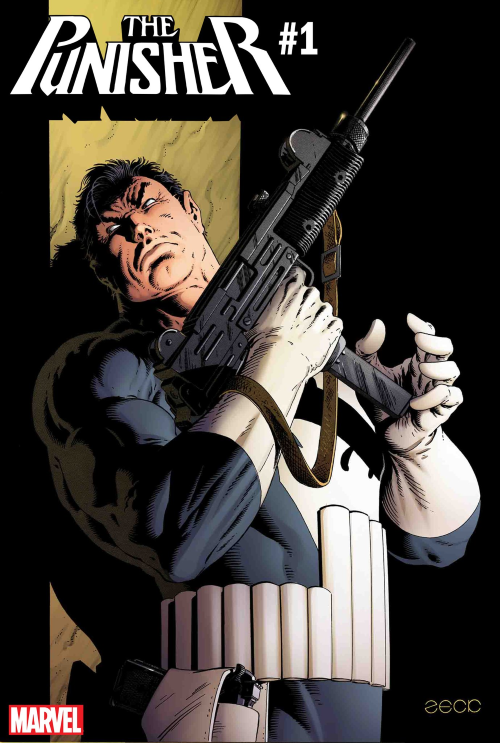
Mike Zeck Cover Variant for The Punisher #1 Relaunch!

Mike Zeck’s Punisher art above will be a variant cover for Marvel’s relaunch of The Punisher…

“We’re going to get back to Frank Castle with a handgun and a knife, stalking the streets of New York, and getting his hands dirty. But we’re also going to see a man who has changed from his time in the armor,” said Rosenberg. “He developed a taste for bigger game and larger targets, and he’s not going to give that up easily. So in a sense it’s back to basics – but on a bigger scale.”

Source: Newsarama.