30 Things We Learned from Tarsem Singh’s “The Cell” Commentary
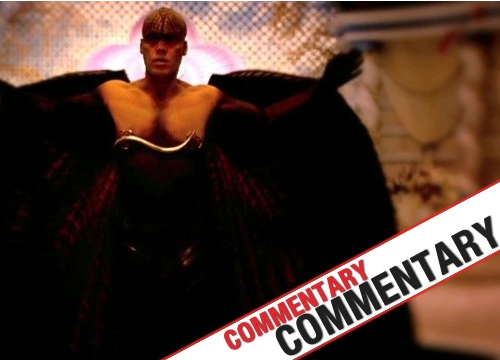
Rob Hunter and Film School Rejects present 30 Things We Learned from Tarsem Singh’s The Cell  Commentary. 

I’ve always thought The Cell was an under-rated film.  Here’s three of my three favorite things learned…

5. Tarsem recalls when Vincent D’Onofrio arrived for lighting tests, “and he came in and he just got into character and he came out with that look, and mmm, just how he moved, how he breathed, his base, just so so perfect throughout.”

13. He recalls a problem with actress Tara Subkoff that bled into her appearance in the film. She was asked if she could swim, and after stumbling briefly she said yes adding “I’m a lifeguard.” Tarsem had already lost the actress he had wanted for the role, and they were nearing the shooting date, so he hired her. “You can lie to a certain extent when somebody says ‘are you a horse rider’ and say yes and then go learn it, but you don’t say you’re a jockey!” He says it ended up being a disaster because he ended up having to do long shots. “I feel no sympathy for the girl when she gets saved in the end, and you can tell because of how I covered her. I just could not get near her.” She couldn’t go in the water without holding her nose, and it resulted in time lost and mounting frustrations. By contrast, the girl playing the bleached corpse, Catherine Sutherland, was great, and he wishes he had switched the two.

15. Peter Sarsgaard makes an uncredited appearance in the film, and Tarsem says he wishes he had more for him to do. “That guy is a great actor.”

 

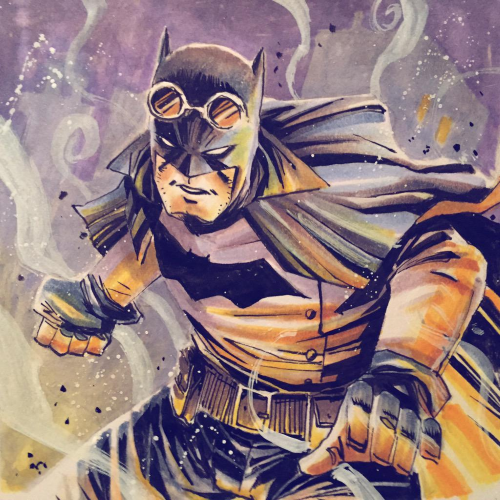
Free Preview of Gravedigger #1 by Chris Mills and Rick Burchett

Long time readers will know how much I love the Gravedigger crime comics created by Chris Mills [writer] and Rick Burchett [artist].  Hard to believe I’ve been talking Gravedigger up for over a decade.

The great news is that Gravedigger is back in print and the first issue is available now.  If my hyping it hasn’t been enough to get you to spring for one of the best crime comics going, then maybe the preview of the first issue provided by TMStash will.

Before you click over, know that the comic contains explicit language and bad guy-on-bad guy violence.  Oh, and there’s a thug in there named Zablo but I’m sure any resemblance to real persons, living or dead, is purely coincidental.

TMStash preview of Gravedigger #1.

You Can Survive An Atom Bomb Survival Wheel

Would you know what to do to survive if an Atom Bomb was dropped on your town?

If you don’t, then you need the handy-dandy You Can Survive An Atom Bomb Survival Wheel!

I wonder if the Atom Bomb Survival Wheel can confirm that the best way of surviving a direct hit from an A-Bomb is to get in a refrigerator (and hope you don’t suffocate) a la Indiana Jones!

Source: Channing Thompson.

12 Things You May Not Know About Mad

Jake Rossen and Mental_Floss present 12 Things You May Not Know About Mad.  Here are three of my favorites…

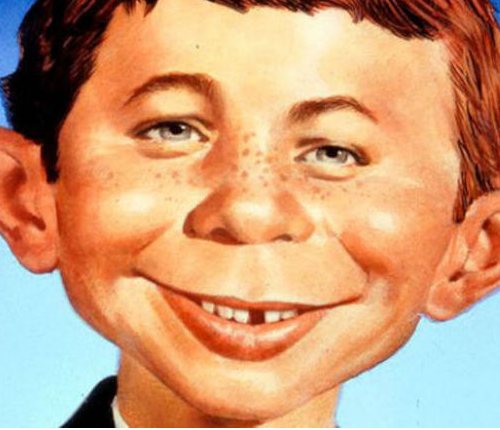
1. No One Knows Who Came Up with Alfred E. Neuman.
Mad creator Harvey Kurtzman was in the offices of a Ballantine Books editor discussing reprints for the fledging publication when he noticed a grinning, gap-toothed imbecile staring back at him from a bulletin board. The unnamed figure was ubiquitous in the early 20th century, appearing in everything from dentistry ads to depictions of diseases. A charmed Kurtzman adopted him as Mad’s mascot beginning in 1954. Neuman later become so recognizable that a letter was delivered from New Zealand to Mad’s New York offices without an address: the envelope simply had a drawing of Alfred.

3. They Predicted John F. Kennedy’s Election in 1960.
But it was a cheat. In the run-up to the 1960 Presidential election, Mad printed a cover that featured Neuman congratulating Kennedy on his victory with a caption that read, “We were with you all the way, Jack!” But the issue was shipped long before votes had been tabulated. The secret? It was a dual cover. Flip it over and Neuman is celebrating Richard Nixon’s appointment to office. Stores were told to display the “right” side of the magazine depending on the outcome.

5. They Didn’t Run Any (Real) Ads for 44 Years.
From the beginning, Gaines felt that printing actual advertisements next to the products they were lampooning would not only dilute their edge but seem more than a little hypocritical. After some back-and-forth, Mad cut ads starting in 1957. The decision was a costly one—most print publications survive on such revenue—but led to the magazine’s keeping a sharp knife against the throat of seductive advertising, including cigarettes. Faced with dwindling circulation in 2001, Mad finally relented and began taking ads to help pay for a switch to color printing.

10 Things You May Not Know About P.T. Barnum

Evan Andrews and History.com present 10 Things You May Not Know About P.T. Barnum.   Here are three of my favorites…

1. Barnum was an entrepreneur from an early age.
Barnum’s knack for moneymaking first manifested during his youth in Bethel, Connecticut. The future showman sold snacks and homemade cherry rum during local gatherings, and by age 12, he had made enough money to purchase his own livestock. By 21, his holdings also included a general store, a small lottery and even his own newspaper called the “Herald of Freedom.”

2. He first rose to prominence by engineering a famous hoax.
In 1835, Barnum launched his career in entertainment by purchasing Joice Heth, a blind slave touted as being the 161-year-old former nurse of George Washington. After billing Heth as “the most astonishing and interesting curiosity in the world,” Barnum put her on display in New York and took her on a small tour of New England. Visitors lined up to gawk at her withered body and hear her tales of “dear little George,” and Barnum helped fuel popular interest by spreading a rumor that she was actually an automaton controlled by a ventriloquist. The truth about Heth didn’t emerge until after her death in February 1836. During a public autopsy—staged by Barnum at the price of 50 cents for admission—it was revealed that she was most likely no older than 80.
3. Barnum didn’t go into the circus business until relatively late in life.
Barnum is best known for his traveling three-ring circuses, but he didn’t make his first forays under the big top until he was 60 years old. Before then, he was better known as the owner of the Manhattan-based American Museum, a sprawling collection of historical artifacts, aquariums, animal menageries, zoological curiosities and freak shows. Some of the museum’s most notable exhibits included General Tom Thumb, a child dwarf who Barnum famously brought to audience with Queen Victoria of Britain; and the “Fejee Mermaid,” which was actually the upper half of a monkey sewn to the bottom of a fish. Barnum only launched his traveling circus after his museum was twice destroyed by fire. He later teamed with his famed partner James Bailey in 1881, and the two went on to make a fortune running their “Greatest Show on Earth.”

10 Creepy, True Stories That Deserve Their Own TV Shows

posted his choices for 10 Creepy, True Stories That Deserve Their Own TV Shows.  Venable makes some good suggestions and my favorite  is…

The Cleveland Torso Murderer
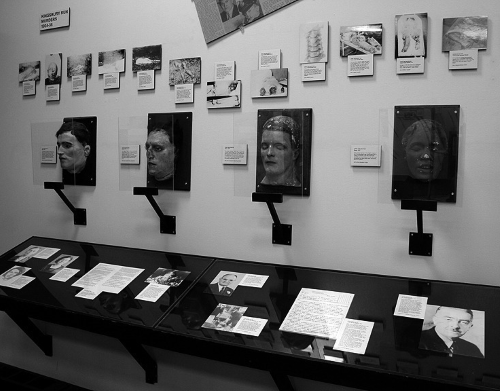
Given how incredible David Fincher’s Zodiac was, it seems only natural that more unsolved serial killer stories would have been made in the last few years. But somehow, the story of the Cleveland Torso Murderer – also known as the Mad Butcher of Kingsbury Run – has yet to make it to the small screen. (But definitely read Brian Michael Bendis’ graphic novel.) His lethal streak took place in the 1930s and included at least 12 victims (most of them unidentified), with all of them decapitated and many dismembered. Thus the nickname. Beyond being unsolved, the murders are remembered as one of the last cases that fell under former Untouchables investigator Eliot Ness, although he wasn’t heavily involved. NBC had plans to turn this into a miniseries back in 2013, but there hasn’t been any news about it since. HBO and Netflix are better homes for this gritty mystery anyway.

I read Bendis’ graphic novel and Max Allan Collins work about the subject and agree that The Cleveland Torso Murderers could make for interesting viewing.

15 Peachy Facts About “Face Off”

Eric D. Snider and Mental_Floss present 15 Peachy Facts About Face Off Here are three of my favorites…

2. IT WAS WRITTEN WITH STALLONE AND SCHWARZENEGGER IN MIND.
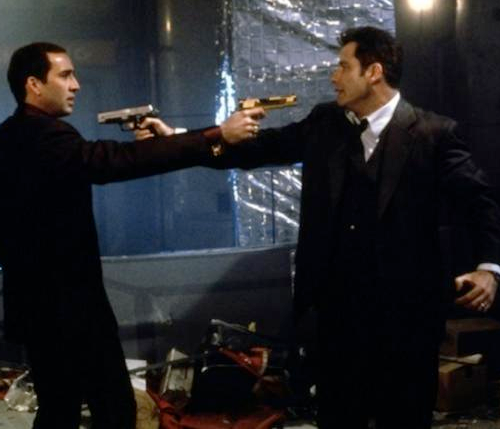
Separately, they were among the top action stars of the day (the day being the early ’90s), so teaming them up was an irresistible idea. Moreover, they were both really famous, and as Colleary once said, “The movie doesn’t work unless the actors have a well-established persona” so audiences can appreciate them impersonating each other. (Editorial note: there’s no way Schwarzenegger and Stallone could have imitated one another’s mannerisms as well as Cage and Travolta do.) The two didn’t make Face/Off, but they did eventually make Escape Plan, in which they escape from a futuristic, off-the-grid, middle-of-the-ocean prison very much like the one in Face/Off.

12. THE JOKE ABOUT TRAVOLTA’S “RIDICULOUS CHIN” WAS TRAVOLTA’S OWN IDEA.
He said, “Nic [Cage]’s character is such an egomaniac. He loves himself—the way he talks, acts, walks, everything about himself. So, we just figured that it follows that he would hate being in my body, having my face. So I added a lot of lines where he makes fun of the way I look—like ‘this ridiculous chin,’ things like that.”

6. THE EPILOGUE, WHERE THE ARCHERS ADOPT CASTOR TROY’S ORPHANED SON, ALMOST DIDN’T HAPPEN.
It was part of the writers’ original story and survived all of their many rewrites, but Paramount didn’t think audiences would like an ending where the hero adopts his enemy’s son. Woo’s alternate idea was for the film to end with some ambiguity about whether or not Eve Archer had her real husband back. When a test audience found that unsatisfying—and, moreover, wanted to know what happened to Castor Troy’s kid—the studio ponied up the money to get the necessary cast members back to film the original ending. According to Werb, “The next time we tested, the numbers went through the roof. There was spontaneous and thunderous applause at the end.”

Violet Jessop – The Luckiest Unlucky Person or the Unluckiest Lucky Person?

If you ever saw Violet Jessop (the lady pictured above) as a passenger on a ship with you, you’d probably want to disembark and get your money back.  Ms. Jessop was on board three ships that suffered major accidents (two which sank and resulted in many fatalities).

In 1911, Ms. Jessop was working as a stewardess on the RMS Olympic which was the longest ship in the world.  On September 20th the Olympic collided with the HMS Hawke.  Despite major damage and the flooding of two compartments the Olympic made it back to port.

In 1912, Ms. Jessop was again working as a stewardess, this time on the RMS Titantic‘s initial and ill-fated voyage. As the Titanic was sinking after hitting an iceberg,  Ms. Jessop was ordered into a life boat and given a small child to hold. Both Ms. Jessop and the child survived when the lifeboat occupants were picked up by the RMS Carpathia.  The child was claimed by a woman who also survived.

In 1916, Ms. Jessop was working as a stewardess for the British Red Cross on the ship Britannic.  On November 21st, the Britannic either struck a sea mine or was torpedoed by a German sub.  There are conflicting theories but no one disputes that the Britannic quickly sank with the loss of thirty souls.  Ms. Jessop survived by jumping from a lifeboat that was being sucked into the ship’s propellers.

Violet Jessop – was she the luckiest unlucky person or the unluckiest lucky person?