13 Fascinating Facts About “The Bridge on the River Kwai”
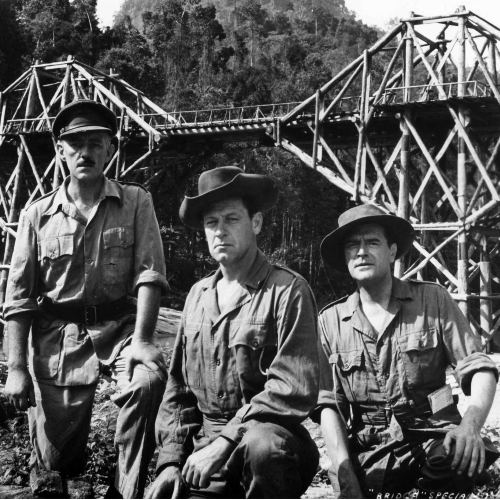
Eric D. Snider and Mental_Floss present 13 Fascinating Facts About The Bridge on the River Kwai. Here are three of my favorites…
1. ITS OSCAR FOR BEST SCREENPLAY WENT TO SOMEONE WHO DIDN’T WRITE IT.
The process of adapting Pierre Boulle’s French-language novel Le Pont de la Riviere Kwai was difficult (more on that later), but the two writers ultimately responsible for it were Carl Foreman (High Noon) and Michael Wilson (A Place in the Sun). Neither of them got credit, though, as The Bridge on the River Kwai was released during the three-year period when people who’d ever been Communists (or who refused to answer questions about it before Congress) were ineligible for Academy Awards. The screenplay was instead credited to the novelist, Boulle—which was quite a feat, since he didn’t speak or read English. (He didn’t attend the Oscars, either.) In 1985, the Academy officially recognized Foreman and Wilson as the screenwriters and posthumously awarded the Oscar to them.
4. DAVID LEAN NEEDED THE WORK.
Though he’d already earned five Oscar nominations (three for directing, two for adapting the Dickens novels) and would soon be widely celebrated for Kwai, Lawrence of Arabia (1962), and Doctor Zhivago (1965), at this stage, Lean was in trouble. He’d just been through a costly divorce from actress Ann Todd. According to one biographer, he was “broke and needed work; he had even pawned his gold cigarette case.” This, plus the fact that he loved to travel, plus the fact that shooting a film in Southeast Asia would be good for him tax-wise, motivated him to accept a project that was bound to be grueling.
10. WILLIAM HOLDEN GOT A BETTER DEAL THAN THE DIRECTOR.
Lean wanted Holden, a big star and recent Oscar winner (for Stalag 17), to play American prisoner Major Shears, over the objections of producer Spiegel, who wanted Cary Grant. Once Spiegel relented, he realized Holden was a box office draw and offered him a great deal: $300,000 salary (about $2.5 million in 2016 dollars), plus 10 percent of the gross. Lean only got $150,000 himself, but he always said Holden was worth it.