25 Things You Might Not Know About Thomas Jefferson
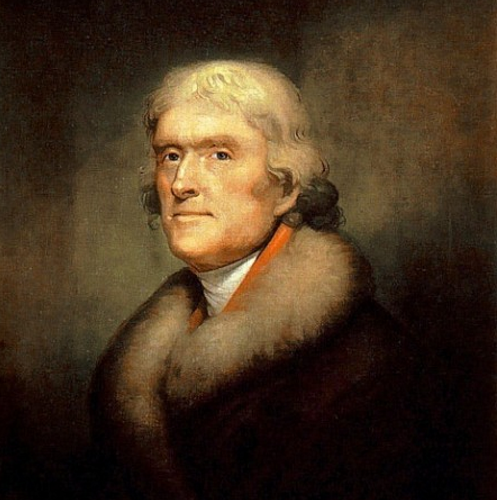
Jake Rossen and Mental Floss present 25 Things You Might Not Know About Thomas Jefferson. Here are three of my favorites…
2. HIS GREATEST WORK WAS A STUDY IN CONTRADICTION.
As a member of the Second Continental Congress and the “Committee of Five” (a group consisting of John Adams, Roger Sherman, Benjamin Franklin, Robert Livingston, and Thomas Jefferson brought together for this purpose), Jefferson was tasked with writing the Declaration of Independence, an argument against the 13 colonies being held under British rule. While the Declaration insisted that all men are created equal and that their right to liberty is inherent at birth, Jefferson’s plantation origins meant that he embraced the institution of slavery. In any given year, Jefferson supervised up to 200 slaves, with roughly half under the age of 16. He perpetuated acts of cruelty, sometimes selling slaves and having them relocated away from their families as punishment. Yet in a book titled Notes on the State of Virginia (which he began writing during his stint as governor and published in 1785), Jefferson wrote that he believed the practice was unjust and “tremble[d]” at the idea of God exacting vengeance on those who perpetuated it. Though Jefferson acknowledged slavery as morally repugnant—and also criticized the slave trade in a passage that was cut from the Declaration of Independence “in complaisance to South Carolina and Georgia”—he offered no hesitation in benefiting personally from it, a hypocrisy that would haunt his legacy through the present day.
11. HIS WIFE HAD A CURIOUS CONNECTION TO HIS MISTRESS.
Jefferson was married for just 10 years before his wife, Martha Wayles, died in 1782 at age 33 of unknown causes. Curiously, Jefferson’s involvement with his slave, Sally Hemings, was part of Martha’s convoluted family tree. Martha’s father, John Wayles, had an affair with Sally’s mother, Elizabeth Hemings—meaning most historians think Sally and Martha were half-sisters.
18. HE PROBABLY HAD A FEAR OF PUBLIC SPEAKING.
Without today’s methods of addressing the public—radio, television, and Twitter—Jefferson was largely free to succumb to his reported phobia of speaking in public. While working as a lawyer, he found himself unable to deliver orated arguments as eloquently as he could write them. When he did speak, it was apparently with a meek disposition. One listener to his inaugural address in 1801 described Jefferson’s speech as being in “so low a tone that few heard it.”