Category: History

Violet Jessop – The Luckiest Unlucky Person or the Unluckiest Lucky Person?

If you ever saw Violet Jessop (the lady pictured above) as a passenger on a ship with you, you’d probably want to disembark and get your money back.  Ms. Jessop was on board three ships that suffered major accidents (two which sank and resulted in many fatalities).

In 1911, Ms. Jessop was working as a stewardess on the RMS Olympic which was the longest ship in the world.  On September 20th the Olympic collided with the HMS Hawke.  Despite major damage and the flooding of two compartments the Olympic made it back to port.

In 1912, Ms. Jessop was again working as a stewardess, this time on the RMS Titantic‘s initial and ill-fated voyage. As the Titanic was sinking after hitting an iceberg,  Ms. Jessop was ordered into a life boat and given a small child to hold. Both Ms. Jessop and the child survived when the lifeboat occupants were picked up by the RMS Carpathia.  The child was claimed by a woman who also survived.

In 1916, Ms. Jessop was working as a stewardess for the British Red Cross on the ship Britannic.  On November 21st, the Britannic either struck a sea mine or was torpedoed by a German sub.  There are conflicting theories but no one disputes that the Britannic quickly sank with the loss of thirty souls.  Ms. Jessop survived by jumping from a lifeboat that was being sucked into the ship’s propellers.

Violet Jessop – was she the luckiest unlucky person or the unluckiest lucky person?
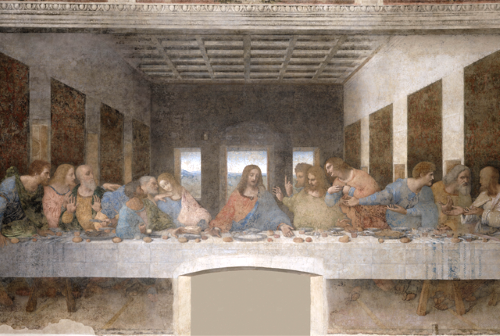
15 Things You Should Know About “The Last Supper”

Kristy Puchko and Mental_Floss present 15 Things You Should Know About The Last Supper.  Here are three of my favorites…

2. The Last Supper captures a climactic moment.

Everyone knows the painting depicts Jesus’ last meal with his apostles before he was captured and crucified. But more specifically, da Vinci wanted to capture the instant just after Jesus reveals that one of his friends will betray him, complete with reactions of shock and rage from the apostles. In da Vinci’s interpretation, the moment also takes place just before the birth of the Eucharist, with Jesus reaching for the bread and a glass of wine that would be the key symbols of this Christian sacrament.

6. Very few of da Vinci’s original brushstrokes remain.

Although the painting itself was beloved, da Vinci’s tempera-on-stone experiment was a failure. By the early 16th century, the paint had started to flake and decay, and within 50 years, The Last Supper was a ruin of its former glory. Early restoration attempts only made it worse.

Vibrations from Allied bombings during World War II further contributed to the painting’s destruction. Finally, in 1980, a 19-year restoration effort began. The Last Supper was ultimately restored, but it lost much of its original paint along the way.

3. You won’t find it in a museum.

Although The Last Supper is easily one of the world’s most iconic paintings, its permanent home is a convent in Milan, Italy. And moving it would be tricky, to say the least. Da Vinci painted the religious work directly (and fittingly) on the dining hall wall of the Convent of Santa Maria delle Grazie back in 1495.

10 Interesting Facts About Christopher Columbus That You Weren’t Taught in Class

When I was a little kid we were taught that Christopher Columbus discovered America… that he was a hero who went against conventional wisdom in his belief that the world wasn’t flat… and so many other things that were just not true!

Johanna and Top10zen present 10 Interesting Facts About Christopher Columbus That You Weren’t Taught in Class.  Here are three of my favorites…

His real name was not Christopher Columbus

The name Christopher Columbus is actually an Anglicized version of the actual name, Cristoforo Colombo, which he acquired in Genoa, his birthplace. The name has also been translated to other languages, and hence we have instances like the Spanish version Cristóbal Colón and the Swedish version Kristoffer Kolumbus. Strikingly, even the name given to him in Genoa is not definite, as supporting historical credentials are rare.

Columbus was a cheapskate

While embarking on his voyage in 1492, Columbus pledged an award of gold to the person who would be the first to see land. Rodrigo de Triana, a sailor, was the first one to view land on 12th October, 1492. He actually sighted what is presently an island in Bahamas named San Salvador by Columbus. Unfortunately, Rodrigo was never given the reward, because Columbus cleverly kept the gold to himself, telling the others that the previous night, he could see some blurred light but had not revealed it because the light was hazy.

Nobody knows where Columbus’ remains are

Columbus’ death occurred in Spain in the year 1506 where his remains were placed until 1527 when they were moved to Santo Domingo. There his remains were kept until 1795 after which they were allegedly sent to Havana. In the year 1898, the remains were believed to have returned to Spain, but astonishingly, a box bearing the name of Columbus and filled with bones was uncovered in Santo Domingo. Ever since then both Santo Domingo and Seville in Spain claim to possess Columbus’ remains. Interestingly, in each of the cities, the concerned bones have been kept in highly structured mausoleums.

10 Times Art Imitates Life in Coppola’s “The Godfather”

David Hunter and Flickchart The Blog present The Annotated Godfather: 10 Times Art Imitates Life in Coppola’s ClassicsGodfather fans and history buffs alike will enjoy this piece.

Here are three are my favorites [click over to the article for full details of each]…

1. “Make Him An Offer He Can’t Refuse”: Johnny Fontane and Frank Sinatra

2. “Jack Dempsey’s joint”: Crooks and Crooked Fighters

4. “I’ve loved baseball ever since…”: The 1919 World Series


The 8 Most Intriguing Theories About Skyjacker D.B. Cooper

One of the greatest unsolved mysteries of the last century is who was D.B. Cooper?
Who is D.B. Cooper? The question has persisted since November 24, 1971, when a mysterious man hijacked a flight from Portland to Seattle, demanded parachutes and $200,000, and skydived into folk-hero history. Cooper’s identity and fate remain unknown — and many theories about both abound.

Cheryl Eddy and i09 look at The 8 Most Intriguing Theories About Skyjacker D.B. Cooper.

Abraham Lincoln Autopsy’s Handwritten Notes

Although the assassination of President Abraham Lincoln took place more than 150 years ago it still captures the imagination of most Americans.

The Fenimore Art Museum in Cooperstown, NY just opened a new installation, “Autopsy for a Nation: The Death of Abraham Lincoln,” marking the 150th anniversary of Lincoln’s assassination. The exhibit’s key items include handwritten notes by the physicians who conducted the President’s autopsy.

If you’d like to see the handwritten notes and transcriptions, you can at i09: True Crime.

10 Final Messages From People Facing Certain Death

Final wills are interesting because they give insight into what a dying person finds important.  Usually the person plans out their final will with the hope that it won’t be used any time soon.

That is not what Alan Boyle’s 10 Final Messages From People Facing Certain Death  is about.  Instead, his piece looks at, well, here’s how he describes it…

Death can take us at any time. But when you realize you have only hours or minutes left to live, you get a chance to deliver a final message to the world. Perhaps it’ll be a phone call or a text message or even just a note scratched into a nearby surface. They’ll be your last words. Make them count.

Source: Listverse.com

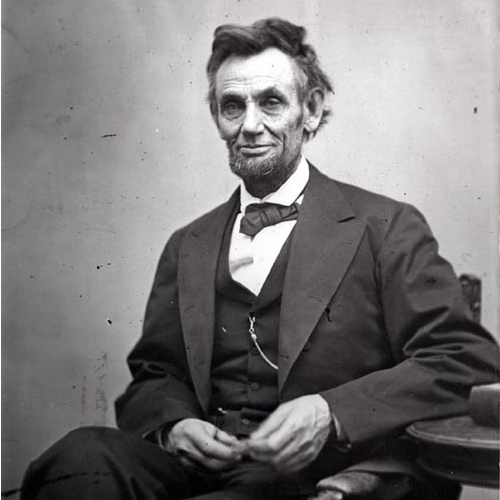
A Few More Things About Abraham Lincoln

Eddie Deezen at Neatorama posts A Few More Things About Abraham Lincoln.  Here are three of my favorites…

  • When Lincoln was nine, a horse kicked him in the forehead while he was in the middle of a sentence. He fell unconscious for several hours and when he awoke, his first words were the completion of the sentence he had been saying when the horse kicked him.
  • The tall, black stovepipe hat that Lincoln used to wear was more than just a hat. Lincoln used it as a portable filing cabinet and kept notes, money and letters in it.
  • Lincoln once left the stage during a political rally because he spotted one of his supporters being beaten. He picked up the assailant by his trousers and physically hurled him twelve feet away.

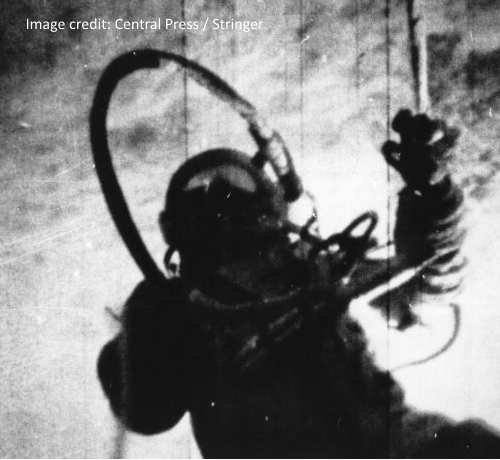
The First Spacewalk Nearly Ended In Tragedy

Astronauts are modern day adventurers. The very first astronauts were that and more.

Those first astronauts were insanely brave and willing to to take chances no man before them had the opportunity to attempt.  Their space ships were small and the computers on board were less powerful than today’s average middle school student’s cell phone.  Each journey into space was a life or death trip with national pride on the line.

Sadly, because the US became so proficient in sending people into space, as citizens we became complacent.  Before the Challenger tragedy, many of the major stations stopped carrying shuttle launches live because people weren’t tuning in.  Ah, but I digress.

Mika McKinnon’s post, 50 Years Ago, The First Spacewalk Nearly Ended In Tragedy is an excellent piece that details just how many ways the first spacewalk nearly killed the cosmonauts completing the mission.

Source: i09.

15 Quirks of U.S. Presidents You Didn’t Learn in School

Mental Floss presents: 15 Quirks of U.S. Presidents You Didn’t Learn in School.

From their list here are three of my favorites…

3. CHESTER A. ARTHUR’S RUMMAGE SALE

You couldn’t call Chester A. Arthur the sentimental type. The 21st president was happy to hand over wagonloads of White House furniture—the former belongings of his long line of esteemed predecessors dating all the way back to John Adams’s term—to the highest bidder. Rumor has it he only snagged $8,000 for the priceless haul.

6. MARTIN VAN BUREN’S LOADED ARGUMENTS

Seemingly of Monroe’s school of thought, Martin Van Buren was known to bring a pair of loaded pistols to Senatorial assemblies, just in case an argument became too heated.

7. BENJAMIN HARRISON’S LIGHT TRAUMA

Benjamin Harrison, whose presidency was the first to oversee a White House wired with electricity, might be commended for embracing scientific progress … if it weren’t for the desperate fear of light switches that kept him from ever actually utilizing this new technology.

Message Undelivered Since WW2 Reveals Explosive Surpise

Recently the bullet above was found by a treasure hunter.  As you can see it was no ordinary bullet in that in contained not gun powder but a secret message.  The message was written in code so the finder posted a picture to a World War II forum and received an answer…

My grandfather served in Italy, I inherited all of his military gear. He saved all of his daily code books, so looked it up. Here is the message:

QM is code for the officer that was tasked with coordinating forces for a particular engagement. This is an engagement status letter that is addressed to that officer.

The (6) 5 letter codes read as follows, from left to right, top to bottom:

THEY – THROW – GRENADES – WE – PULL – PINS – AND – THROW – BACK

The final code at the bottom is a phrase:

NOTIFY REINFORCEMENTS STAND DOWN – NOT NEEDED

Could this be some kind of joke that was never delivered?  Apparently not.  The Nazis were throwing grenades that weren’t armed until the Allied forces armed and then threw them back at the Nazis.

As Paul Harvey used to say, “And now for the rest of the story.”

Source: Sploid.

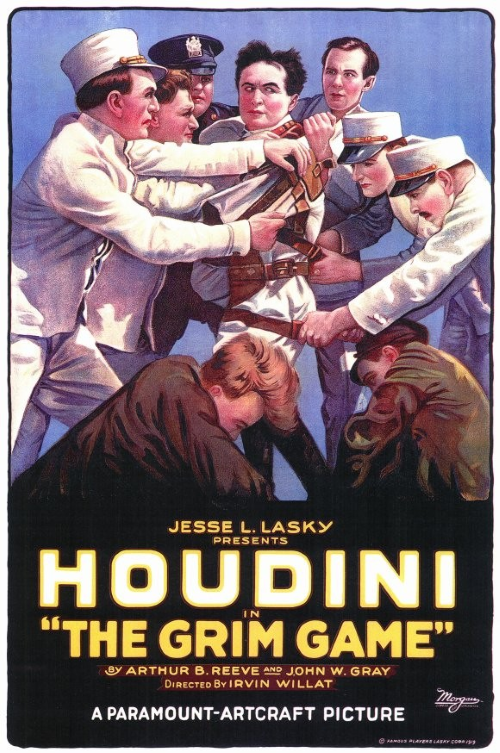
Houdini’s Lost Film, “The Grim Game” Restored and Premieres in March!

The Grim Game,  a film once thought lost will premiere at the TCM Classic Film Festival in March.

The Grim Game, made in 1919 was Harry Houdini‘s first starring role and considered by many his best film.  I look forward to see The Grim Game when it makes its fully restored way into rotation on the TCM network.

For the full story on the film and restoration, check out this piece at Deadline.com.