10 Interesting Facts About Christopher Columbus That You Weren’t Taught in Class
When I was a little kid we were taught that Christopher Columbus discovered America… that he was a hero who went against conventional wisdom in his belief that the world wasn’t flat… and so many other things that were just not true!
Johanna and Top10zen present 10 Interesting Facts About Christopher Columbus That You Weren’t Taught in Class. Here are three of my favorites…
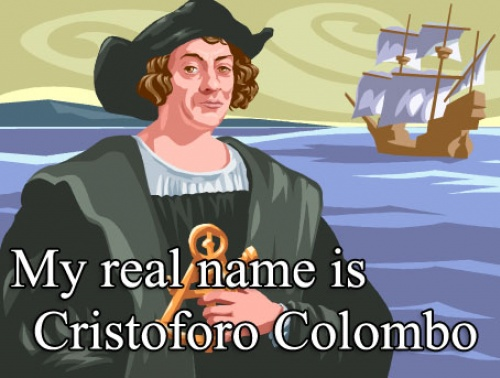
His real name was not Christopher Columbus
The name Christopher Columbus is actually an Anglicized version of the actual name, Cristoforo Colombo, which he acquired in Genoa, his birthplace. The name has also been translated to other languages, and hence we have instances like the Spanish version Cristóbal Colón and the Swedish version Kristoffer Kolumbus. Strikingly, even the name given to him in Genoa is not definite, as supporting historical credentials are rare.
Columbus was a cheapskate
While embarking on his voyage in 1492, Columbus pledged an award of gold to the person who would be the first to see land. Rodrigo de Triana, a sailor, was the first one to view land on 12th October, 1492. He actually sighted what is presently an island in Bahamas named San Salvador by Columbus. Unfortunately, Rodrigo was never given the reward, because Columbus cleverly kept the gold to himself, telling the others that the previous night, he could see some blurred light but had not revealed it because the light was hazy.
Nobody knows where Columbus’ remains are
Columbus’ death occurred in Spain in the year 1506 where his remains were placed until 1527 when they were moved to Santo Domingo. There his remains were kept until 1795 after which they were allegedly sent to Havana. In the year 1898, the remains were believed to have returned to Spain, but astonishingly, a box bearing the name of Columbus and filled with bones was uncovered in Santo Domingo. Ever since then both Santo Domingo and Seville in Spain claim to possess Columbus’ remains. Interestingly, in each of the cities, the concerned bones have been kept in highly structured mausoleums.