15 Fateful Facts About “Gilligan’s Island”
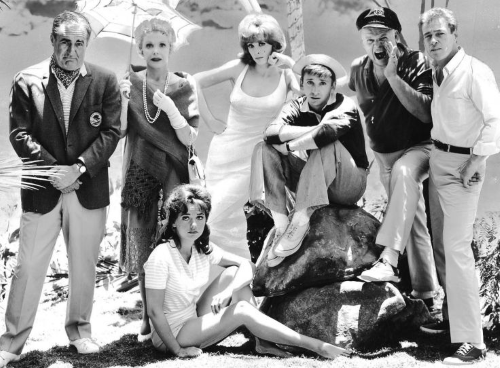
Kara Kovalchik and Mental_Floss present 15 Fateful Facts About Gilligan’s Island.   Here are three of my favorites (and this was one of the hardest to get down to top three )…

5. THE ASSASSINATION OF JFK DELAYED PRODUCTION ON THE SERIES.

The pilot for the series was filmed over several days in November of 1963 on the island of Kauai in Hawaii. The last day of shooting was scheduled for November 23, 1963 in Honolulu Harbor for the scenes showing the S.S. Minnow embarking on its fateful three-hour tour. Late in the morning on November 22, a crew member ran to the set and announced that he’d just heard on the radio that President John F. Kennedy had been shot. As Lyndon Johnson was sworn in as President, it was announced that all military installations (including Honolulu Harbor) would be closed for the next two days as a period of mourning. Filming was delayed by several days as a result, and in the opening credits—as the Minnow cruises the harbor—the American flag can be seen flying at half-mast in the background.

2. GILLIGAN’S FIRST NAME IS WILLY.
After getting a green light from CBS for the pilot, Schwartz went about assembling his cast. He chose the name of the bumbling first mate—Gilligan—from the Los Angeles telephone directory. Gilligan’s first name was never mentioned during the series, but according to Schwartz’s original notes, it was intended to be “Willy.” Yet Bob Denver always insisted that “Gilligan” was the character’s first name. “Almost every time I see Bob Denver we still argue,” Schwartz once admitted. “He thinks Gilligan is his first name, and I think it’s his last name. Because in the original presentation, it’s Willy Gilligan. But he doesn’t believe it, and he doesn’t want to discuss it. He insists the name is Gilligan.”

7. DAWN WELLS STILL GETS PAID FOR GILLIGAN’S ISLAND.
All of the actors signed contracts that guaranteed them a certain amount of money per original episode plus a residual payment for the first five repeats of each episode. This was a pretty standard contract in 1965, when as a rule most TV shows were only rerun during the summer months as a placeholder between seasons.

Even though the word “syndication” wasn’t yet a standard term in the TV production glossary, Dawn Wells’ then-husband, talent agent Larry Rosen, advised her to ask for an amendment to that residual clause in her contract, and the producers granted it, never thinking the series would be on the air nearly 50 years later. As a result, the estate of the late Sherwood Schwartz (who reportedly pocketed around $90 million during his lifetime from his little microcosm-on-an-island show) and Dawn Wells are the only two folks connected to the show who still receive money from it.
30 Things We Learned from Tarsem Singh’s “The Cell” Commentary

Rob Hunter and Film School Rejects present 30 Things We Learned from Tarsem Singh’s The Cell  Commentary. 

I’ve always thought The Cell was an under-rated film.  Here’s three of my three favorite things learned…

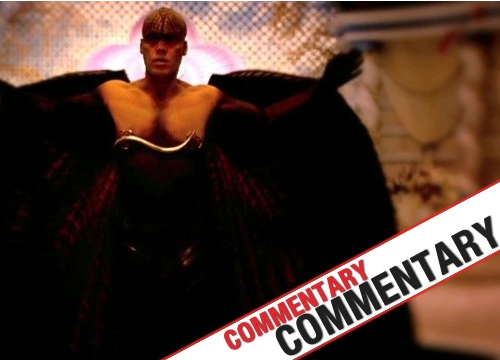
5. Tarsem recalls when Vincent D’Onofrio arrived for lighting tests, “and he came in and he just got into character and he came out with that look, and mmm, just how he moved, how he breathed, his base, just so so perfect throughout.”

13. He recalls a problem with actress Tara Subkoff that bled into her appearance in the film. She was asked if she could swim, and after stumbling briefly she said yes adding “I’m a lifeguard.” Tarsem had already lost the actress he had wanted for the role, and they were nearing the shooting date, so he hired her. “You can lie to a certain extent when somebody says ‘are you a horse rider’ and say yes and then go learn it, but you don’t say you’re a jockey!” He says it ended up being a disaster because he ended up having to do long shots. “I feel no sympathy for the girl when she gets saved in the end, and you can tell because of how I covered her. I just could not get near her.” She couldn’t go in the water without holding her nose, and it resulted in time lost and mounting frustrations. By contrast, the girl playing the bleached corpse, Catherine Sutherland, was great, and he wishes he had switched the two.

15. Peter Sarsgaard makes an uncredited appearance in the film, and Tarsem says he wishes he had more for him to do. “That guy is a great actor.”


Free Preview of Gravedigger #1 by Chris Mills and Rick Burchett

Long time readers will know how much I love the Gravedigger crime comics created by Chris Mills [writer] and Rick Burchett [artist].  Hard to believe I’ve been talking Gravedigger up for over a decade.

The great news is that Gravedigger is back in print and the first issue is available now.  If my hyping it hasn’t been enough to get you to spring for one of the best crime comics going, then maybe the preview of the first issue provided by TMStash will.

Before you click over, know that the comic contains explicit language and bad guy-on-bad guy violence.  Oh, and there’s a thug in there named Zablo but I’m sure any resemblance to real persons, living or dead, is purely coincidental.

TMStash preview of Gravedigger #1.

You Can Survive An Atom Bomb Survival Wheel

Would you know what to do to survive if an Atom Bomb was dropped on your town?

If you don’t, then you need the handy-dandy You Can Survive An Atom Bomb Survival Wheel!

I wonder if the Atom Bomb Survival Wheel can confirm that the best way of surviving a direct hit from an A-Bomb is to get in a refrigerator (and hope you don’t suffocate) a la Indiana Jones!

Source: Channing Thompson.

12 Things You May Not Know About Mad

Jake Rossen and Mental_Floss present 12 Things You May Not Know About Mad.  Here are three of my favorites…

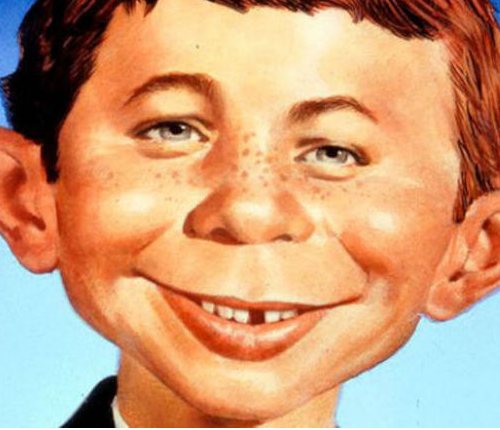
1. No One Knows Who Came Up with Alfred E. Neuman.
Mad creator Harvey Kurtzman was in the offices of a Ballantine Books editor discussing reprints for the fledging publication when he noticed a grinning, gap-toothed imbecile staring back at him from a bulletin board. The unnamed figure was ubiquitous in the early 20th century, appearing in everything from dentistry ads to depictions of diseases. A charmed Kurtzman adopted him as Mad’s mascot beginning in 1954. Neuman later become so recognizable that a letter was delivered from New Zealand to Mad’s New York offices without an address: the envelope simply had a drawing of Alfred.

3. They Predicted John F. Kennedy’s Election in 1960.
But it was a cheat. In the run-up to the 1960 Presidential election, Mad printed a cover that featured Neuman congratulating Kennedy on his victory with a caption that read, “We were with you all the way, Jack!” But the issue was shipped long before votes had been tabulated. The secret? It was a dual cover. Flip it over and Neuman is celebrating Richard Nixon’s appointment to office. Stores were told to display the “right” side of the magazine depending on the outcome.
5. They Didn’t Run Any (Real) Ads for 44 Years.
From the beginning, Gaines felt that printing actual advertisements next to the products they were lampooning would not only dilute their edge but seem more than a little hypocritical. After some back-and-forth, Mad cut ads starting in 1957. The decision was a costly one—most print publications survive on such revenue—but led to the magazine’s keeping a sharp knife against the throat of seductive advertising, including cigarettes. Faced with dwindling circulation in 2001, Mad finally relented and began taking ads to help pay for a switch to color printing.

10 Things You May Not Know About P.T. Barnum

Evan Andrews and History.com present 10 Things You May Not Know About P.T. Barnum.   Here are three of my favorites…

1. Barnum was an entrepreneur from an early age.
Barnum’s knack for moneymaking first manifested during his youth in Bethel, Connecticut. The future showman sold snacks and homemade cherry rum during local gatherings, and by age 12, he had made enough money to purchase his own livestock. By 21, his holdings also included a general store, a small lottery and even his own newspaper called the “Herald of Freedom.”

2. He first rose to prominence by engineering a famous hoax.
In 1835, Barnum launched his career in entertainment by purchasing Joice Heth, a blind slave touted as being the 161-year-old former nurse of George Washington. After billing Heth as “the most astonishing and interesting curiosity in the world,” Barnum put her on display in New York and took her on a small tour of New England. Visitors lined up to gawk at her withered body and hear her tales of “dear little George,” and Barnum helped fuel popular interest by spreading a rumor that she was actually an automaton controlled by a ventriloquist. The truth about Heth didn’t emerge until after her death in February 1836. During a public autopsy—staged by Barnum at the price of 50 cents for admission—it was revealed that she was most likely no older than 80.

3. Barnum didn’t go into the circus business until relatively late in life.
Barnum is best known for his traveling three-ring circuses, but he didn’t make his first forays under the big top until he was 60 years old. Before then, he was better known as the owner of the Manhattan-based American Museum, a sprawling collection of historical artifacts, aquariums, animal menageries, zoological curiosities and freak shows. Some of the museum’s most notable exhibits included General Tom Thumb, a child dwarf who Barnum famously brought to audience with Queen Victoria of Britain; and the “Fejee Mermaid,” which was actually the upper half of a monkey sewn to the bottom of a fish. Barnum only launched his traveling circus after his museum was twice destroyed by fire. He later teamed with his famed partner James Bailey in 1881, and the two went on to make a fortune running their “Greatest Show on Earth.”