12 Dusty Facts About “Unforgiven”
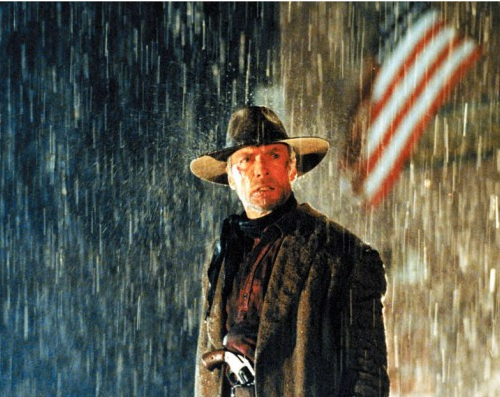
Eric D. Snider and Mental_Floss present 12 Dusty Facts About Unforgiven. Here are three of my favorites…
4. EASTWOOD WAS INITIALLY STEERED AWAY FROM THE MOVIE.
Sonia Chernus, a longtime associate of Eastwood’s (and screenwriter of The Outlaw Josey Wales), read The Cut-Whore Killings in the 1980s and was appalled by it. She wrote Eastwood this memo: “We would have been far better off not to have accepted trash like this piece of inferior work … I can’t think of one good thing to say about it. Except maybe, get rid of it FAST.” (It may be worth noting that Chernus was in her seventies at the time, and the script was full of profanity and violence.) Eastwood took her advice and didn’t read the script. Then, while looking for someone to rewrite a different project, he read The Cut-Whore Killings as a sample of Peoples’ work, not realizing it was the screenplay Chernus had warned him away from.7. THEY BUILT A PRETTY CONVINCING WESTERN TOWN.
Eastwood’s production designer, Henry Bumstead, and his team built the main set for the 1880s town of Big Whiskey, Wyoming on a lonesome prairie in Alberta from which no signs of modern civilization could be seen in any direction. The nearest big city was Calgary, 60 miles away. For authenticity—and since so much of the movie was to be shot on this set—all of the buildings were fully functional (and expensive), not just facades.11. THE FINAL PRODUCT SHOWS ALMOST NO CHANGES FROM THE ORIGINAL SCRIPT.
That’s a rarity in Hollywood, where even the best screenplays are tinkered with as they’re converted from words on a page into images on a screen. Eastwood had some ideas for revising Peoples’ script, too, only to discover that “the more I fiddled with it, the more I realized I was screwing it up.” All he ended up changing was the title. According to Peoples, Frances Fisher—who plays Strawberry Alice—told him “that this was the first time she saw a shooting script that was entirely in white. Most of them are multicolored, full of blue and red pages or whatever representing various changes in the screenplay.”