13 Nostalgic Facts About American Graffiti
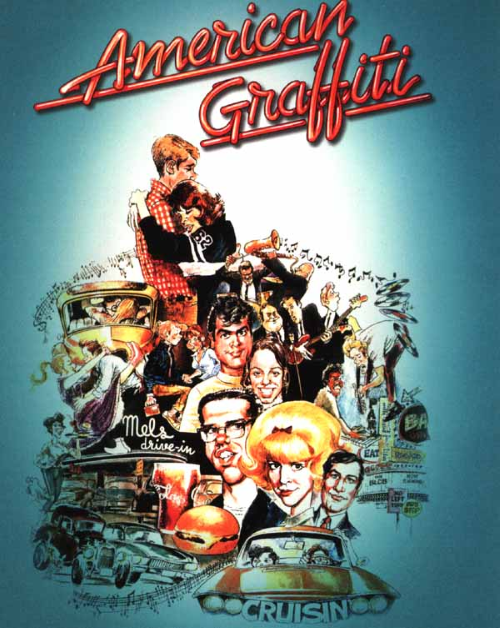
Eric D. Snider and Mental_Floss present 13 Nostalgic Facts About American Graffiti. Here are three of my favorites…
3. CONTRARY TO POPULAR BELIEF, THERE IS NO ACTUAL CONNECTION BETWEEN AMERICAN GRAFFITI AND HAPPY DAYS.
Happy Days premiered five months after American Graffiti was released. It was set in the ’50s, had Ron Howard playing a teen very similar to his American Graffiti character, used “Rock Around the Clock” as its theme song, and even borrowed the American Graffiti font for the credits. You’d think that Happy Days was somehow a spin-off of the movie, but you’d be wrong. It actually began as an unsold pilot in 1971 and aired in 1972 as part of the anthology series Love, American Style. (Lucas watched it at some point when he was considering casting Howard in American Graffiti.) After the movie took off, and with ’50s nostalgia in high gear (Grease was burning up Broadway), ABC reconsidered the Happy Days pilot, ordered a series, and did everything they could to make it remind people of American Graffiti. It ran for 10 years and was one of the most popular sitcoms in TV history.
8. THE PRODUCER HAD TO BECOME MACKENZIE PHILLIPS’ LEGAL GUARDIAN FOR THE SHOOT.
Mackenzie Phillips was just 12 years old when she arrived to make the film, and though she had showbiz experience (her father, John Phillips, was in The Mamas & the Papas), neither she nor her parents realized that California law required her to have a guardian present. “They were almost going to have to recast me, but Gary Kurtz”—a producer on the film—”and his family said, ‘We’ll take her,'” Phillips said in 1999. ” So they went to the courts in San Francisco and got guardianship of me.” Phillips lived with the Kurtzes for the duration of the shoot and described it as a happy experience.
2. IT WAS SAVED FROM BECOMING A TV MOVIE BY THE GODFATHER.
Universal Pictures gave Lucas a budget of $600,000, or about $3.5 million in 2016 dollars, to make the movie—in other words, not very much. When Coppola came onboard as a producer shortly after the release of The Godfather, Universal gave Lucas another $175,000. Later, when the film was finished and had test-screened positively, Universal inexplicably wanted to drastically re-edit it and release it as a TV movie. Lucas objected but had no clout. Coppola, on the other hand—by this time an Oscar-winner—could make studio executives listen. He convinced them to do only a little bit of trimming (the deleted scenes were reincorporated for home video release) and to release the film theatrically.