14 Tricky Facts About “The Sting”
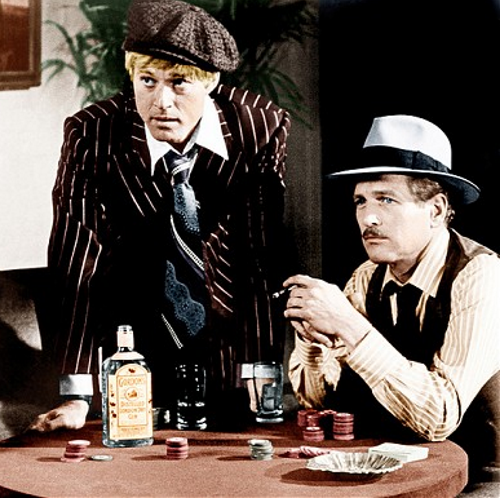
Eric D. Snider and Mental_Floss present 14 Tricky Facts About The Sting. Here are three of my favorites…
2. REUNITING BUTCH AND SUNDANCE WASN’T THE NO-BRAINER YOU’D EXPECT.
Separately, Robert Redford and Paul Newman were two of the biggest movie stars in the world in the early 1970s. As a duo, they were perhaps even more popular, with mega-hit Butch Cassidy and the Sundance Kid (1969) fresh in people’s memories. When the director of that film, George Roy Hill, signed on for The Sting, Redford soon followed. Then came Newman, as described above. But while a Butch and Sundance reunion sounded tempting (and lucrative), the studio had a concern: In the movie, the two con men’s partnership hinges on the possibility that one (or both) will try to double-cross the other. With Redford and Newman so famously chummy, Universal was concerned that audiences wouldn’t believe such a betrayal was possible, and the film would thus lose some of its suspense. Hill assuaged their fears.6. ROBERT SHAW’S LIMP WAS REAL.
Shaw, who played crime boss Doyle Lonnegan in the film, hurt his leg playing racquetball two days before shooting began. Director Hill decided to work with it and had Shaw turn his injury into a character trait.8. THE DIRECTOR ISN’T AS FAMOUS AS YOU’D THINK, CONSIDERING HE MADE TWO OF THE HIGHEST-GROSSING FILMS OF ALL TIME.
George Roy Hill’s Butch Cassidy and the Sundance Kid made $102 million in 1969, or about $575 million at today’s ticket prices. When Hill reunited with his Butch and Sundance for The Sting, the result took in $156 million ($723 million adjusted for inflation). The Sting was the fourth highest-grossing film in history at the time, behind The Exorcist (which was released the same week), Gone with the Wind, and The Sound of Music, and ahead of The Godfather.Butch Cassidy and the Sundance Kid was number eight, making Hill the only director to have two movies in the top 10. But Hill was reclusive compared to most Hollywood directors, disliking publicity tours and talk show interviews. As a result, despite his successes (he also made Slap Shot and The World According to Garp), he never quite became a household name.